


Quick Answer: Who Was King Tang of Shang?
King Tang (商汤, Shāng Tāng), also called Cheng Tang (成汤, Chéng Tāng), is remembered as the founding king of Shang. Transmitted accounts say he defeated Jie, the last Xia ruler. Later Shang oracle bones identify a founding ancestor whom specialists connect to Tang.[1][2][3]
- Traditional story: Tang challenges Jie and replaces Xia rule.[1][2]
- Shang inscription: Later divinations show continuing ritual attention to the founding ancestor.[3]
- Archaeology: Finds associated with Early Shang show the scale and material culture of the early polity.[4][5]
The founder belongs to the Bronze Age Shang dynasty. The much later Tang dynasty uses 唐 (Táng). The founder’s name uses 汤 (Tāng).[4][5]
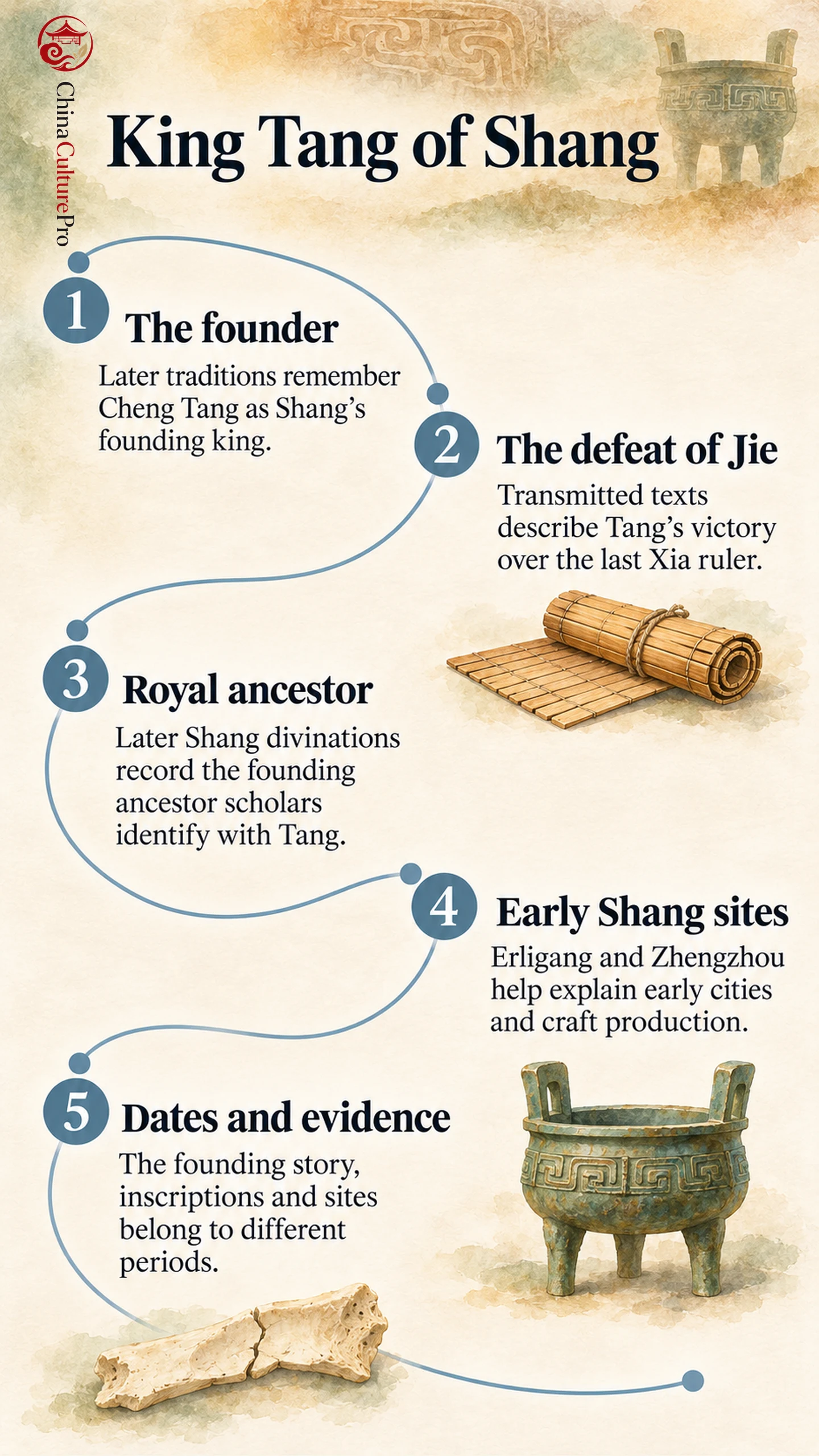
A founding story can tell us what later generations valued in a king. A royal inscription can show how that king’s descendants remembered him. In the case of the Shang founder, those records belong to different times and answer different questions.
How Later Texts Describe Shang’s Founding
The Annals of Xia in the Records of the Grand Historian portrays Jie as a ruler who lost support and Tang as a rival whose conduct attracted allies. It presents Tang’s campaign as the transition from Xia to Shang. The Annals of Yin also connects Tang with Bo. These writings shaped the remembered foundation story long after the period they describe.[1][2]
Their depiction of the two rulers has a moral structure. The story explains why the old ruler deserved to lose authority and why another could take his place. That helps explain its importance in Chinese historical writing. The dates, personal details and wording require separate evidence.[1][2][5]
What the Shang Evidence Can Tell Us
Later Shang divination inscriptions refer to the founding ancestor as Da Yi (大乙, Dà Yǐ). Scholar David Keightley identifies him with Cheng Tang in an example of a divination about an ancestral figure. This is evidence for his place in the royal lineage as it was understood during the Shang. The inscriptions were made generations after the founder’s time.[3][4]
The evidence is especially abundant at Yinxu, near Anyang, in the Late Shang. The records from the period of King Wu Ding illustrate this difference. Those scribes recorded events and queries of their own court, as well as rituals directed towards ancestors. Tang and Wu Ding belong to different parts of that long history.[3][4][5]
What Early Shang Archaeology Adds
Archaeologists use sites and objects at Erligang and Zhengzhou to describe Early Shang. Their evidence helps explain the development of cities and craft production near the period Shang is conventionally thought to have begun. The conventional boundary around 1600 BCE is an approximate archaeological period marker, with no exact year attached to Tang’s campaign.[4][5]
The Xia question carries another limit. Researchers have proposed connections between Xia traditions and the site of Erlitou, but the connection remains debated. Combining the evidence works best when the transmitted account, late royal inscriptions and material remains each keep their own dates and scope.[4][5]
FAQs About King Tang of Shang
Is Cheng Tang another name for the Shang founder?
Yes. Cheng Tang is another name for the founding ruler remembered as King Tang of Shang. Shang inscription specialists associate him with the founding ancestor Da Yi.[1][2][3]
Do the oracle bones confirm the details of Tang’s defeat of Xia?
The Late Shang inscriptions attest to the founder’s place in the ancestral system. The account of his campaign against Jie comes chiefly from transmitted historical texts.[1][3][4]
Sources
[1] Chinese Text Project. Records of the Grand Historian: Annals of Xia
[2] Chinese Text Project. Records of the Grand Historian: Annals of Yin, Passage on Tang and Bo
[3] David N. Keightley, via The Ohio State University. Readings on Shang Oracle-Bone Inscriptions
[4] Roderick Campbell. The Shang Economy: Archaeological Periodization
[5] Smithsonian National Museum of Asian Art. Art and Archaeology of Ancient China