

Quick Answer
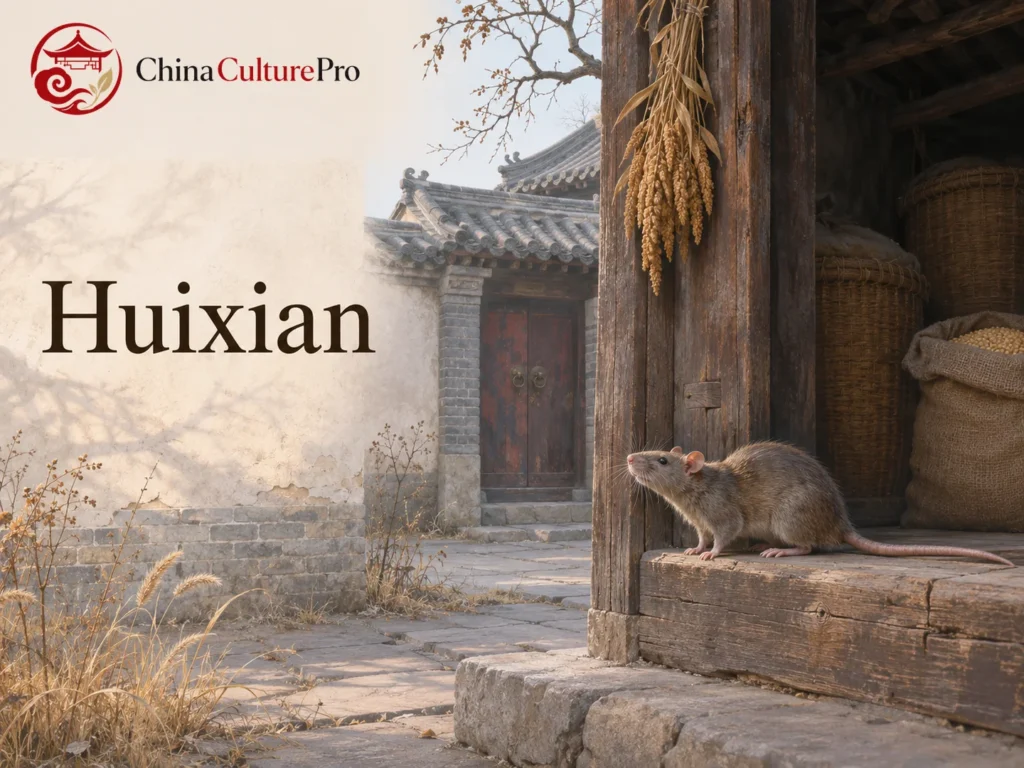
Huixian (灰仙, Huīxiān) is the rat spirit in one widely cited list of the Five Immortals (五大仙, Wǔ Dàxiān) of northern Chinese folk religion. Hui means “gray.” Historical accounts also record groups of four animals and a local five-member group that included a hare.[1][2]
- The common list: Rat joins fox, weasel, hedgehog, and snake.
- Local names: The fifth animal depends on the community and account.
- Prints: A wedding procession gives clues to a different folk story.
A catalogue may name Hui as part of a group even when the object depicts another figure.[1][2][3]

A woodblock print of a wedding among rodents shows a lively procession with musicians, flags, and a bridal sedan. Its catalogue explains the wedding story and the accompanying New Year custom. The catalogue of a late Qing devotional print, by comparison, names Hui as the rat in a list of animal spirits.[2][3]
Where the Rat Appears in the Five-Animal List
The list recorded with the print of Third Lord Hu (胡三爺, Hú Sānyé) names five spirits: Hu the fox, Huang the weasel, Bai the hedgehog, Liu the snake, and Hui the rat. The figure actually depicted holds a gourd and is identified as the fox spirit. The text alongside the print is the evidence for the wider list.[2]
The Chinese animal name in this catalogue is lǎoshǔ (老鼠), a common word for rats or mice. “Rat spirit” is a useful English label for Huixian here because historical descriptions of this five-member list also give the English animal as “rat.” The religious name alone gives no zoological species.[1][2]
What the Beijing-Area Records Say About the Fifth Spirit
Li Wei-tsu’s historical study describes the Four Great Families (四大門, Sì Dàmén) of fox, weasel, hedgehog, and snake around Beijing. In reviewing other accounts, he notes lists that add Hui the rat. He attributes that particular addition to earlier writers.[1]
Li also records a five-animal grouping in Shunyi that includes a hare. That example differs from the four-plus-rat list in the same study. These records show why it helps to ask which village, source, or tradition is being described when someone names five spirits. The guide to Chinese folk religion gives a wider context for local variation.[1]
Why a Rodent Wedding Print Is a Different Clue
The woodblock subject often called the rodent wedding (老鼠娶親, Lǎoshǔ Qǔqīn) presents the animals as participants in a human-style wedding. One museum print shows a mounted groom, musicians, and attendants carrying a bridal sedan. The image’s procession is the clue that it illustrates a wedding story.[3]
A second print gives the procession a different turn: a cat interrupts the musicians. Its catalogue records two dates for the wedding custom, the third and twenty-fifth days of the first lunar month. These details belong to New Year folklore. The evidence for Huixian as one of five animal spirits comes from the lists and field records.[1][2][4]
FAQs About Huixian
What does Huixian mean?
Hui means “gray,” and xian is a term for an immortal or transcendent being. In the five-animal list discussed here the name refers to the rat spirit.[1][2]
Is the rat always included in northern animal spirit groups?
The sources document four-member groups without a rat and five-member groups in which the additional animal can vary.[1]
Does a rodent wedding print depict Huixian?
The two examples discussed here illustrate a wedding tale. For an identification as Huixian, look for an inscription or an object record connecting that image with the animal spirit tradition.[2][3][4]
Sources
[1] Li Wei-tsu, Asian Ethnology. On the Cult of the Four Sacred Animals in the Neighbourhood of Peking
[2] National Museum of History, Taiwan. Third Lord Hu, 07663
[3] National Museum of History, Taiwan. Rodent wedding print, 90-00129
[4] National Museum of History, Taiwan. Rodent wedding print, 85-00395