
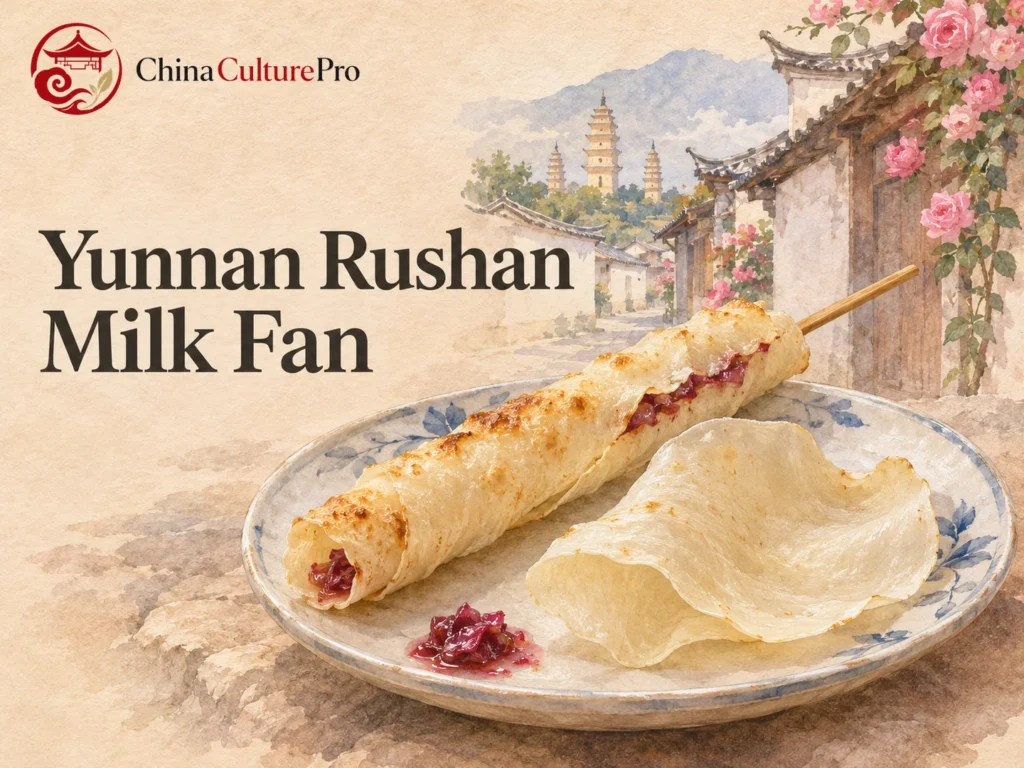

Quick Answer: What Is Yunnan Rushan Milk Fan?
Yunnan rushan (乳扇, rǔshàn), or milk fan, is a thin cow’s-milk cheese associated with the Bai (白族, Báizú) communities around Dali. The maker stretches warm curd into a pale sheet and dries it on bamboo. The curved shape is the reason for the English name “milk fan.”[1][2]
- Shape: The ivory sheets are thin enough to curve as they dry.[1][2]
- Street snack: Grilling softens the cheese so a vendor can roll it and add rose syrup or another sweet topping.[2][3]
- Other service: Frying makes the thin cheese crisp. Small pieces can also go into a cup of Bai sweet tea.[2][3]
A dried fan, a hot grilled roll and a crisp fried piece can all come from the same thin cheese sheet.

Hang a stretched sheet of curd over bamboo and it takes on the shape that gives milk fan its name. Back over heat, the sheet behaves differently. It can soften into a roll or turn light and crisp, depending on how it is cooked.
How Cow’s Milk Becomes a Dried Fan
The milk forms curds when it meets a heated souring liquid. Once the curds separate from the whey, the maker gathers them and works them while they are pliable. The curd is spread and stretched into a sheet, then shaped over bamboo rods or a drying frame. The finished cheese is generally ivory to pale yellow.[1][4]
At this stage the sheet is still recognisable as a fan, sometimes with rolled or curled edges. Around the Dali basin, craft reporting identifies Dengchuan in Eryuan County as a major producing place and also records production in Xizhou and Xiaguan.[2]
Grilled and Fried Rushan Around Dali
At a street stall, warming the sheet over the grill makes it soft enough to catch on a stick and roll into a tube. Vendors may spread it with rose syrup, rose preserve or condensed milk as it rolls. It feels softer hot and becomes a little chewier as it cools.[2][3]
Fried rushan is a familiar household preparation. The thin sheet puffs or blisters and takes on a golden colour, leaving it crisp enough to break. A local description notes a dusting of sugar. Filled rushan also appears at banquets, with sweet fillings between pieces of cheese.[1][2][3]
The Sweet Course in Bai Three-Course Tea
In Bai three-course tea (三道茶, sān dào chá), the cups commonly move from bitter to sweet to a lingering finish. The sweet second cup can contain small pieces or flakes of rushan.[2][4] In that setting the cheese gives a milky note to the tea and is served in small pieces, a different use from the grilled street roll.
This serving belongs to the hospitality traditions of Bai communities. The tea course and the fried or grilled snacks are examples of how one dairy ingredient fits several occasions in Dali and Yunnan food culture.
Rushan and Rubing: Read the Shape
Rubing (乳饼, rǔbǐng) is another Yunnan cheese. The curds are drained and pressed together, yielding a block that can be cut into thick pieces. The curd in rushan is pulled into a thin sheet and dried instead. If a menu offers both, choose rushan for a thin roll or crisp sheet and rubing cheese for a substantial slice.[4]
FAQs About Rushan Milk Fan
What Kind of Milk Is Used for Rushan?
Traditional Dali rushan described in the local accounts is made with cow’s milk. The curd is stretched into thin sheets and dried on bamboo.
Is Rushan Always Served Sweet?
Rose syrup and sugar are familiar additions, especially to grilled and fried rushan. The dairy sheet itself can also be cooked in savoury dishes.
Which Course of Bai Three-Course Tea Contains Rushan?
The sweet second course can contain small pieces of milk fan. The cheese adds a milky note to the sweet tea.
Fuentes
[1] Dali City People’s Government. Local specialty: rushan (特产——乳扇)
[2] China Ethnic News, via Yunnan Net. A taste of Dali through milk fan (寻味大理,乳扇香里的烟火与交融)
[3] Yunnan Net. Dali’s local food and culture (霞客行之江山多娇·游学云南丨大理)
[4] Bryan and Silvia Allen. Mozzarella of the East: Cheese-making and Bai culture