
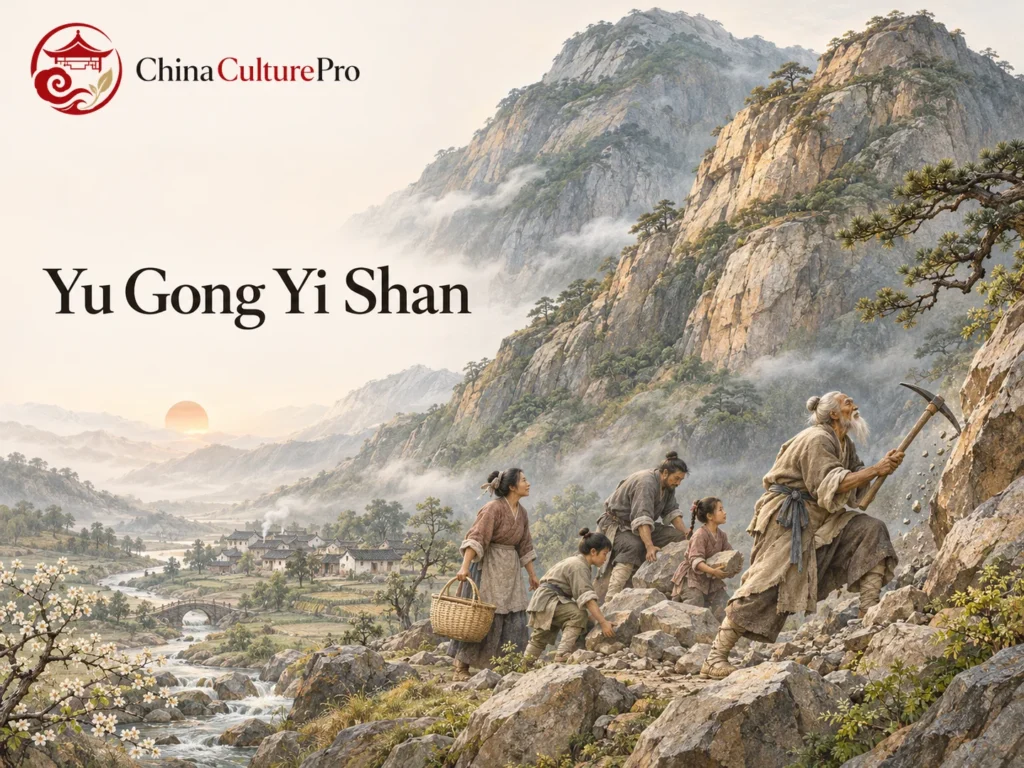

Quick Answer: What Does Yu Gong Yi Shan Mean?
Yu Gong Yi Shan (愚公移山, yú gōng yí shān) means “the Foolish Old Man (愚公, Yú Gōng) moves the mountains.” It usually praises the perseverance needed to take on an enormous task. In the Liezi (列子, Lièzǐ), an old man reasons that his family can keep digging long after he dies. In the end, heavenly intervention moves the mountains.[1][2]
- The obstacle: Two mountains force the household to take long detours.[1]
- The usual meaning: Steady effort can make a seemingly impossible project achievable.[2]
- An ironic use: If there is an obvious shortcut, calling someone’s approach Yu Gong Yi Shan can poke fun at how much labor the method requires.[2]
The surrounding sentence tells you whether the speaker admires the persistence or questions what the person is doing with it.
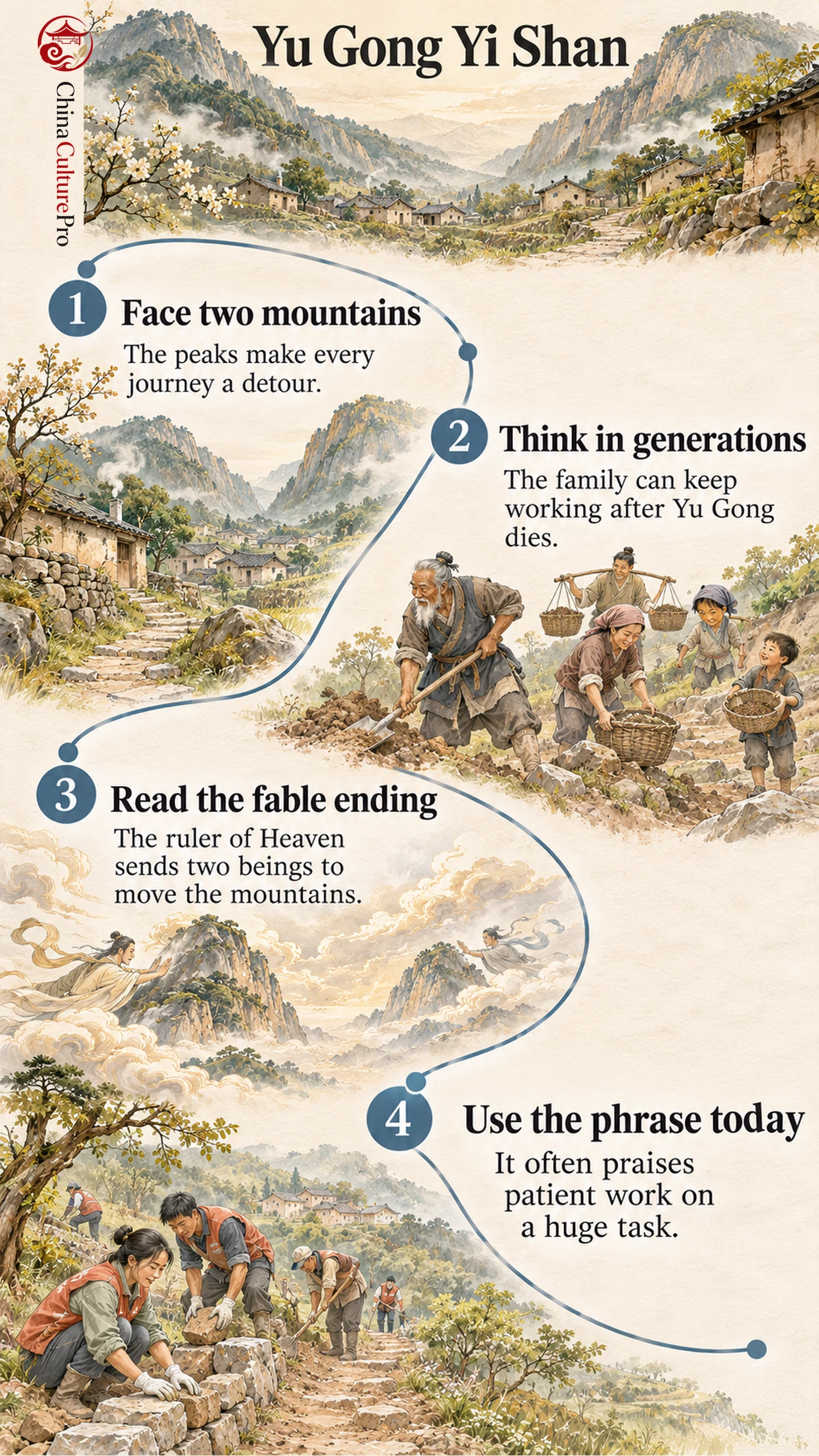
In the fable, the old man expects to leave the job unfinished in his lifetime. What matters to him is that his descendants can continue and the mountains will stay the same size.[1]
Why Yu Gong believes the mountains can be moved
In “Questions of Tang” (汤问, Tāng Wèn), a chapter of the Liezi, Yu Gong is nearly ninety. Mount Taihang (太行山, Tàiháng Shān) and Mount Wangwu (王屋山, Wángwū Shān) obstruct the way from his home. His family agrees to help clear a passage, and his wife raises a question that has to be answered first. Where will they put the earth and stones? The family chooses a distant place by the sea. Even a neighbor’s young son comes to help.[1][2]
The Wise Old Man (智叟, Zhìsǒu) mocks the plan, measuring the task against the strength Yu Gong has left. Yu Gong grants that he will die, then considers the work across several generations. His children and their children can keep carrying earth away, and the mountains will not grow. The argument changes what counts as a reasonable time to finish the job.[1]
A deity learns what the family is doing and fears that they will never stop. The heavenly ruler is moved by Yu Gong’s sincerity and sends two beings with the strength to carry away the mountains. The family’s work moves the heavenly ruler to act. The two figures he sends carry one mountain each to a new location.[1][2]
How a painter retold the story in 1940
Xu Beihong (徐悲鸿, Xú Bēihóng) made two versions of the subject in 1940. He completed the ink version first and a large oil painting later that year. The Central Academy of Fine Arts Art Museum records that Xu wanted the subject to become a large mural. That plan remained unrealized.[3]
The ink work, about 4.2 meters wide, gives viewers room to follow the workers across the surface. Its scale and the row of workers give the shared labor an emphasis of its own. Viewers encounter the work in progress, with the final intervention still outside the scene.[1][3]
How to use Yu Gong Yi Shan in modern Chinese
The positive use fits a large goal that people can approach through steady work, such as restoring a trail year after year. The ironic use fits when the effort is clear and the method looks unnecessarily slow. Surrounding words such as 精神 (“spirit”) signal admiration, while a question about the method can turn the same phrase into teasing criticism.[2]
- Admiring the effort: 村里人靠着愚公移山的精神,几年下来,把荒了的山路一点点修好了。 “The villagers kept at it for years and restored the abandoned mountain path bit by bit.”
- Questioning the method: 放着现成的工具不用,偏要一条一条手抄,这也太愚公移山了吧? “We already have a tool for this. Copying every entry by hand is making the job much harder than it has to be.”
These are original examples. The second sounds teasing because the tool makes that approach avoidable. The guide to Chinese chengyu gives other examples of how details from fables or histories become shorthand for judgments about present situations.
FAQs About Yu Gong Yi Shan
Does Yu Gong move the mountains himself?
He starts the work with his family. In the final episode, the ruler of Heaven orders two powerful beings to carry the mountains away.[1][2]
Why is he called the Foolish Old Man?
The name means “Foolish Old Man.” The other man is called wise, but the fable asks which one sees further. Yu Gong thinks beyond his own lifetime.[1][2]
Is there an English equivalent?
“Where there’s a will, there’s a way” captures the broad positive message. “Move mountains” preserves the strongest image. To convey work carried on for generations, spell out the duration.[2][4]
Fuentes
[1] Wikisource. Liezi, volume 5, Questions of Tang
[2] Ministerio de Educación de Taiwán. Dictionary of Chinese Idioms, Yu Gong Yi Shan
[3] Central Academy of Fine Arts Art Museum. The Foolish Old Man Moves a Mountain
[4] Chinese Text Project. Yu Gong Yi Shan dictionary entry