

Quick Answer: What Is Taishun String Puppetry?
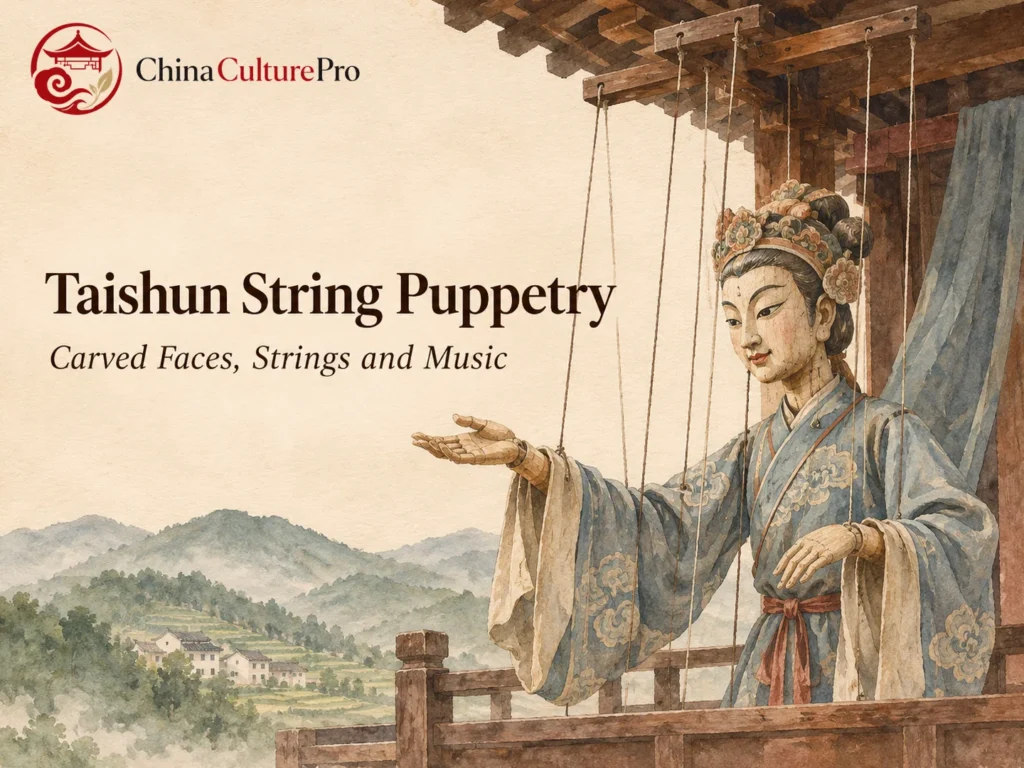
Taishun string puppetry (泰顺提线木偶戏, Tàishùn Tíxiàn Mù’ǒuxì) is a tradition from the mountain county of Taishun in Zhejiang. Puppeteers guide wooden figures from above. Singing, speech and instrumental accompaniment can support the action.[1][2][3]
- Object: Look for a carved and painted wooden head on a costumed figure.[1][2]
- Movement: Follow the strings as the head turns or a hand rises.[5][6]
- Sound: A traveling troupe and a solo performer divide the music differently.[2][3]
Start by watching what happens to the carved face when the puppet tilts its head.

A puppet’s eyes stay in place as its head turns. That small change can make a figure look as though it has noticed someone across the stage.
What the Carver Gives the Puppet
Local carvers have used camphor wood and other fine-grained woods for the heads. The heritage listing identifies influences from northern Zhejiang and Quanzhou alongside distinct local carving and costume practices. The National Art Museum of China documents the carving of Ji Guifang (季桂芳, Jì Guìfāng).[1][2]
The puppeteer can turn the carved head slowly or sharply to give the same expression a different effect. In shadow puppetry, the lit screen is central to what the audience sees. In this tradition the costumed wooden figure is directly visible.[1][2][5]
How Strings and Music Share the Stage
A museum account describes a traveling troupe and a solo format called biandanxi (扁担戏, biǎndànxì). In the solo arrangement described by the museum, a performer works the strings by hand and plays the gong and drum with the feet.[2]
Researchers from the Central Academy of Fine Arts documented one troupe with bowed strings, a reed instrument, gong and drum behind the stage. Listen for a percussion cue while the puppet changes direction. The beat and the change in the puppet’s movement are two parts of the same cue.[2][3]
A Named Play and a Teaching Tradition
The heritage profile of Zhang Lianghua (张良华, Zhāng Liánghuá) records his direction work on The Flaming Mountains (火焰山, Huǒyàn Shān) in 1987. He collected scripts, puppets and stage objects and took performances to rural audiences. The collection kept examples of the repertoire and stagecraft together.[4]
A report from 2026 shows Cai Xiaohua (蔡晓华, Cài Xiǎohuá) teaching children. Watch a demonstration for how separately controlled parts of the figure can come together in one gesture.[5][6]
FAQs About Taishun String Puppetry
Does Taishun also have glove puppetry?
Yes. Taishun has more than one form of Chinese puppetry with distinct ways of moving a figure. A string puppeteer works from above and a glove puppeteer puts a hand inside the figure.[1][2]
Do all Taishun string puppets have the same number of strings?
The count varies with the role and what it needs to do. A simple figure can use fewer strings than one that has to perform a wider set of actions.[5][6]
Fuentes
[1] China Intangible Cultural Heritage Network. Taishun String Puppetry
[2] National Art Museum of China. Taishun Puppets and Ji Guifang
[3] Central Academy of Fine Arts. A Return Visit to Taishun Puppetry
[4] China Intangible Cultural Heritage Network. Zhang Lianghua
[5] Xinhua. The Strings of Taishun Puppetry
[6] Xinhua. String Puppetry in Taishun