

Quick Answer: What Does Lingzhi Mean in Chinese Art?
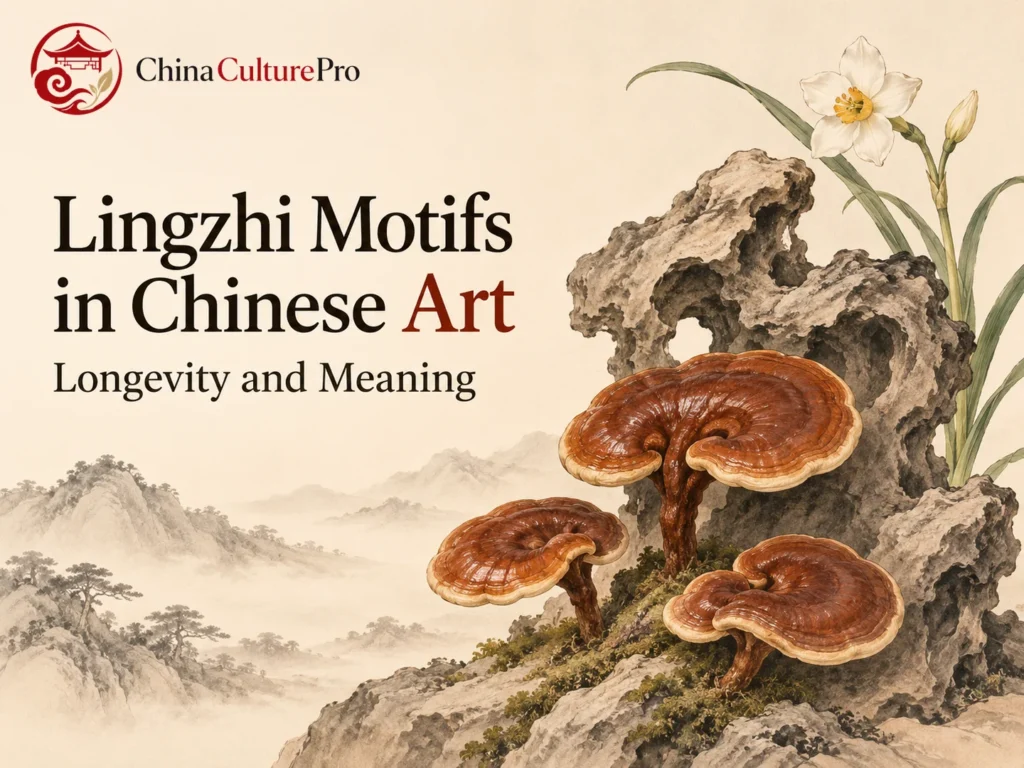
Lingzhi (灵芝, língzhī) often expresses a wish for long life in Chinese art. Artists show the fungus growing beside rocks, held by a figure or worked into the shape of an object. Its rounded cap can resemble the head of a ruyi scepter.[1][2][3]
- Shape. Look for a rounded or lobed cap on a stalk, sometimes with several overlapping caps.[1]
- Companions. Deer, cranes or immortals can strengthen the long-life association.[1][2]
- Occasion. Inscriptions can tie the fungus to a birthday or the New Year.[3][4]
The form can carry a broad wish. Nearby figures and written dedications can identify the occasion.

Look low on a carved landscape and you may find a small group of fungi below the deer and trees. In another work, a figure holds a fungus up for the viewer to see. Placement can show how much of the message the motif carries.
How to Recognize the Lingzhi Form
Start with the stalk. It often curves and widens into a rounded shelf or a cap with a shallow notch. Some artists stack several small caps on branching stalks. In a landscape carving, the stalks may rise close to a rock. In porcelain, an artist can use the shape as the whole outline, as on a Qianlong ink palette made with a bluish, crackled glaze.[1][2]
A similar outline appears on some ruyi scepters. A long handle is a clue to a scepter. Read the full form if only a curled top is visible. Auspicious mushroom shapes and ruyi heads look at the different ways artists adapted the silhouette.[1]
Lingzhi With Deer, Cranes and Immortals
A Qianlong carved wood brush pot in the Palace Museum surrounds its wall with deer, cranes, plants and rocks. The small fungus caps sit among much taller trees and rocky forms. An inscription and two small seals help the catalogue read the scene as a wish for long life, descendants and good fortune. Deer imagery can carry several meanings, so the fungus and the inscription matter here.[2]
The goddess Magu appears with a basket of fungi on a Kangxi dish in the Asian Art Museum. In that context, the fungus belongs to the story and devotional imagery of a figure associated with longevity. The basket is one of her attributes, alongside a garden hoe on this dish.[1]
Lingzhi in New Year and Birthday Paintings
Wu Changshuo’s 1919 painting Spring Offerings brings the fungus together with narcissus, a garden rock and red nandina berries. The verse imagines the fungus keeping its color when the year is about to turn. These elements make a seasonal greeting as well as a wish for long life. Shen Zhou’s painting of lingzhi, orchid, magnolia and rock offers a Ming example of the fungus arranged with a different set of plants.[3][5]
A folding fan painted in 1963 by Lu Yanshao shows a man holding lingzhi. Its inscription identifies it as a seventieth-birthday gift. The inscription fixes the occasion. The fungus conveys the artist’s wish for the recipient to live a long life.[4]
FAQs About Lingzhi Motifs
Can a lingzhi motif also look like a ruyi head?
Yes. Both can have a lobed or curved outline. A stalk in a landscape points toward the fungus. A handle and a separate head point toward a scepter.[1][2]
Does a deer always identify the fungus beside it as lingzhi?
A deer is one clue. A stalk and the shape of the cap, or a catalogue identification, give you more direct evidence for lingzhi.[1][2]
Fuentes
[1] Asian Art Museum. Motifs for Longevity, gallery labels for objects B60P376 and B60P2051
[2] The Palace Museum. Carved Wood Brush Pot with Cranes and Deer, object 00121903
[3] The Metropolitan Museum of Art. Wu Changshuo, Spring Offerings, object 1988.324.2
[4] The Metropolitan Museum of Art. Lu Yanshao, Searching for Fungus, object 1986.267.394
[5] National Palace Museum. Shen Zhou, Lingzhi, Orchid, Magnolia and Rock