


Quick Answer: What Is Cai Xiang’s Letter to Feng Jing?
Letter to Feng Jing is the traditional English name of Cai Xiang’s Siyong Letter (思咏帖, Sī Yǒng Tiè), a Northern Song letter in ink on paper, usually dated to 1051. The album leaf measures 29.7 × 39.7 cm and belongs to the National Palace Museum, Taipei. It discusses departure from Hangzhou and gifts of tea and a celadon bowl. The recipient’s identity needs qualification: research published in 2023 challenges the identification as Feng Jing and proposes another official as a possible recipient.[1][2]
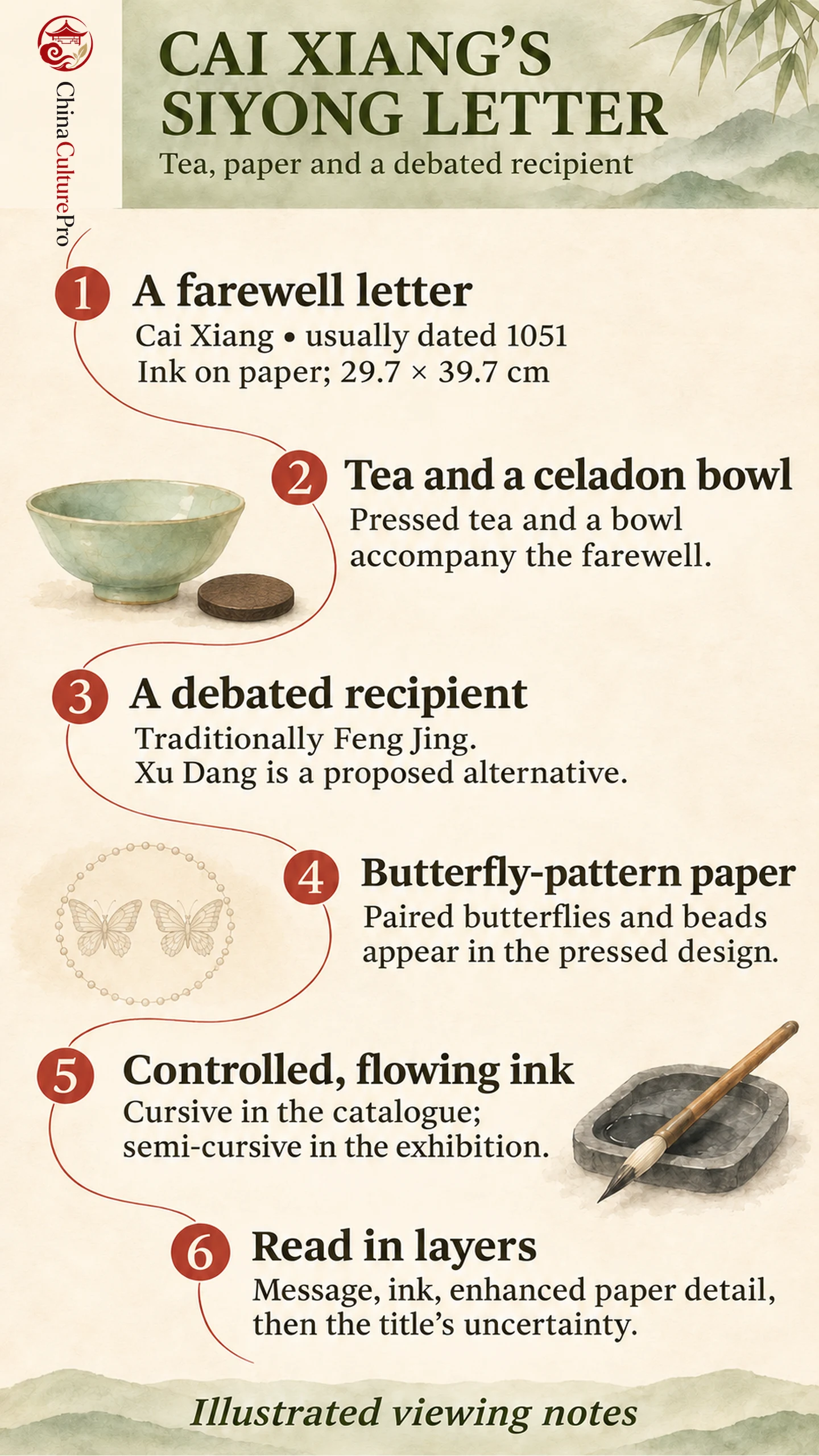
This small sheet rewards three kinds of reading: what Cai says to his correspondent, how he writes it, and what the decorated paper contributes. Its familiar title remains useful for finding the work, but it should not settle a disputed historical identity before the evidence is considered.
The Surviving Letter at a Glance
| Campo | Identification |
|---|---|
| Escritor | Cai Xiang |
| Period and usual dating | Northern Song; 1051, traditionally placed in the fourth lunar month |
| Format | Album leaf, from Song Calligraphy II |
| Medium and size | Ink on paper; 29.7 × 39.7 cm |
| Catalogue script classification | Cursive script (草书, cǎoshū) |
| Collection | National Palace Museum, Taipei |
| Destinatario | Traditionally Feng Jing; challenged in later scholarship |
The collection record’s longer English title is Letter to Feng Jing of the State Farms Bureau. That catalogue wording identifies the same work, rather than a second letter. The 1051 dating remains the conventional reference point; it should be distinguished from the separate question of who received it.[1][2][3]
A Farewell Accompanied by Tea and a Bowl
Cai opens by acknowledging a letter and expressing his thoughts of the recipient. He has spent two months in Hangzhou and is finally leaving, recalling abundant sightseeing and drinking. He is pleased to hear that his correspondent enjoys good relations with the prefect, then offers wishes for health in early summer. A hurried closing accompanies brief remarks about a valued tea cake and a celadon bowl.[1]
The tea is conventionally identified as large dragon tea (大龙团茶, dà lóngtuán chá), a prestigious pressed tea associated with Song tribute culture. The bowl is identified in older explanations as Yue celadon; later discussion treats its Zhejiang, probably Yue, origin as an inference from the setting and material culture.[3][4]
Cai values the tea highly but describes the bowl with modest reservation. Read that contrast as part of a gift exchange: quality, courtesy and friendship meet within a few lines. It does not prove that celadon had ceased to be used for tea, nor that this particular bowl survives as an identifiable museum object.[1][4]
The guides to Chinese tea culture and Chinese celadon provide background for those objects. Here, their importance comes from their place in the letter, alongside the sender’s departure and good wishes.
Why the Recipient’s Identity Is Disputed
The address uses the courtesy name Dangshi together with official titles, rather than spelling out “Feng Jing.” The traditional identification linked that courtesy name to the well-known official. A 2023 study by Tong Yongchang argues that the combination of rank and appointment does not fit Feng Jing’s career. It also examines chronology, regional connections and social networks.[2]
The study proposes Xu Dang (许当, Xǔ Dāng), associated with Quanzhou, as the likeliest alternative, while acknowledging gaps in the surviving evidence. A 2024 discussion by Xie Mingliang follows that proposed correction. This supports treating Feng Jing as a challenged identification; it does not turn Xu Dang into a conclusively established recipient.[2][4]
The official title translated as “State Farms Bureau” also needs care. In this context it could indicate a bureaucratic rank, rather than prove that the correspondent was personally administering farmland. This is why the combination of titles matters more than matching a courtesy name alone.[2]
For reading the object, retain two levels of certainty: Cai’s message about travel, relationships and gifts is visible in the text; the historical name assigned to its addressee depends on reconstruction.
Butterfly Paper and Controlled, Flowing Brushwork
The sheet is decorative pressed paper (砑花笺, yàhuājiān), with a weave-like texture and paired butterflies arranged within a beaded circle. Such subtle designs can be difficult to distinguish in ordinary photographs; enhanced images help reveal the surface. A plain-looking thumbnail is therefore poor evidence that the paper was undecorated.[3]
The catalogue calls the writing cursive, while the exhibition discussion describes its poised, freely moving handling as semi-cursive (行草书, xíngcǎoshū). These descriptions direct attention to abbreviation and movement alongside controlled character construction. They need not imply two different surviving objects.[1][3]
Compare the inked lines with the support beneath them. The butterfly pattern belongs to the paper’s preparation, rather than being a picture Cai inserted between sentences. Its presence makes the material of correspondence part of the viewing experience without requiring an invented symbolic explanation for the butterflies.
The broader account of Chinese calligraphy helps place such a personal letter among works preserved for their brushwork. Here, the decorated surface and tea gifts keep that brushwork connected to a particular social exchange.
How to Look at the Letter in Four Passes
- Establish the message. Identify the stay in Hangzhou, impending departure, wishes for health and closing gift remarks before studying isolated characters.
- Follow the writing. Compare the main text with the closing lines. Look for changes in spacing, abbreviation and scale without assuming that a fluent line means careless execution.
- Inspect an enhanced paper detail. Find the paired-butterfly design and its surrounding beads in a suitable reproduction. Separate the pressed pattern from black ink and later marks.
- Return to the title. Keep the familiar Feng Jing label as a finding aid, while noting that the recipient has been challenged and the alternative remains proposed.
For the writer’s wider practice, continue to Cai Xiang’s works and style. When revisiting the reproduction, ask what you can actually see in the ink, what needs enhanced photography, and what depends on a historian’s identification.
FAQs About Letter to Feng Jing by Cai Xiang
Is this the same letter as Leaving the Capital?
No. Leaving the Capital is a separate condolence-related letter. This work concerns departure from Hangzhou, social news and gifts of tea and a bowl.
Is the surviving object a stone rubbing?
The object discussed here is an ink-on-paper album leaf. Later modelbook versions preserve the letter in a different form and should not be confused with this sheet.[1][5]
Does the tea cake mean modern pu-erh tea?
No. The letter is associated with Song pressed tribute tea. A cake shape alone does not establish the modern tea category pu-erh.[3]
Fuentes
[1] National Palace Museum. Letter to Feng Jing of the State Farms Bureau, collection record
[2] Tong Yongchang. National Palace Museum Monthly, May 2023: 蔡襄〈致通理當世屯田尺牘〉收信人考辨
[3] National Palace Museum. A Special Exhibition of Painting and Calligraphy on Song Dynasty Decorated Paper
[4] Xie Mingliang. National Palace Museum Monthly, February 2024: 記蔡襄〈致通理當世屯田尺牘〉
[5] National Palace Museum. Three Rarities Hall Modelbook, Letter to Feng Jing of the State Farms Bureau