


Quick Answer: Who Was Ouyang Xun?
Ouyang Xun (欧阳询, Ōuyáng Xún; 557–641) was an early Tang calligrapher especially admired for regular script (楷书, kǎishū).[1]
- Style: Ou style (欧体, Ōu tǐ) combines precision with forceful structure.[1]
- Range: His tradition also includes running script (行书, xíngshū).[1]
- Transmission: A rubbing (拓本, tàběn) carries an inscribed design onto paper, helping preserve and circulate it.[6]
Read the date and medium of the surviving object alongside the name of the original calligrapher.
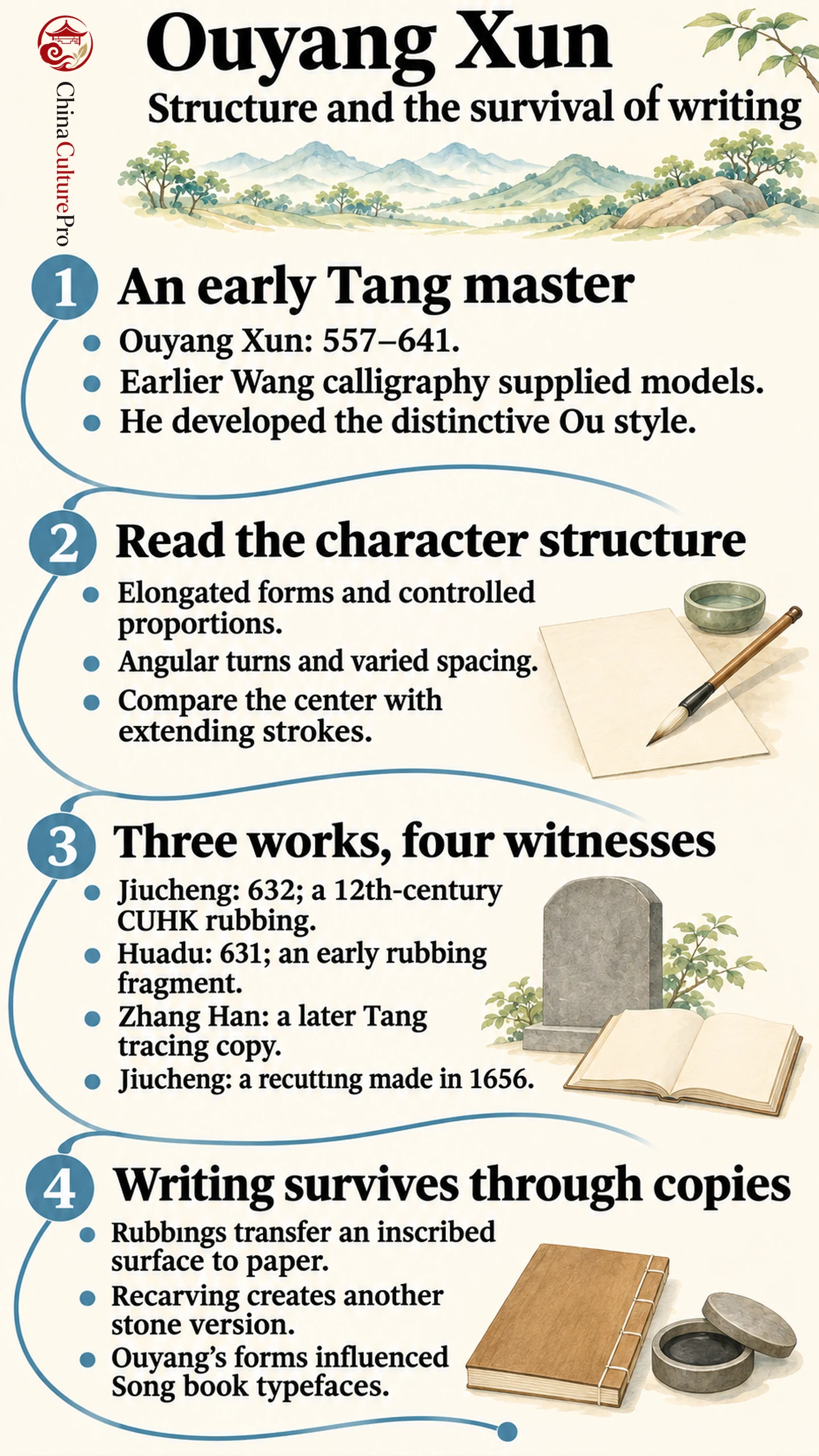
A museum object labeled with Ouyang Xun’s name may preserve writing through stone, a paper impression or a careful handwritten copy. Each gives access to his style through a different material history.
An Early Tang Master with Older Models
Ouyang Xun lived through the Chen, Sui and Tang dynasties. He held scholarly office at the Hongwen Academy and became one of the leading figures in early Tang calligraphy.[1]
He studied the writing of Wang Xizhi and Wang Xianzhi, drawing on earlier traditions before developing his own manner.[1] His achievement grew from an existing history of regular writing.
Reading the Structure of Ou Style
Look for elongated characters, controlled proportions and angular changes of direction. These features are visible in the transmitted Biography of Zhang Han, which combines regular and running forms.[4]
Begin with the space inside a character. Compare it with the gap before the next one, then examine how a long stroke reaches beyond the compact center. This way of reading calligraphy makes structure visible even before the text is translated.
Precision need not mean an equal square around every character. Follow the relationship between firm edges and varied proportions across several columns, rather than treating each mark as an isolated shape.
Three Major Works in Four Surviving Objects
The examples below separate a composition’s historical date from the age and form of a particular physical witness.
| Work or inscription | Original date | Surviving object to compare |
|---|---|---|
| Inscription on the Sweet Spring at Jiucheng Palace | 632 | Twelfth-century paper rubbing; album of 36 leaves, CUHK Art Museum, 1992.0024.[2] |
| Huadu Temple Stele | 631 | Rubbing fragment, BnF Pelliot chinois 4510; cataloged as seventh century (?) with ninth–tenth-century mounting.[3] |
| Biography of Zhang Han | Associated with Ouyang’s early Tang writing | Eighth- or ninth-century Tang tracing copy (摹本, mó běn); album leaf, ink on paper, Palace Museum.[4] |
| Jiucheng Palace inscription, later version | Original inscription: 632 | Paper rubbing from a recutting (翻刻, fānkè) made in 1656; National Palace Museum, Taipei.[5] |
The Huadu fragment preserves only the opening of a much longer inscription, so it supports comparison of individual characters more readily than the monument’s complete layout.[3]
The Zhang Han leaf is now described as a tracing copy, probably made by a later copyist. Its value lies in preserving well-structured, elongated forms and angular strokes associated with Ouyang’s writing.[4]
What Copies and Rubbings Preserve
A traditional stone rubbing is made by pressing damp paper into an inscribed surface and applying ink. Incised characters commonly appear white against a dark ground.[6] This differs from following a model with a brush on paper.
The original Jiucheng Palace stele remains at Linyou in Shaanxi, but repeated rubbing has worn its surface. Later recarvings used surviving impressions as models; the Taipei example records a recutting of 1656.[5]
Compare the age of the text, the stone and the paper object separately. A later impression may retain an earlier design, while a newly cut stone introduces another stage of reproduction. Inscriptions and collecting records help trace these changes.
Ouyang’s influence also reached book production: his calligraphy supplied a model for typefaces used in Song woodblock-printed books.[4] His legacy therefore extends beyond practicing from a single famous stele.
FAQs About Ouyang Xun
Did Ouyang Xun invent regular script?
No. He developed a distinctive manner from earlier writing traditions, including those of the two Wangs.[1]
Is the Zhang Han manuscript his original handwriting?
The surviving Palace Museum leaf is presented as a later Tang tracing copy.[4]
Why can a 632 inscription have a much later object date?
The later date can identify a paper impression or recarving, rather than the original composition.[2][5]
Fuentes
[1] Palace Museum. Ouyang Xun
[2] Chinese University of Hong Kong. Inscription on the Sweet Spring: The Art Museum’s Twelfth-Century Rubbing
[3] Bibliothèque nationale de France, catalogue metadata via Biblissima. Huadu Temple Stele: Pelliot chinois 4510
[4] Hong Kong Palace Museum. Biography of Zhang Han in Running-Regular Script: Tang Copy
[5] National Palace Museum. Jiucheng Palace Inscription: Rubbing from a Recut of 1656
[6] Field Museum. Chinese Rubbings Collection