


Quick Answer: What Is Leaving the Capital by Cai Xiang?
Leaving the Capital (离都帖, Lí Dū Tiè) is a personal letter by Cai Xiang, generally dated to 1055, preserved as an album leaf in the National Palace Museum, Taipei. Written in ink on paper, it measures 29.2 × 46.8 cm. Cai thanks a friend for condolences after the death of his eldest son during a journey south. The work combines a painful message with rounded, substantial yet flowing brushwork.[1][2]
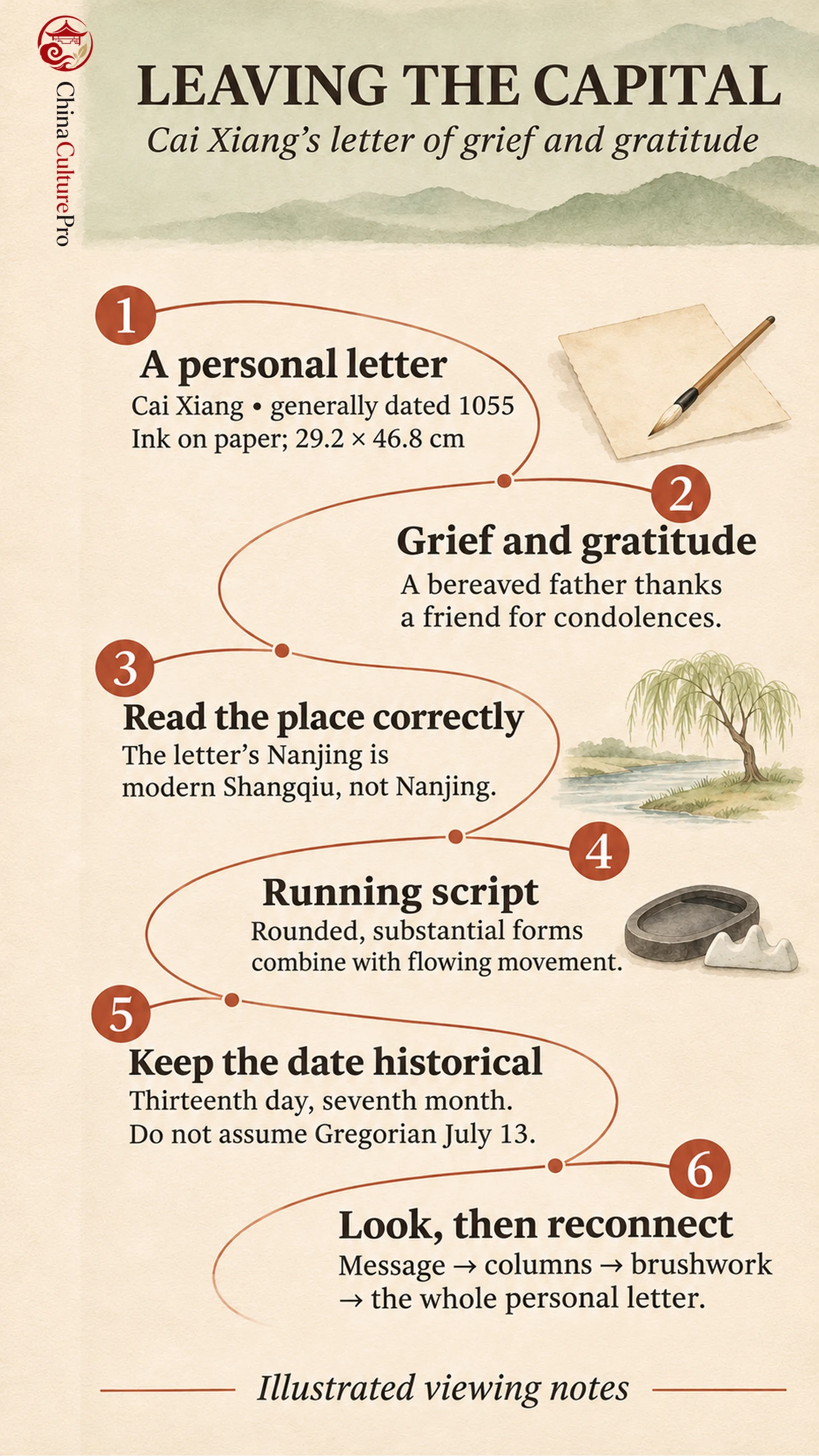
Start by reading it as correspondence. The title may suggest a farewell poem or a view of a capital city, but the surviving object is a father’s reply to a sympathetic friend. Its practical and courteous phrases are part of the encounter, alongside its grief.
The Letter at a Glance
The fuller title, Letter to Gentleman Du (致杜君长官尺牍, Zhì Dù Jūn Zhǎngguān Chǐdú), identifies the recipient. Older English labels use “Tu” for the same surname. The short title comes from the opening account of leaving the capital.[1]
| Campo | Identification |
|---|---|
| Calligrapher | Cai Xiang |
| Period and date | Northern Song dynasty; generally dated 1055 |
| Objeto | Personal letter, now an album leaf |
| Medium and size | Ink on paper; 29.2 × 46.8 cm |
| Script | Running script (行书, xíngshū) |
| Collection | National Palace Museum, Taipei |
The leaf belongs to the album known in English as Ink Treasures of the Four Song Masters. Its present album format describes how the sheet is preserved; the text itself addresses one person rather than an audience of gallery visitors.[1]
What Cai Xiang Tells His Friend
Cai recounts leaving the capital and reaching Nanjing, where his eldest son died after seven days of illness. The letter calls that illness shanghan (伤寒, shānghán), a historical medical term. It is safest to retain that wording rather than turn it into a secure modern diagnosis from this short account.[1]
He describes his sorrow, acknowledges the friend’s message and another letter, and says that an approaching river crossing prevents a meeting. He then thanks the recipient, asks after the household and adds news that other family members are well. The conventional ending does not erase the distress expressed earlier; it keeps the exchange moving between people who know one another.[1]
This mixture gives the work its particular force. A summary such as “a letter about bereavement” identifies the subject but loses the social action: condolences have arrived, a reply is owed, a meeting cannot happen, and family news must still be passed on. Read those practical details together with the emotional sentences.
The wider tradition of Chinese calligraphy includes just such communication. Letters could serve immediate relationships while also being valued for their writing; their later survival as art need not make their original message secondary.[3]
Why Nanjing Here Means Modern Shangqiu
The capital in the title is Kaifeng. The Nanjing mentioned in this letter is the Song “Southern Capital,” associated with modern Shangqiu in Henan, rather than today’s city of Nanjing in Jiangsu. Reading the familiar place-name in its modern sense would place the reported loss on the wrong part of the journey.[1]
The guide to the Song dynasty supplies the broader historical setting. For this letter, the key point is narrower: historical capital designations must be interpreted in their own period. The title describes departure, while the letter looks back on what followed it.
Rounded Brushwork Within a Letter of Grief
Cai’s brushwork is full and rounded but remains mobile. Its substantial forms and generous internal spacing have been compared with Yan Zhenqing. The letter maintains composure even though its message is deeply distressed.[2]
Running script allows abbreviated forms and connections within characters without requiring every character to join its neighbor. Follow how a stroke thickens, turns or tapers, then notice where the brush lifts and a fresh form begins. The flexible brush can make markedly different widths within one written movement.[4][5]
In the reproduction, columns do not all end at the same height, and the smaller continuation on the left differs from the main block. Compare those changes in scale and placement before looking closely at individual strokes. The red impressions around the writing belong to the object’s collecting history; they are distinct from Cai’s black-ink message.[1]
The text establishes grief more securely than any isolated stroke does. You can observe a change of pressure or spacing without claiming to know the exact thought behind it. This lets the letter retain both its practiced craft and its particular human circumstances.
How to Examine the Letter
- Read a short account of the message. Establish the death, the condolence reply and the missed meeting before treating the sheet as an abstract arrangement.
- Follow the main columns. Read downward and proceed from right to left. Compare the lengths of the columns and the spaces between them rather than imposing a printed page’s uniformity.
- Compare heavy and light marks. Choose two nearby characters and follow their thick strokes, fine transitions and endings. Avoid assuming that every dark mark was written with greater emotional force.
- Return to the whole sheet. Notice the smaller continuation, signature area and red seals separately. Reconnect the close details with the scale and purpose of a personal letter.
For a fuller account of the writer, Cai Xiang’s works and style provides the next step. When comparing works, ask whether each was a private message, a copied poem or a formal inscription; that purpose changes what the writing is doing.
FAQs About Leaving the Capital by Cai Xiang
Is Leaving the Capital a poem or a letter?
It is a letter thanking a friend for condolences. The brief title refers to its opening account of leaving the capital, rather than identifying a poem.
Was it written on July 13 in the modern calendar?
The text gives the thirteenth day of the seventh month. That historical calendar date should not be presented as Gregorian July 13 without a separate conversion.[1]
Can I appreciate it without reading Chinese?
Yes. Begin with a reliable account of the message, then compare column spacing, character size and changes in inked line. A transcription helps connect those visual observations with the letter’s words.
Fuentes
[1] National Palace Museum. Letter to Gentleman Du, collection record and transcription
[2] National Palace Museum. Letter to Officer-Gentleman Tu
[3] The Metropolitan Museum of Art. Out of Character: Calligraphy and Social Networks
[4] Asian Art Museum. Words as Art: Scripts and Tools
[5] Dawn Delbanco, The Metropolitan Museum of Art. Caligrafía china