

Quick Answer: Who Was Cai Xiang?
Cai Xiang (蔡襄, Cài Xiāng; 1012–1067) was an official and calligrapher of the Song del Norte (北宋, Běi Sòng). His reputation rests on regular script (楷书, kǎishū), running script (行书, xíngshū) and the ability to combine disciplined forms with fluent brush movement. He is conventionally counted among the Four Song Masters (宋四家, Sòng Sì Jiā).[2][8]
- Range: Formal court writing and personal letters served different purposes.
- Style: Earlier calligraphic models remained important to his work.
- Evidence: Original ink, stone inscriptions (碑刻, bēikè) and later modelbooks, or fatie (法帖, fǎtiè), preserve different aspects of a composition.[1][5][7]
The title of a work or the artist named in a catalogue does not by itself identify the surviving object as an autograph.
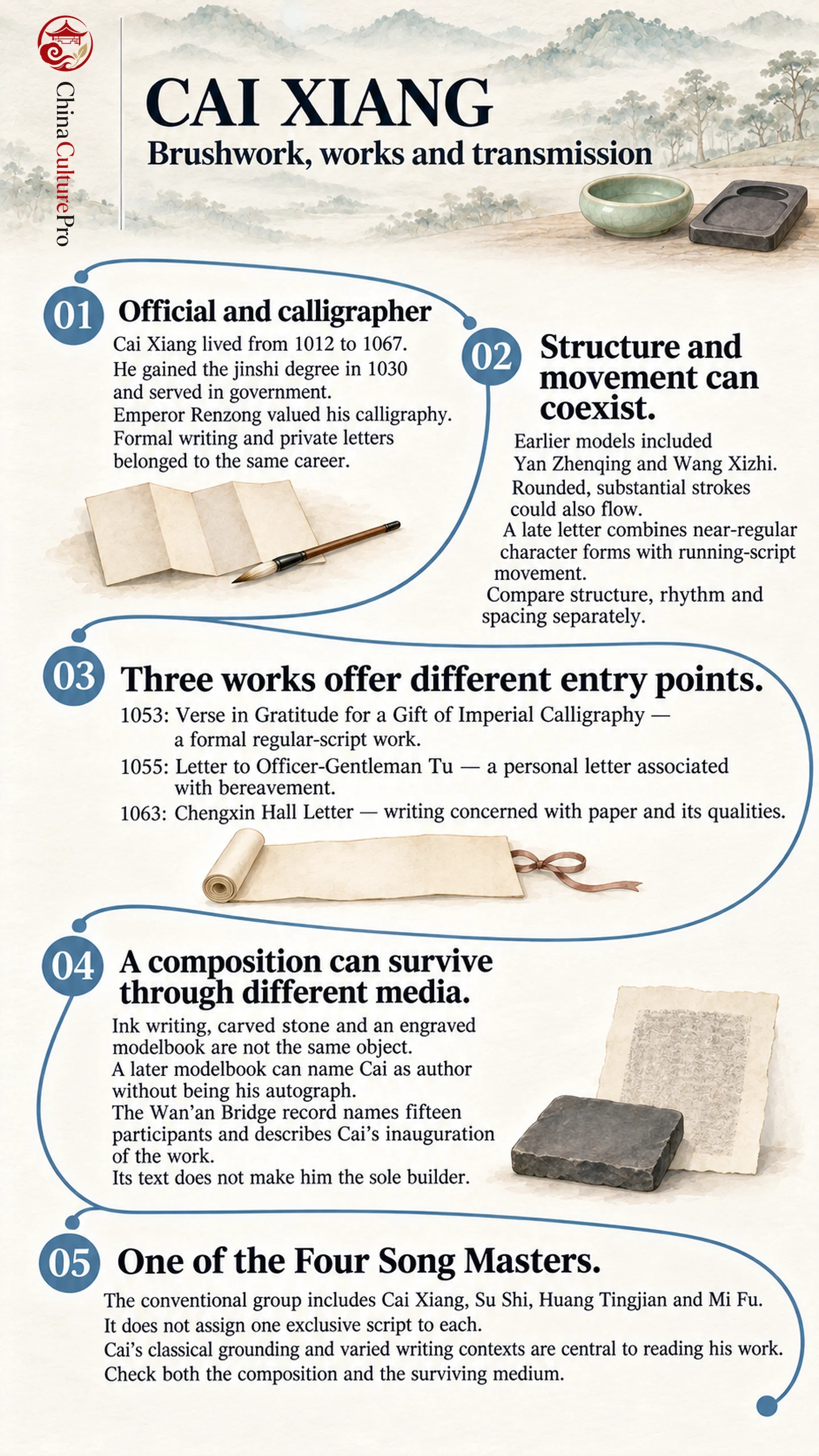
Cai Xiang’s calligraphy appears in intimate letters, formal writing and monumental inscriptions. Comparing these settings helps explain his range. Looking closely also requires asking what survives: an ink manuscript, lettering transferred to stone, or a later impression made to circulate an admired composition.
An Official Whose Writing Had Many Uses
Cai used the courtesy name Junmo (君谟, Jūnmó) and came from the Xianyou (仙游, Xiānyóu) area in present-day Fujian (福建, Fújiàn). He gained the jinshi (进士, jìnshì) degree through the imperial examinations in 1030, then served in central and regional government. [1][3]
The Emperor Renzong (宋仁宗, Sòng Rénzōng) valued his calligraphy and gave him imperial handwriting. His biography also records political remonstrance and service in Fujian. Those appointments made writing part of his public responsibilities as well as his scholarly life.[1]
Classical Structure with a Moving Brush
Cai’s work drew on earlier models, including Yan Zhenqing (颜真卿, Yán Zhēnqīng) and Wang Xizhi (王羲之, Wáng Xīzhī). Rounded, substantial strokes could coexist with a flowing line. Upright character construction did not require the brush to move stiffly.[2][3][5]
The distinction between regular and running scripts is useful, but the two qualities can meet within one work. A late letter has forms close to regular script while its brush movement approaches running script. Look separately at the shape of each character, the movement connecting strokes, and the space around the writing.[2]
Three Works for Reading His Range
Compare the formal court text with two personal letters. Their different purposes help explain the range of his surviving calligraphy.[3][4][5]
| Work | Contexto | What to compare |
|---|---|---|
| Verse in Gratitude for a Gift of Imperial Calligraphy (谢赐御书诗表, Xiè Cì Yùshū Shī Biǎo) | A regular-script work dated 1053, held by Taito City Calligraphy Museum, Tokyo. | The formal purpose and composed character structure. |
| Letter to Officer-Gentleman Tu, also called Leaving the City (离都帖, Lídū Tiè) | An ink letter associated with mourning for his eldest son in 1055; National Palace Museum, Taipei. | Rounded strokes, generous spacing and the movement of a personal letter. |
| Chengxin Hall Letter (澄心堂纸帖, Chéngxīntáng Zhǐ Tiè) | An ink letter dated to the Double Ninth Festival in 1063; National Palace Museum, Taipei. | Its concern with paper and the material conditions of fine writing. |
Ink, Stone and Later Modelbooks
An ink manuscript preserves ink traces (墨迹, mòjì) on the writing surface. An inscription involves a transfer into carved material. Cai’s Record of Wan’an Bridge (万安桥记, Wàn’ān Qiáo Jì) commemorates what is also called Luoyang Bridge (洛阳桥, Luòyáng Qiáo). Its text names a group of fifteen people responsible for the undertaking and describes Cai’s inauguration of the completed work. It should not be used to make him the project’s sole builder.[6]
Later fatie, or model calligraphy collections, provided another route of transmission. An engraved modelbook can preserve a composition attributed to Cai without being the sheet he wrote. Check whether the catalogue describes ink writing or an engraved modelbook impression.[7]
A modelbook version of the paper letter also transmits its practical concerns: the desired sheet’s width, thickness and firmness, and a request for a supply of comparable paper. That text gives evidence about material expectations. The ink letter, its later engraved version and traditions about the paper’s origin remain different objects or claims.[4][7]
His Place among the Four Song Masters
The conventional group places Cai alongside Su Shi (苏轼, Sū Shì), Huang Tingjian (黄庭坚, Huáng Tíngjiān) and Mi Fu (米芾, Mǐ Fú). It recognizes four prominent calligraphers rather than assigning one exclusive script to each. Cai was older than the others, and his classical grounding helps connect earlier traditions with Northern Song practice.[2][5][8]
A useful reading of the calligraphy considers structure, brush movement, spacing, purpose and medium together. A personal letter, formal text and carved inscription ask the viewer to notice different things.[2][3][5][7]
FAQs About Cai Xiang
Was Cai Xiang the same person as Cai Jing?
No. Cai Xiang and Cai Jing (蔡京, Cài Jīng) were different people. Similar surnames should not merge their careers or attributed works.[1]
Did Cai Xiang write only regular script?
No. His personal letters also demonstrate running-script movement. His achievement cannot be reduced to one script category.[2]
Is a modelbook impression the same as an original ink letter?
No. A later engraved impression transmits a model through another medium; it is not the paper carrying the calligrapher’s original ink.[7]
Fuentes
[1] History of Song, chapter 320. Biography of Cai Xiang
[2] National Palace Museum. The Expressive Significance of Brush and Ink: Cai Xiang’s Letter
[3] National Palace Museum. Letter to Officer-Gentleman Tu
[4] National Palace Museum. A Letter: Chengxin Hall Letter
[5] Tokyo National Museum. Chinese Calligraphy: Yan Zhenqing and Cai Xiang
[6] Cai Xiang / Licheng District Gazetteer inscription transcription. Record of Wan’an Bridge
[7] National Palace Museum. Imperial Engraved Modelbooks of the Studio of Wonderful Ink, Volume 3: Chengxin Tang Paper Modelbook
[8] Shanghai Museum. Chinese Calligraphy: Song-Dynasty Masters