

Quick Answer: What Is a Chinese Calligraphy Copybook?
A Chinese calligraphy copybook presents examples to study and reproduce. A historical modelbook (法帖, fǎtiè) can collect impressions taken from engraved versions of older writing. A modern practice book (字帖, zìtiè) may present characters for copying with grids, outlines or other guides. The terms can overlap in use. [1][2][5][7]
- Historical examples: A bound volume can contain models by several writers, transmitted through later impressions. [1][2][7]
- Practice material: A model can help you study the proportions and stroke shapes of a character. [5][6]
- Copying choices: Write beside the model to reconstruct the form, or trace over a practice copy to follow its placement more closely. [5]
Check whether you are looking at an ink original, an engraved reproduction, a rubbing or a modern printed guide. Each shows a different stage of the model’s history. [3][4][7]
A page with a famous calligrapher’s name may be several stages removed from the original writing. That can still make it a useful model. The key is to know which features the page preserves and what you want to practice.
Historical Modelbooks and Modern Practice Books
The original engraving of the Chunhua Pavilion Model-book dates to 992. A surviving volume consists of ink-on-paper rubbings. Another project, the Ming modelbooks from the Stopping Cloud Mansion, recorded a volume of Song writing carved in 1551. A date in a modelbook may therefore refer to the engraving of the compilation, even when the writer it names lived much earlier. [1][2]
A collection can transmit a piece even when the ink manuscript also survives. A Ming modelbook volume includes a version of the Requiem draft by Yan Zhenqing. The later impression shows the result of a carving and transfer process. The ink manuscript shows cancellations directly on the page. Compare the two before treating a mark in a reproduction as the exact trace left by the brush. Each carries different evidence. The process of making stone rubbings explains why the finished paper surface differs from a direct ink line. [3][4][7]
A practice book can organize the page around the learner. It might enlarge one character, print a pale outline or place a grid next to the example. These aids can make it easier to check the relative positions of strokes. A grid makes placement easier to judge. An outline can show the shape to aim for, but you may need a separate stroke guide to see the order and direction. [5][6]
Freehand Copying and Tracing
In freehand copying (临, lín), the model sits beside or in front of you. You look at it and reconstruct the strokes on another sheet. That distance makes you decide where the parts belong. In tracing (摹, mó), an outline or translucent practice sheet keeps the example beneath your marks. Tracing helps compare lengths and positions. Copying beside the model shows what you can reconstruct from looking alone. [5]
How to Practice With a Calligraphy Copybook
1. Choose One Clear Model
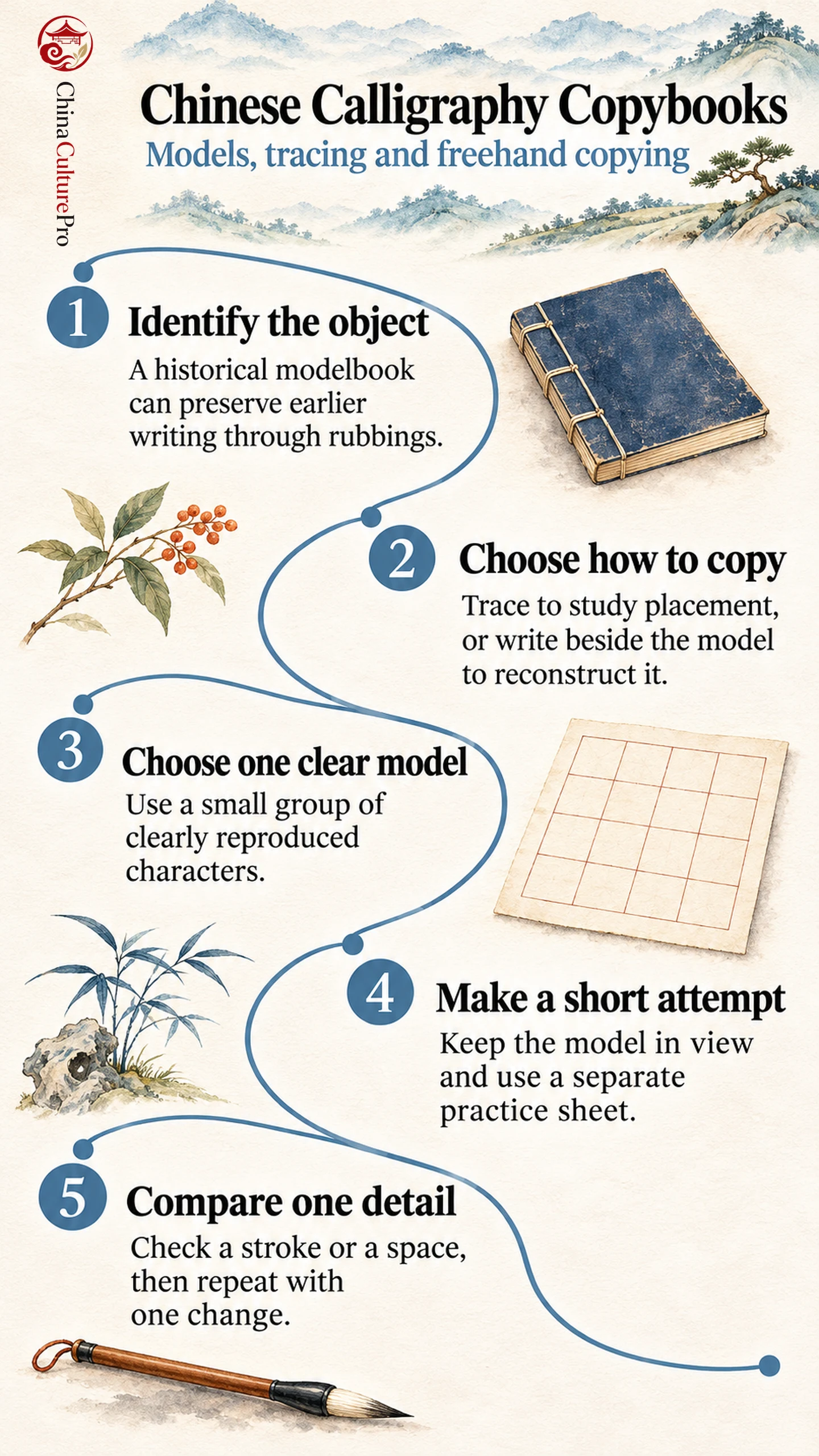
Pick one clearly reproduced model and a short group of characters. Check the script, scale and stroke order before you begin. [5][6]
For a first attempt, the distinct parts of regular script are useful. Use a stroke guide when you want to practice movement as well as visual proportions. [5][6]
2. Trace or Copy a Small Group
Trace on a separate practice copy to study placement, or copy beside the model to practice reconstructing the characters. Keep the model in view. [5]
Use a practice print or an ordinary exercise sheet for tracing. Keep ink off a borrowed or original copybook page. Compare the same forms while keeping the paper and brush consistent, as in Chinese calligraphy for beginners. [5][6]
3. Compare and Repeat One Change
Place your work next to the model. Check one detail such as a stroke ending, the width of a character or the space between components. Repeat the form with that change in mind. [5][6]
For example, if the right component sits too low, adjust its position on the next attempt and compare the two results before changing the brush or ink. For finished works, how to read Chinese calligraphy explains how to inspect spacing and material. [5][6]
FAQs About Chinese Calligraphy Copybooks
Is a Copybook the Same as an Original Manuscript?
A copybook can preserve an earlier piece through a tracing, engraving, rubbing or modern reproduction. Compare the date of the model with the date and medium of the item in front of you. [1][2][3][4]
Should Beginners Trace or Copy Freehand?
Trace if you want help seeing placement. Copy beside the model to find out which parts you can reconstruct on your own. The exercises can be used together. [5]
Which Script Works Well for a First Copybook?
A clear regular-script example helps you see the individual components. Choose a page with readable forms and enough detail to compare how they were made. [5][6]
Fuentes
[1] Princeton University Art Museum. Chunhua Pavilion Model-book, Volume 1
[2] National Palace Museum. Ming Rubbings of Modelbooks from the Stopping Cloud Mansion, Volume Seven
[3] National Palace Museum. Ming Modelbook Rubbing of Draft of a Requiem for My Nephew
[4] National Palace Museum. Draft of a Requiem for My Nephew
[5] Zhengzhou University of Science and Technology teaching materials. Calligraphy Appreciation
[6] Smithsonian National Museum of Asian Art. Standard Script
[7] The Metropolitan Museum of Art. Wang Xizhi: On the Seventeenth Day