

Quick Answer: What Does Ke Zhou Qiu Jian Mean?
Ke Zhou Qiu Jian (刻舟求剑, kè zhōu qiú jiàn) means to cling to an old method after the conditions that made it useful have changed. The story is about a traveler who marks his boat where he drops a sword. The mark travels with the boat, while the place he needs to find stays behind.[1][2]
- Literal image: Mark the boat to look for a sword.[1]
- The mistake: The traveler treats a mark on a moving object as a fixed location.[1][2]
- Modern use: Criticize an old rule or reference used without checking whether it still fits.[2]
The mark can be accurate about the boat and still lead the traveler to the wrong place.

A man makes a careful record of where he was standing. Later, it tells him nothing about where the lost object is. The gap between those two locations makes the story a compact argument about changing circumstances.[1][2]
The Mark on the Boat
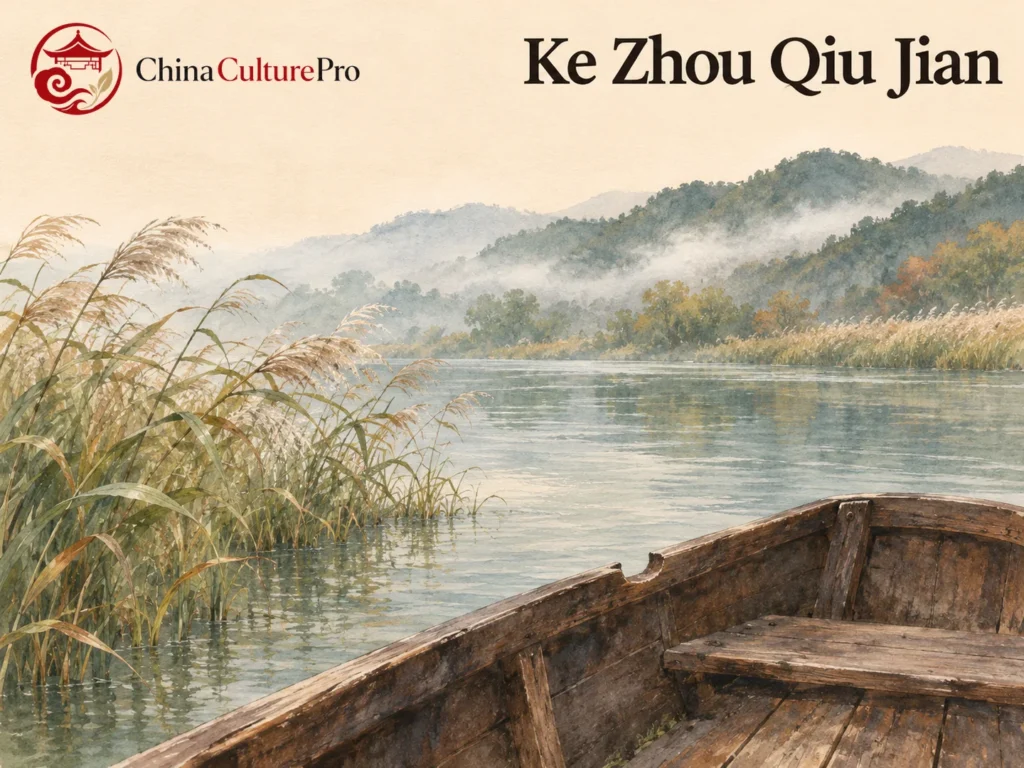
In the Spring and Autumn Annals of Lü Buwei (吕氏春秋, Lǚshì Chūnqiū), a man from Chu drops his sword from a boat while crossing a river. He cuts a mark into the side of the boat at the place it fell. When the boat stops, he tries to search below the mark.[1][2]
The error is easy to see from shore. The mark shows where the sword passed the side of the boat, but the boat has gone on. A spot on the river and a spot on the boat are two different references. The traveler’s careful mark does not preserve the relationship he needs.[1]
Why the Story Appears in Observing the Present
The anecdote appears in the chapter Observing the Present. The text compares the traveler’s search with governing by rules that remain unchanged as times change. The moving boat makes the point visible: a rule can stay fixed while the world it refers to changes.[1]
The comparison gives a reason to reconsider old rules when conditions shift. An older rule may once have served its purpose. The problem arises when someone assumes it will keep giving the same answer under new conditions.[1][2]
How to Use Ke Zhou Qiu Jian Today
Someone might say 车站已经搬了,还照着旧地图找,岂不是刻舟求剑? The station has moved, but the traveler still follows an old map. The idiom criticizes treating the map as a reliable guide after the feature it marks has changed.[2]
In English, “cling to an outdated method” captures the sense. A fuller translation might say “keep using the old rule after the situation has changed.” Preserve the boat and sword in a retelling or when an author deliberately brings the image into the passage.[1][2]
How It Differs From An Tu Suo Ji
An Tu Suo Ji (按图索骥, àn tú suǒ jì) can criticize mechanical use of a model. It can also describe following a useful clue. Ke Zhou Qiu Jian is critical because the reference no longer points to what the person hopes to find.[2][3]
FAQs About Ke Zhou Qiu Jian
Why is the mark no longer useful?
It moved with the boat, while the location where the sword fell did not move with it.[1]
What is a natural English translation?
“Cling to an outdated method” is natural. A literary translation can retain the image of marking a boat to find a sword.[1][2]
Does the idiom criticize all old methods?
It criticizes a method that no longer fits the circumstances. An older method can still work if the relevant conditions hold.[1][2]
Fuentes
[1] Chinese Text Project. Observing the Present in the Spring and Autumn Annals of Lü Buwei
[2] Taiwan Ministry of Education. Idiom dictionary entry for 刻舟求劍
[3] Taiwan Ministry of Education. Idiom dictionary entry for 按圖索驥