


Quick Answer: What Was the Hong Kong New Wave?
The Hong Kong New Wave (香港新浪潮, Xiānggǎng Xīnlàngcháo) was a change in local filmmaking in the late 1970s and early 1980s. Directors who had worked in television and other new entrants brought different habits to established film genres. Ann Hui, Tsui Hark, Patrick Tam and Allen Fong are among the filmmakers associated with the movement.[1][2][4][6]
- The Secret (1979) rearranges a murder story through a nonlinear investigation.[5]
- The Butterfly Murders (1979) joins swordplay with mystery.[8]
- Father and Son (1981) draws on an older tradition of Cantonese social realism.[6]
The label covers filmmakers who took different approaches to the city, the industry and its audiences.
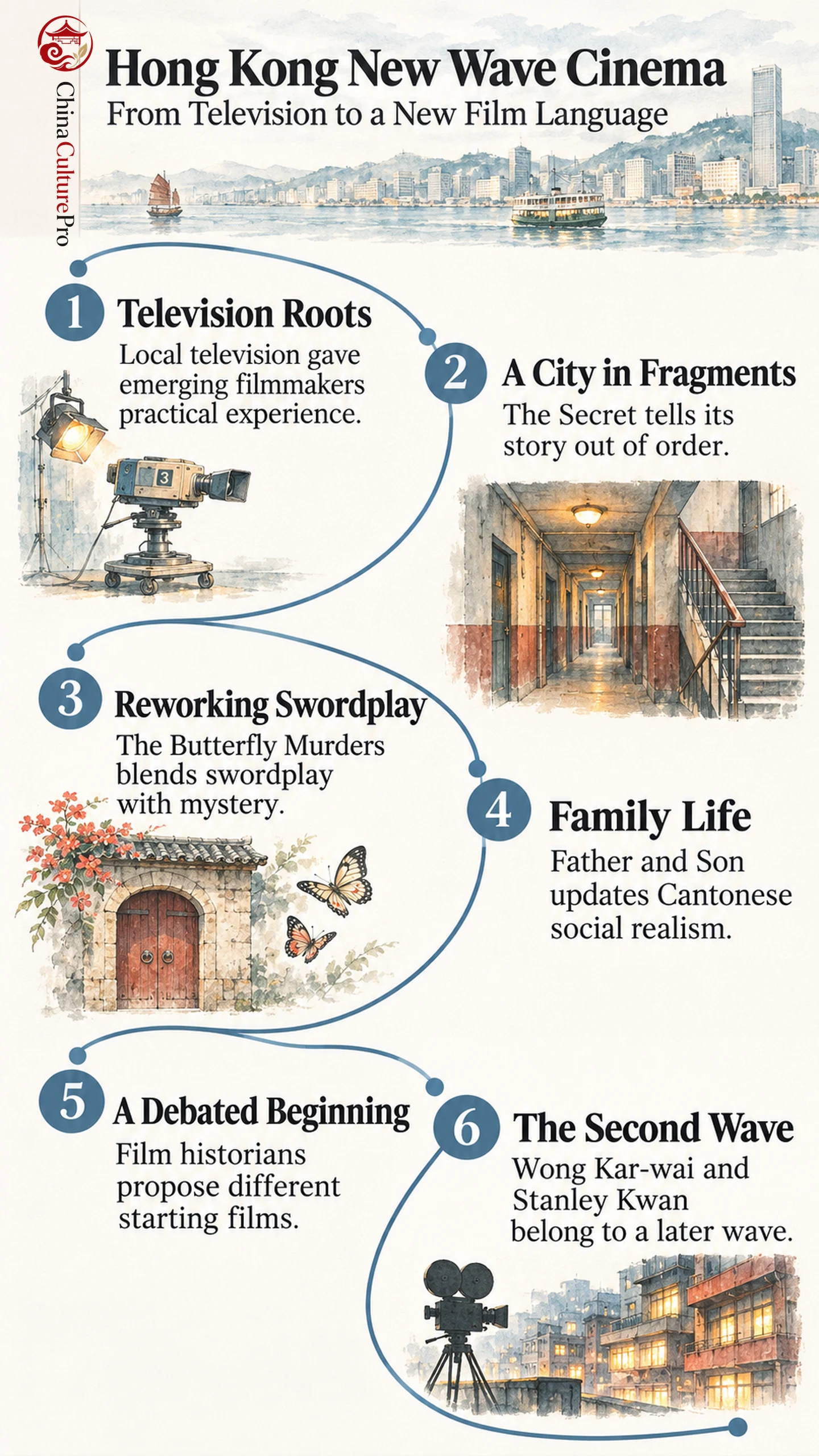
A cramped apartment, a martial-arts mystery and a father’s hopes for his child seem unlikely to belong to one film movement. Seen together, these stories show what changed when directors began treating familiar material as an opportunity to change how films were told.
How Television Changed Who Made Films
New entrants came out of the television industry around Broadcast Drive, where competing stations had relied on writers and directors to make local programming. Independent companies took chances on some of those filmmakers as television talent moved to cinemas.[2] The move opened feature directing to people who had been making programmes for local audiences. The rise of these directors belongs to the wider history of modern Chinese culture and its mass media.
Ann Hui worked on drama and documentary at TVB, then made short dramas at Radio Television Hong Kong. Her From Vietnam (1978), made for the series Below the Lion Rock, preceded her first feature, The Secret.[3] Television provided experience with local settings and social subjects. The next step into feature production gave her room to alter the form.
Three Ways the New Wave Changed Familiar Stories
The Secret has a thriller’s murder case. Ming, a friend of the victims, takes the viewer through a story that reveals information out of order. The crowded interiors of older apartments sit alongside the spare rooms of a developing city. The change in space gives the viewer a way to read the characters’ unease.[5]
Martial-arts films offered a different kind of experiment. Wuxia (武侠, wǔxiá), or tales of martial heroes, was already familiar to audiences. Tsui Hark’s The Butterfly Murders mixes swordplay, detective fiction and science-fiction elements, while Patrick Tam’s The Sword (1980) also reworks genre conventions.[4][8] The history of Shaw Brothers film culture gives context for the studio-era audience for swordplay. The distinction between wuxia and historical drama helps explain why the setting alone does not define the genre.
Allen Fong’s Father and Son focuses on a young man’s growth and the expectations his father places on him. It updates a Cantonese tradition of attention to family and working-class life.[6] Here the experiment lies in how closely the film follows ordinary experience.
Why the Movement Has No Single First Film
The Hong Kong Film Archive considers several candidates, including Jumping Ash (1976), The Extras (1978) and The Butterfly Murders (1979). Each represents a different kind of beginning, from an early expression of new habits to the first work of a central figure. Critics grouped the films as a movement as they looked for a way to understand the changes.[1][4]
Where the Second Wave Fits
Retrospectives may use Second Wave for filmmakers who emerged later. The British Film Institute places Wong Kar-wai and Stanley Kwan in a later wave and discusses films such as Chungking Express and Center Stage as examples.[7] This wider periodization explains why films from the 1990s sometimes appear alongside works made around 1979. Mainland China’s Sixth Generation describes a separate history of filmmaking.
FAQs About Hong Kong New Wave Cinema
When did the Hong Kong New Wave begin?
Its core period spans the late 1970s and early 1980s. Sources disagree about which film began it.[1]
Which film is a useful introduction to Ann Hui’s work?
The Secret (1979) was her first feature. Its investigation moves back and forth in time.[3][5]
Does Wong Kar-wai belong to the Hong Kong New Wave?
The British Film Institute places him in the later Second Wave, alongside Stanley Kwan.[7]
Fuentes
[1] Hong Kong Film Archive. Revisiting the New Wave
[2] Hong Kong Film Archive. When the Wind Was Blowing Wild
[3] Hong Kong Film Archive. Ann Hui director profile
[4] Hong Kong Film Archive. Revisiting the New Wave: Film Screenings
[5] Hong Kong Film Archive. The Secret (Restored Version)
[6] Hong Kong Film Archive. Father and Son (4K Digitally Restored Version)
[7] British Film Institute. Autumn 2014 programme
[8] Hong Kong Film Archive. ProFolio 109: The Butterfly Murders