
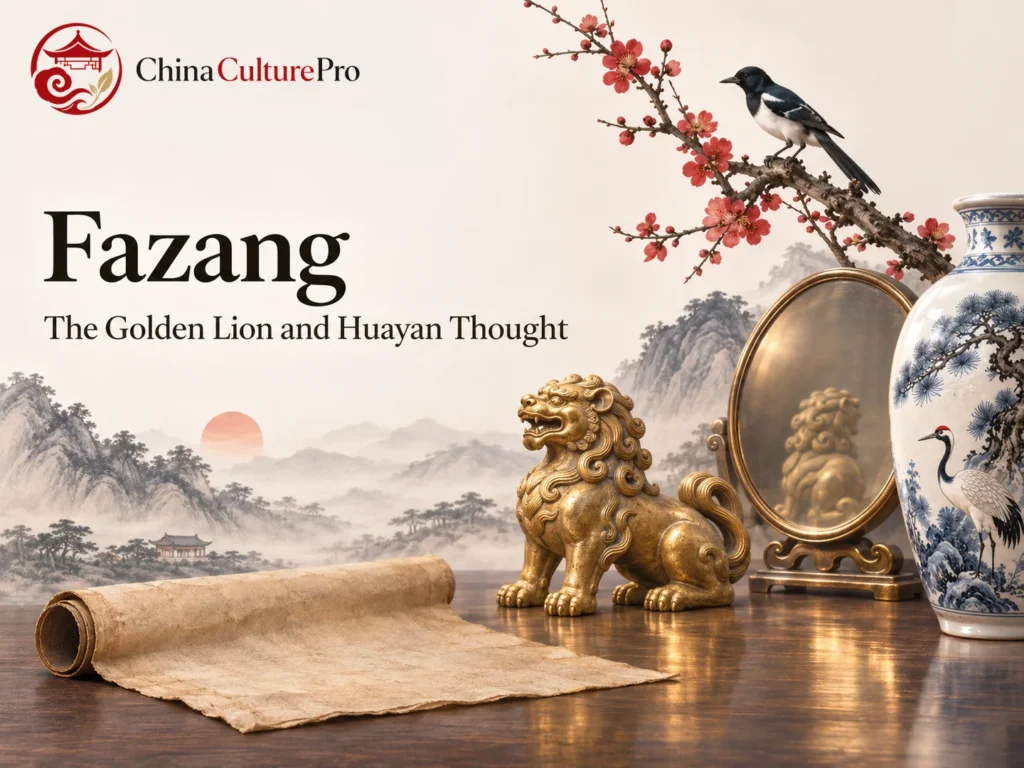

Quick Answer: Who Was Fazang?
Fazang (法藏, Fǎzàng, 643–712) was a Buddhist scholar whose work shaped Huayan Buddhism (华严宗, Huáyán Zōng). He commented on the Flower Garland Sutra, received imperial patronage and is remembered as the third patriarch of the Chinese Huayan tradition.[1]
- The golden lion: Its shape depends on the gold and the work of a craftsperson.[3]
- The mirrors: Repeated reflections help illustrate how phenomena can enter into one another’s appearance.[2][4]
- The sources: A short treatise survives. A later chronicle gives the court setting.[3]
The two examples help explain different aspects of the relationships Fazang examined in his writings.

Fazang (法藏, Fǎzàng) used a familiar object to approach a difficult question. A gold lion has a mane and claws, a shape, a material and a history of being made. Each description captures something different about the same figure. The analogy offers a way into his work on Huayan Buddhism (华严宗, Huáyán Zōng).[1][3]
A Scholar at the Tang Court
Fazang was born in Chang’an to a family of Sogdian ancestry. He studied with the Huayan teacher Zhiyan and extended his teaching through commentaries, including work on the Avatamsaka, or Flower Garland Sutra. Patronage from Wu Zetian helped give his teaching a place at the imperial court. The title of third patriarch describes the position Huayan lineage histories assign him.[1][2]
What the Golden Lion Illustrates
The Treatise on the Golden Lion (金狮子章, Jīn Shīzi Zhāng) begins with the figure’s dependence on conditions. Gold can take the shape of a lion through skilled work. Its mane and paws are distinct as forms, but the same material is present throughout. The statue supplies an example of how a thing arises through conditions and can be understood through the relation of its parts to the whole.[3]
A later Buddhist chronicle places the demonstration in Wu Zetian’s palace. That story provides a traditional setting for the analogy. The treatise provides direct evidence of the argument the image was used to convey.[3]
What the Mirrors Add
Another account says that Fazang arranged mirrors around a Buddha image. Each mirror reflected the image and other mirrors. Looking into one reflection could reveal several more. The arrangement illustrates a Huayan idea called interpenetration, in which things retain their differences and each can reflect or include aspects of the others.[2][4]
The two analogies work at different scales. The lion draws attention to how material, form and parts make one figure possible. The mirrors show how the same image can recur inside other reflections.[2]
FAQs About Fazang
Was Fazang the first Huayan patriarch?
The traditional lineage calls him the third patriarch. Zhiyan, his teacher, is counted as the second.
Did the gold lion symbolize wealth?
Its value in the treatise comes from how a single material can take a form with many parts. The lion gives Fazang an example for discussing dependence and form.
Does the mirror story describe an actual surviving room?
The story preserves a traditional teaching demonstration. It describes how reflection can make a difficult relationship visible.
Fuentes
[1] Stanford Encyclopedia of Philosophy. Huayan Buddhism
[2] Internet Encyclopedia of Philosophy. Fazang (Fa-tsang)
[3] Religions. Treatise of the Golden Lion: An Exploration of the Doctrine of the Infinite Dependent Arising of Dharmadhātu
[4] Harrassowitz Verlag. Introduction to the Mirror Hall Study