


Quick Answer: What Is Faxiang Buddhism?
Faxiang Buddhism (法相宗, Fǎxiàng Zōng) is a Chinese tradition of Yogācāra associated with the Tang translator Xuanzang and his disciple Kuiji. The name refers to the characteristics of phenomena. Weishi (唯识, wéishí), or consciousness-only, is another name associated with the tradition.[1][2]
- Text: Xuanzang’s Cheng Weishi Lun (成唯识论, Chéng Wéishí Lùn) draws on Indian explanations of a short work by Vasubandhu.[1]
- Teaching: Eight kinds of consciousness explain different aspects of experience and habit.[3]
- Practice: The analysis serves a Buddhist aim of transforming patterns of grasping.[4]
The phrase consciousness-only raises philosophical questions about how objects appear to us. Buddhist texts and their interpreters do not all answer those questions in the same way.[3]
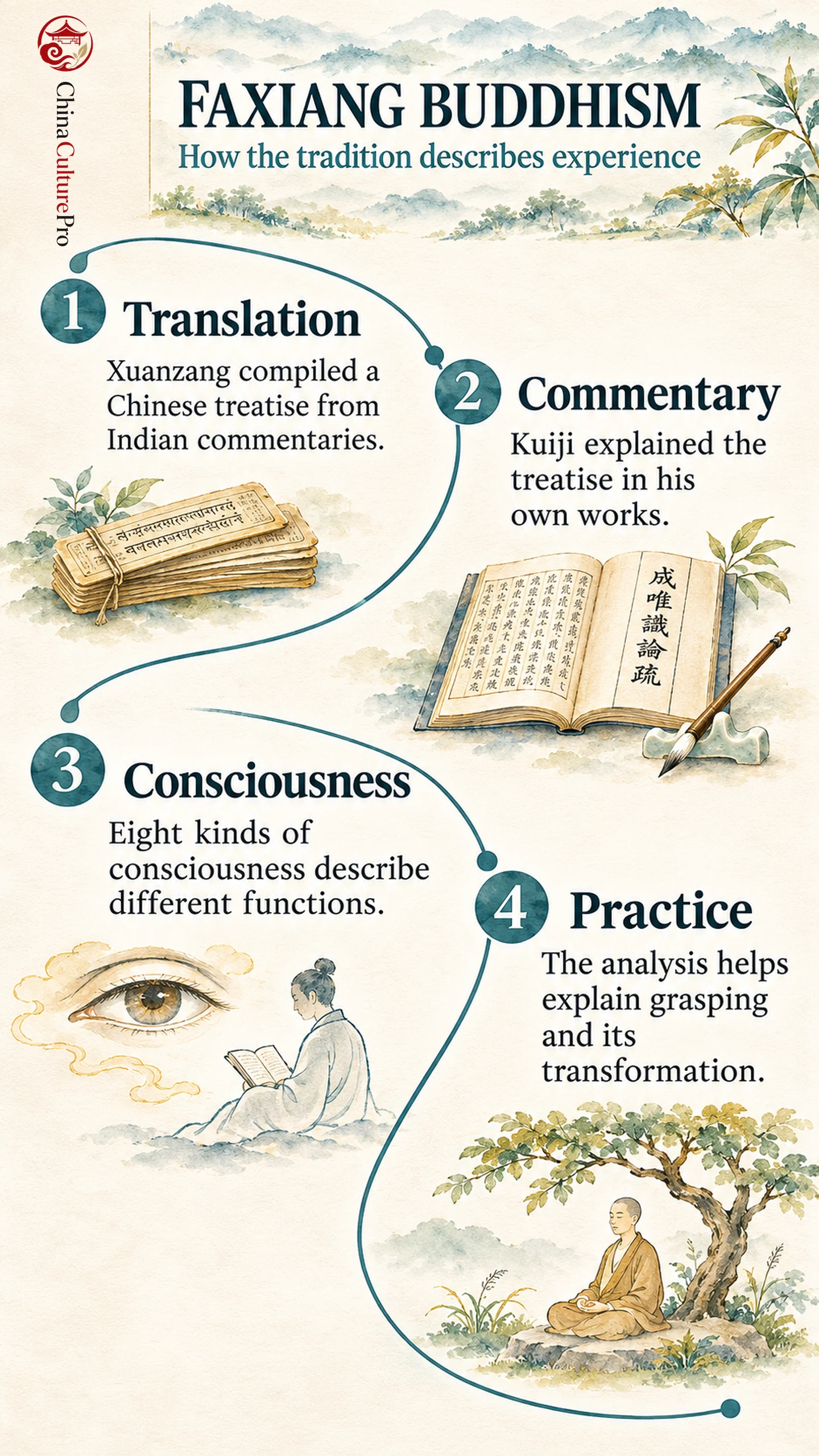
Faxiang Buddhism (法相宗, Fǎxiàng Zōng) grew through translation and commentary. A Chinese treatise brought Indian discussions into a form that Tang scholars could study together. The name Weishi (唯识, wéishí) points to the tradition’s concern with how perception and experience arise.
Xuanzang’s Treatise and Kuiji’s Commentaries
The Cheng Weishi Lun (成唯识论, Chéng Wéishí Lùn), often translated as the Treatise on the Demonstration of Consciousness-Only, draws on commentaries to Vasubandhu’s Thirty Verses. Xuanzang brought these discussions into a Chinese compendium. Kuiji subsequently wrote explanations of the treatise and works that organized the tradition’s teachings. The history involves both the translation of Indian material and the work of Chinese scholars who explained and extended it.[1][2]
What the Eight Consciousnesses Describe
Six kinds correspond to the five senses and the ordinary mental awareness that works with them. The seventh is associated with the persistent grasping of a self. The eighth, called store consciousness (阿赖耶识, ālàiyē shí), accounts for the continuity of dispositions. Yogācāra texts describe these dispositions as seeds that can give rise to later experiences when the conditions for them arise.[3]
For example, hearing a remark involves hearing and interpreting words. A familiar impulse to defend oneself illustrates how grasping can shape the experience. The Buddhist analysis connects such patterns to a wider aim of changing the basis of habitual reactions and attachments.[3][4]
What a Lineage Portrait Shows
A painting from Saidaiji Temple in Nara depicts Xuanzang holding a scripture bound in an Indian format. The portrait belongs to a setting where Hossō, the Japanese tradition related to Faxiang, honors him as a patriarch. The manuscript in his hands points to the textual transmission his lineage remembers.[5]
Xuanzang’s legacy gives readers one starting point for comparing Chinese Buddhist schools. Huayan built much of its teaching around the Flower Garland Sutra, while Sanlun took its name from a set of three treatises. Each lineage draws on a different set of texts and questions.
FAQs About Faxiang Buddhism
Are Faxiang and Yogācāra the same?
Faxiang refers to a particular East Asian lineage of the wider Yogācāra tradition, associated in China with Xuanzang and Kuiji.
Is store consciousness an eternal self?
It describes the continuity of conditioned tendencies. Yogācāra authors analyze the tendency to mistake that continuity for a self.
What is the main Faxiang text?
Xuanzang’s Cheng Weishi Lun is a central text. Kuiji’s commentaries help explain its arguments and place in the tradition.
Fuentes
[1] University of California eScholarship. Robert Sharf, Is Yogācāra Phenomenology? Some Evidence from the Cheng Weishi Lun
[2] Internet Encyclopedia of Philosophy. Xuanzang (Hsuan-tsang)
[3] Stanford Encyclopedia of Philosophy. Yogācāra
[4] Stanford Encyclopedia of Philosophy. Yogācāra, notes
[5] Nara National Museum. Portrait of the Priest Xuanzang