
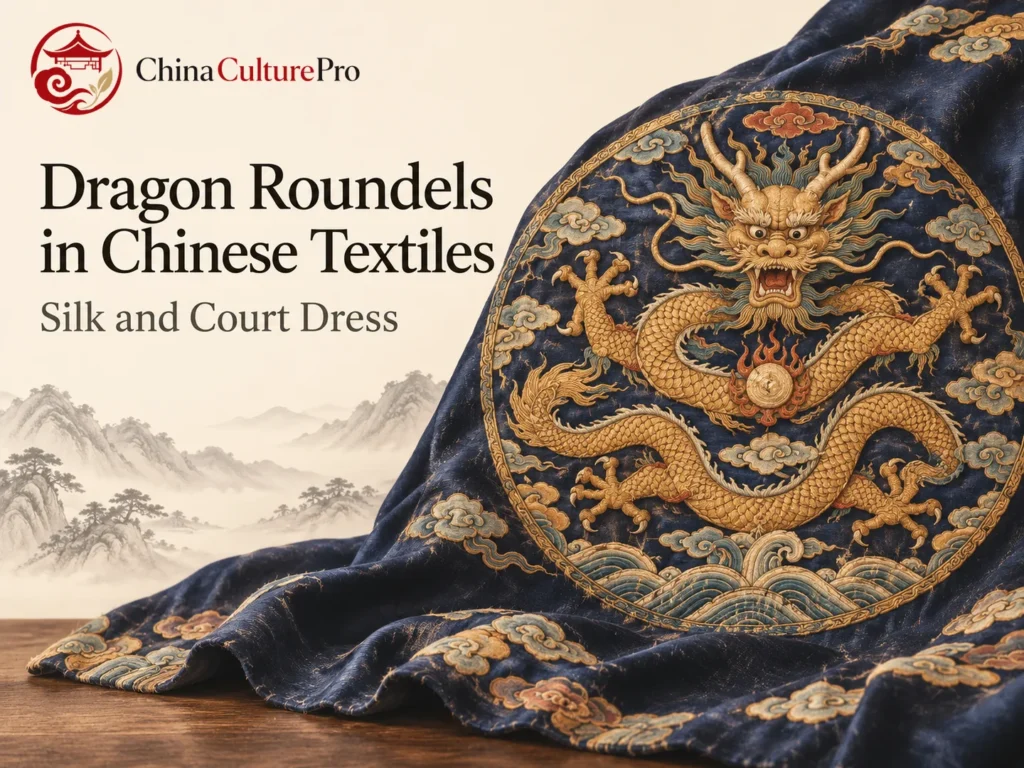

Quick Answer: What Are Dragon Roundels?
A dragon roundel is a circular or lobed textile design that encloses a dragon. Some were woven into repeating lengths of silk. Others formed prominent medallions at places such as the chest, back and shoulders of a garment.[1][2][3]
- Outline. Find the perimeter of the design around the dragon.
- Technique. A roundel may be woven into the silk or embroidered over a woven ground.[1][2][3]
- Placement. In Qing court dress, the arrangement and the dragons’ poses can help identify a garment type.[3][4]
For a fragment, record the shape and technique first. Its original position may require a matching piece or a catalogue record.

On Yuan silk, a scalloped outline can belong to a repeating pattern. On a Qing prince’s garment, a roundel could mark a shoulder. The fabric around the dragon tells you which kind of design you are looking at.
Woven Roundels in Yuan and Ming Silk
A Yuan silk fragment in the Cleveland Museum of Art shows dragons and phoenixes inside lobed outlines on a field of tiny hexagons. A curled dragon reaches toward a pearl. The lobes repeat across the cloth, where some designs are cut by the fragment’s edges. The museum associates the lobed framing with eastern Iranian craftsmen who had relocated to northern China.[1]
A sixteenth-century Ming medallion in the Metropolitan Museum of Art uses kesi (缂丝, kèsī), a tapestry weave, with silk and metallic thread. The dragon belongs to a dense circular design about 38 cm across. Ming records cited by the museum describe dragon medallions on robes worn by members of the imperial family.[2]
Four Roundels on Qing Ceremonial Dress
An early eighteenth-century Qing set at the Met includes four roundels for a prince’s formal ceremonial garment. The chest and back each show a frontal dragon (正龙, zhènglóng). Each shoulder shows a dragon in motion (行龙, xínglóng), with its head in profile. On the corresponding emperor’s garment, the museum describes four frontal dragons.[3]
These medallions were worked in silk and metallic embroidery on navy silk satin. Among the clouds around the dragon are seven Buddhist auspicious emblems. They form a separate set of signs from the Twelve Imperial Symbols.[3][6]
Eight Roundels on a Qing Festival Overcoat
An eighteenth-century woman’s festival overcoat (吉服褂, jífúguà) at the Met was worn above a festival robe. It carries eight dragon roundels embroidered on satin. The museum dates it to the early part of the century by comparing it with excavated clothing.[4]
Under standards established around the middle of the eighteenth century, coats with eight dragon roundels were reserved for the empress dowager, the empress, imperial concubines of the first three ranks and the crown prince’s consort. Within this garment type, the same count could indicate any of those court positions.[4]
What to Look for on a Complete Garment
Start with the opening, sleeves and edges, then trace each dragon’s relation to the shoulders or hem. Uncut yardage in the Art Institute of Chicago shows where roundels would sit once an empress’s court surcoat was made up. Four frontal dragons surround the neck and shoulders. Four profile dragons would sit at knee level, with two at the front and two at the back. Lishui water-and-mountain borders frame the hem and cuffs on this example.[6]
Finally, check for an overlap. On a Qing court robe at the Met, eight dragons are visible when worn, while a ninth sits beneath the front overlap. A photograph of the robe fastened can therefore leave one dragon out of view.[5]
FAQs About Dragon Roundels
Does a dragon roundel identify an emperor’s garment?
A roundel can narrow the possibilities. Look for the type of garment, date, placement and any surviving companion roundels. Princes and high-ranking women also wore clothes decorated with dragon roundels.[3][4]
Are eight dragon roundels the same as eight visible dragons?
An eight-roundel overcoat has eight discrete medallions. The count of visible dragons on a robe concerns what its wearer displays when it is fastened. One Qing robe has eight visible dragons and a ninth below the overlap.[4][5]
Fuentes
[1] Cleveland Museum of Art. Textile with Phoenixes and Dragons, accession 1995.73
[2] The Metropolitan Museum of Art. Dragon Medallion, object 36.65.33
[3] The Metropolitan Museum of Art. Dragon Roundel from a Ceremonial Garment, object 62.97.37
[4] The Metropolitan Museum of Art. Festival Overcoat, object 43.137
[5] The Metropolitan Museum of Art. Court Robe, object 30.75.107
[6] Art Institute of Chicago. Clothed to Rule the Universe: Ming and Qing Dynasty Textiles, Museum Studies 26(2), cat. 9