


Quick Answer: What Does Dong Shi Xiao Pin Mean?
Dong Shi Xiao Pin (东施效颦, Dōng Shī xiào pín) means to imitate someone blindly and get the opposite of the desired effect. The story comes from the Zhuangzi (庄子, Zhuāngzǐ), where a woman copies the frown of Xi Shi (西施, Xī Shī) without understanding why it looked appealing on her.[1][2]
- Literal image: Dong Shi imitates Xi Shi’s frown.[1]
- Source detail: The Zhuangzi names Xi Shi and leaves the imitator unnamed.[1][2]
- Modern use: Criticize a copy that borrows an outward form and misses what made it work.[1]
The phrase judges the imitation and usually carries a critical tone.
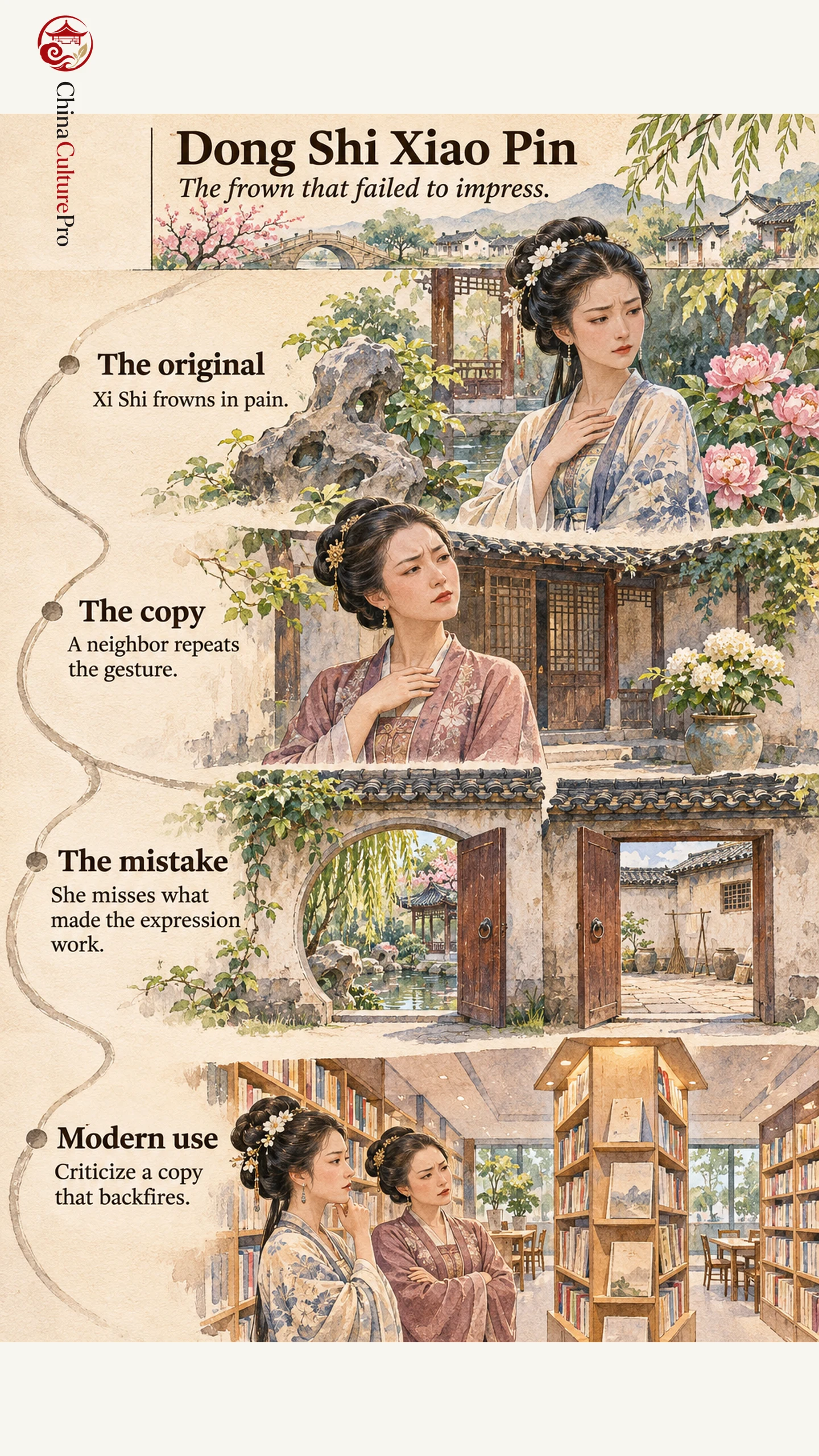
One woman holds a hand to her chest and frowns in pain. A neighbor sees the expression, copies it and expects the same response. Her neighbors’ reaction exposes what she missed about the original gesture.[1][2]
The Two Women in the Zhuangzi
In The Revolution of Heaven, a chapter of the Zhuangzi, Xi Shi experiences pain and frowns. A woman from the same village sees the expression and thinks it beautiful. She goes home and reproduces it. Her neighbors close their doors or hurry away when they see her.[2]
The text describes the neighbor by appearance and does not call her Dong Shi. Later versions give her that name, which pairs “east” with the “west” in Xi Shi. In the fixed expression, xiào means to imitate and pín means to frown.[1][2]
Why Copying the Frown Backfires
The story asks what the imitator understood. She observed an expression and liked its effect. The passage says she did not understand why the frown seemed beautiful in the first place. She could copy the movement, but the circumstances and the person were different.[2]
In the wider discussion, the parable illustrates the problem of applying practices from one time in another without adjusting them. The issue extends beyond appearance. A practice can work in one setting and fail when it is copied unchanged into another.[1][2]
How to Use Dong Shi Xiao Pin Today
Imagine a bookshop copying the decor of a large chain so closely that its small reading area becomes unusable. A customer might say 这家书店照搬别人的布置,结果东施效颦,连看书的地方都没了。 The criticism falls on a layout copied without considering the shop’s needs.[1]
“A clumsy imitation” gives a short English gloss. “Copy the surface and miss the point” can fit when the speaker cares about why the model worked. In a retelling of the parable, preserve the frown and identify whose expression is being copied.[1][2]
How It Differs From Han Dan Xue Bu
Han Dan Xue Bu (邯郸学步, Hándān xué bù) also warns about unthinking imitation. Its image focuses on someone who fails to learn another way of walking and loses their own. Dong Shi Xiao Pin focuses on how the copied gesture or style produces the wrong effect.[1]
FAQs About Dong Shi Xiao Pin
Is Dong Shi named in the original story?
No. The Zhuangzi calls her a woman of the village. Dong Shi is the name attached to the character in the later idiom.[1][2]
Does the idiom only refer to appearance?
The parable is about an expression and appearance. Modern use can criticize imitation in design, performance or other work.[1]
What is a natural English translation?
“An imitation that backfires” is a natural gloss when the surrounding text makes clear what was copied.[1]
Fuentes
[1] Taiwan Ministry of Education. Idiom dictionary entry for 東施效顰
[2] Chinese Text Project. Zhuangzi, The Revolution of Heaven