

Quick Answer: How Did Chinese Silk Develop?
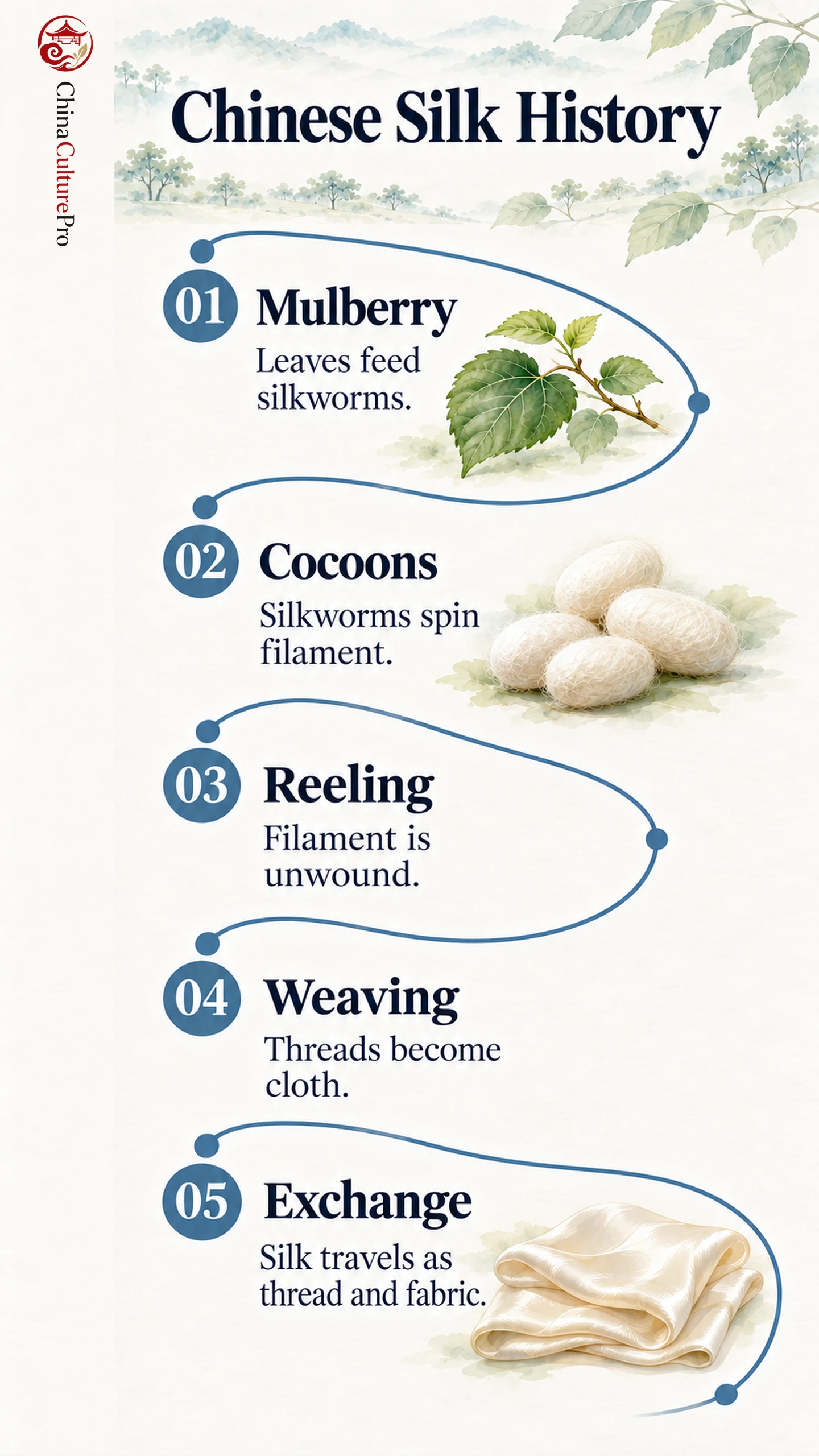
Chinese silk developed through linked skills. People grew mulberry trees, raised silkworms, reeled filament and wove cloth. Silk then circulated as thread, fabric and finished goods, while the skills of making it spread in their own ways.
- Early traces: Researchers have reported silk proteins in soil from Neolithic burials. A chemical trace is different from a surviving woven garment.
- Making silk: Sericulture (蚕桑, cánsāng) links silkworm care with the mulberry cultivation that supports it.
- Weaving: Han tombs preserve both fine garments and miniature models of pattern looms.
- Trade: Silk traveled through exchange networks, sometimes as a small component of an object made elsewhere.
A cloth or thread can be evidence of exchange even when it tells us little about where its maker learned the craft.
A gauze gown from a tomb near Changsha and a blue silk cord on a felt garment excavated in Iran show two very different uses of the same fiber. One preserves the work of making a light garment. The other shows how a small piece of silk could enter a textile assembled from different materials. Together they place silk among Chinese technologies that changed as their products circulated. [2][3][5][6]
Early Silk Evidence and What It Can Show
Silk and other fibers decay in conditions that can preserve pottery, bone and stone. At Jiahu, a Neolithic site in present-day Henan, researchers analyzed soil samples from burials. They reported peptides consistent with silk fibroin, the main structural protein in silk, from tomb contexts dated to about 8,500 years ago. The study provides evidence at the level of residues. A surviving cloth would answer additional questions about weave, finish and use. [1]
The same researchers point to tools such as bone needles as clues to textile work. A needle can serve different materials, and a protein trace does not describe a loom or a system of raising silkworms. To understand those stages, later evidence from textiles, tools and craft traditions is needed. [1][2][4]
From Mulberry Leaf to Woven Cloth
Sericulture includes tending mulberry trees and raising silkworms that feed on the leaves. Later work turns the cocoons into textile material. In reeling, silk filament is unwound from the cocoon. Thread can then be prepared for weaving. In weaving, lengthwise warp threads are held under tension while crosswise weft threads pass through them. The arrangement of those threads can affect the texture and design of the fabric. These stages depend on different tools and knowledge. [2]
UNESCO’s description of Chinese silk craftsmanship traces the chain from mulberry cultivation through reeling, making thread, design and weaving. It also documents how families and apprentices transmit the skills. Silk-making links cultivation with work done in homes and workshops. [2]
Han Gowns and Looms: Two Kinds of Evidence
Two plain unlined gauze gowns were excavated from Tomb 1 at Mawangdui (马王堆, Mǎwángduī). A Hunan Museum researcher reports that the straight-front gown weighs 49 grams and the curving-front gown 48 grams. The weights are observations about specific pieces of silk clothing from the Han dynasty. Both use the same kind of gauze, but their collars and cuffs are made from different materials. Even two similar garments record separate choices about construction. [3]
At Laoguanshan (老官山, Lǎoguānshān) in Chengdu, archaeologists recovered four wood-and-bamboo models of pattern looms. China National Silk Museum describes the models alongside thread remains and small figures that may depict workshop workers. The equipment is associated with patterned jin (锦, jǐn) silks. The miniature looms provide a different view from the gowns. They show what weaving equipment could look like and how a workshop could be represented in a burial. As with finds from imperial tombs, the burial context helps explain what objects were grouped together. [4]
How Silk Traveled as Thread, Cloth and Skill
A Parthian garment fragment in the Metropolitan Museum of Art, dated to about the first half of the first century BCE, was excavated in northern Iran. It is made of felt with a cotton lining and uses a blue silk cord at the neckline. The Met proposes that the silk cord likely reached Iran from China through routes now known as the Silk Roads. A cord on a garment shows how even a small amount of the fiber could be incorporated into clothing in a new setting. [5][6]
Accounts about the spread of silk production focus on other things. A painted panel associated with Khotan tells a story of a princess hiding silkworm eggs and mulberry seeds in her headdress. The sixth-century author Procopius tells of monks bringing silkworm eggs to the Byzantine Empire. Each account links the movement of living stock with knowledge of how to raise it. The first is a story painted on wood and the second a written narrative. Both show how people explained the acquisition of a valuable skill. [7][8]
Why Silk Is a Craft Tradition as Well as a Trade Good
The craft requires people to pass on knowledge of several kinds of work. UNESCO records that families and apprentices helped transmit Chinese silk-making skills. In some villages, waste from silkworm raising fed pond fish, while mud from the ponds helped fertilize mulberry trees. Such a system makes production part of local agriculture. A product moving through a merchant network can leave evidence far from the landscape and community that made it. [2][5][6]
FAQs About Chinese Silk History
Where did silk production begin?
China preserves very early evidence of silk. Neolithic protein traces and later textiles and equipment provide different kinds of evidence for the history of production.
What is the difference between sericulture and silk weaving?
Sericulture concerns the raising of silkworms and the mulberry cultivation that supports it. Weaving interlaces prepared threads into cloth. Reeling and thread preparation connect the two.
Did silk always travel with the knowledge of how to make it?
Silk thread and cloth could circulate separately from silkworm stock and production skills. An imported textile can document exchange without establishing that its new owner could make silk.
Fuentes
[1] Yuxuan Gong and colleagues. Biomolecular Evidence of Silk from 8,500 Years Ago
[2] UNESCO Intangible Cultural Heritage. Sericulture and Silk Craftsmanship of China
[3] Hunan Provincial Department of Culture and Tourism. Curving-Front Plain Unlined Gauze Gown at Hunan Museum
[4] China National Silk Museum. Laoguanshan Pattern Loom
[5] Metropolitan Museum of Art. Textile Fragment
[6] UNESCO World Heritage Centre. Silk Roads: The Routes Network of Chang’an–Tianshan Corridor
[7] British Museum. Silk Princess Painting
[8] Procopius, Fordham University Internet Medieval Sourcebook. The Roman Silk Industry