
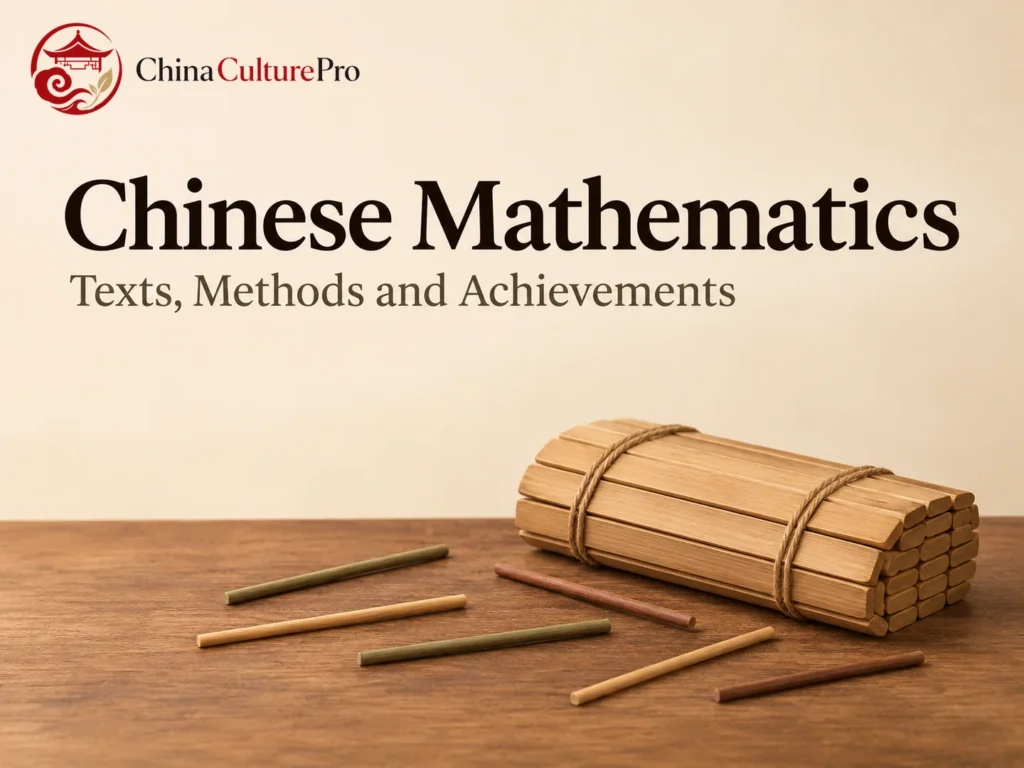

Quick Answer: What Characterized Historical Chinese Mathematics?
Historical Chinese mathematics used written problems, physical counters and repeatable methods to calculate quantities. Different sources preserve work on land measurement, fractions, equations, geometry and calendars.
- Early texts: Bamboo strips from an early Han tomb preserve a collection of calculations.
- Number tools: Counting rods (算筹, suànchóu) represent numbers through their arrangement and place.
- Equations: A classical text describes table-based methods for finding several unknown quantities and working with negative values.
- Geometry: Commentaries and later histories preserve methods and approximations for the circle.
A bamboo manuscript, a commentary and a report about a lost book give different kinds of evidence.

An empty space on a counting board can represent a zero place. A short problem about grain can lead to several unknowns. A later historical record can preserve an approximation even when the book that explained it has been lost. These are three ways into the history of mathematics and technologies of calculation in China. [1][2][4][7]
Early Reckoning on Bamboo Strips
Writings on Reckoning (筭数书, Suànshù Shū) was found in a tomb at Zhangjiashan in Hubei. Christopher Cullen describes about 190 bamboo strips carrying roughly seven thousand characters. Documentary evidence suggests that the tomb was closed in 186 BCE, early in the Western Han dynasty. If the dating is correct, the manuscript was already in the tomb by then. Individual procedures may have circulated earlier. [1]
The collection is anonymous. Some sections carry surnames, but those could refer to scribes or contributors. The physical arrangement of surviving strips and the contents of the text are both evidence. A modern edition must account for what survives on the objects before a reader can follow the mathematics. [1]
Counting Rods and Decimal Place Value
On a calculating surface, a group of rods can stand for units, tens or hundreds depending on where it lies. Adjacent places use alternating forms to reduce confusion, with the units and hundreds using one orientation and the tens using the other. For example, two groups with the same number of strokes could be distinguished by position and by the direction of the rods. An empty position could mark a zero place. [2][3]
In a number such as 304, the hundreds and units positions carry different values, while the tens position stays empty. This is a place-value idea even though the operator has left a space instead of writing a zero symbol. Later, a Chinese abacus held its counters on rods within a frame. A calculating surface and a bead frame make place values visible in different ways. [2][3][9]
How the Nine Chapters Organized Problems
The Nine Chapters on the Mathematical Art (九章算术, Jiǔzhāng Suànshù) presents problems and procedures for tasks such as measuring fields, exchanging grain, distributing quantities and working with right triangles. The problems show how rules for areas and fractions could apply to practical quantities. They also give clues about the questions that mattered in administration, trade and engineering. [4][5]
The chapter called fangcheng (方程, fāngchéng) arranges quantities in tables and uses operations to eliminate unknowns. Imagine a modern example in which one basket of each kind weighs seven units, and two baskets of the first kind plus one of the second weigh eleven. Subtracting the first total from the second leaves one basket of the first kind weighing four units. Putting four back into the first total leaves three for the other basket. This example uses modern wording to illustrate the elimination idea. The original text lays out its coefficients in columns and also includes rules involving positive and negative quantities. [3][4][5]
Liu Hui and Zu Chongzhi on the Circle
Liu Hui (刘徽, Liú Huī) wrote a commentary on the Nine Chapters conventionally dated to 263 CE. In his treatment of the circle, an inscribed polygon provides a way to approximate the area. Increasing the number of sides makes the polygon fit the circle more closely. The commentary helps readers see why repeated refinement can improve the approximation. [4][5][6]
Zu Chongzhi (祖冲之, Zǔ Chōngzhī) gave 355 divided by 113 as an approximation to pi. The later History of the Sui Dynasty also credits him with placing pi between 3.1415926 and 3.1415927. The fraction is a convenient approximation. The narrow interval is a separate statement about where the true value lies. His own mathematical book is lost, so the reported result survives more clearly than the exact sequence of steps he used to get it. [7]
Song Mathematics and Later Calculation
Qin Jiushao (秦九韶, Qín Jiǔsháo) compiled his mathematical work in 1247, during the Song dynasty. It includes methods for working with remainders from several divisions. In a small modern example, eight leaves a remainder of two when divided by three and three when divided by five. Adding fifteen preserves both remainders. Qin’s book deals with more demanding versions of that kind of problem. The subject connects mathematical structure with practices such as calendar calculation and work done in Chinese astronomy. [8]
Qin’s text also uses a small circle to represent zero. It gives a written counterpart to a place that could be left empty during work with rods. Oral instruction offers another. UNESCO describes the rhymes used in traditional abacus practice to remember how counters should move. A learner could associate a spoken rule with a position and a movement. That form of transmission is harder to see in an object case, even when the instrument itself is on display. [9]
FAQs About Chinese Mathematics
Did Chinese mathematicians use negative numbers?
Yes. The fangcheng chapter of the Nine Chapters includes rules for working with negative quantities in calculations.
Were counting rods and the Chinese abacus the same tool?
Counting rods could be laid out and moved on a surface. An abacus holds sliding beads on rods inside a frame. Both can represent decimal place values.
Did Zu Chongzhi calculate an exact value of pi?
The fraction 355/113 is a close approximation. The interval reported in a later history describes how tightly he bounded the value.
Fuentes
[1] Christopher Cullen, Needham Research Institute. The Suan Shu Shu, Writings on Reckoning
[2] University of St Andrews MacTutor. Chinese Numerals
[3] Man-Keung Siu, University of Hong Kong. An Excursion in Ancient Chinese Mathematics
[4] University of St Andrews MacTutor. Nine Chapters on the Mathematical Art
[5] Karine Chemla and Guo Shuchun. The Nine Chapters: Critical Edition and Commentary
[6] University of St Andrews MacTutor. Liu Hui
[7] University of St Andrews MacTutor. Zu Chongzhi
[8] University of St Andrews MacTutor. Qin Jiushao
[9] UNESCO Intangible Cultural Heritage. Chinese Zhusuan, Knowledge and Practices of Mathematical Calculation Through the Abacus