

Quick Answer: What Is the Chinese Abacus?
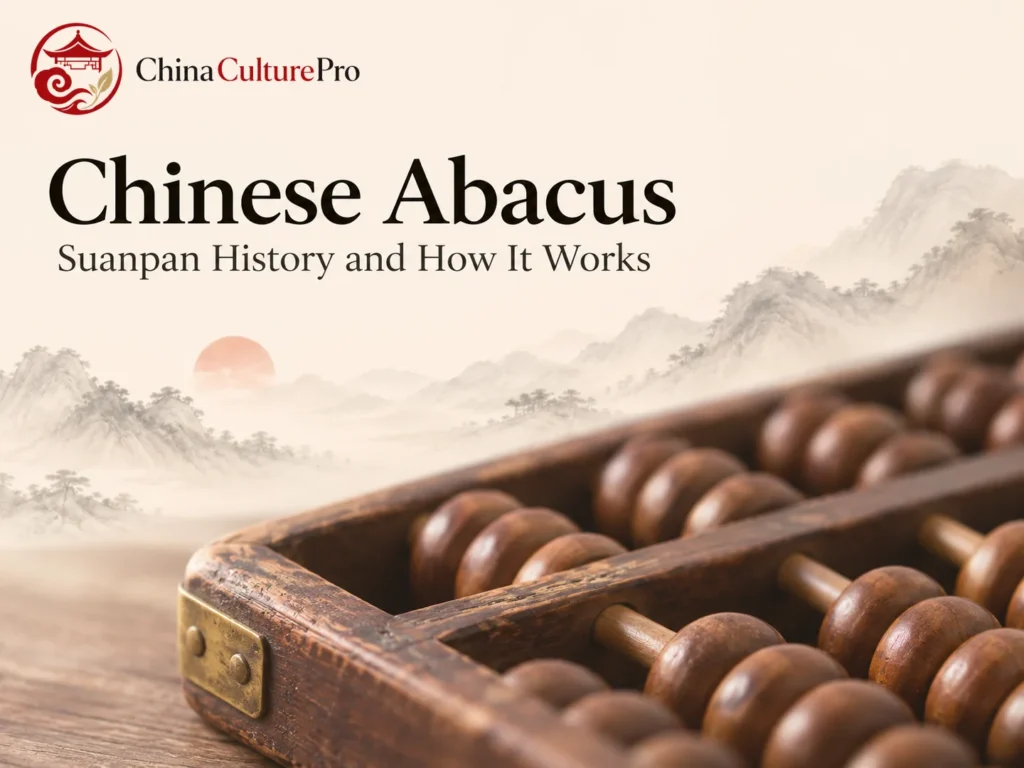
The Chinese abacus, or suanpan (算盘, suànpán), is a frame of sliding beads used for arithmetic. In the common traditional design, each rod has two beads above a bar and five below.
- Upper beads: Each counts as five at its rod’s place value when moved toward the bar.
- Lower beads: Each counts as one at that place value when moved toward the bar.
- Place value: In decimal work, a rod to the left of the units rod represents tens, and the next represents hundreds.
- Practice: Zhusuan (珠算, zhūsuàn) is the learned tradition of calculating with the abacus.
The worked example below uses whole numbers on a traditional two-and-five frame.

Read an abacus by looking at the beads resting against the crossbar. A cleared rod shows zero. A rod with one upper bead and three lower beads active shows eight at that place value. This simple arrangement links the instrument to a longer history of Chinese mathematics, where numbers could be represented and transformed by moving physical counters. [1][3][5][6]
How the Suanpan Developed
Counting rods and bead frames both made calculation visible and movable. Historian Frank Swetz connects the decimal arrangement of the Chinese abacus to the earlier computing board and rod tradition. A bead frame holds the counters in place, so each column stays aligned while the operator works. Scholars disagree on the chronology and on whether abaci from different regions influenced one another. Similar uses alone do not establish a line of descent. [1][3]
An illustration in a late Ming arithmetic manual gives a firm point in the record. Swetz discusses the 1592 General Source of Computational Methods, compiled by Cheng Dawei (程大位, Chéng Dàwèi). Waseda University Library holds an edition with a 1593 preface. The 1592 manual documents the design by the late Ming. The Waseda preface dates that edition’s prefatory material. The instrument itself may have been in use earlier. [3][4]
What the Beads and Rods Mean
A Smithsonian specimen has fifteen bamboo rods in a rosewood frame. Each rod carries two upper beads and five lower beads, separated by a crosspiece. It was used in a museum display in 1928. This particular object has no maker’s mark. Its museum record supplies evidence of its design and when it entered a display, while its earlier ownership and the age of the design are separate questions. It is one of many surviving objects that help trace Chinese inventions. [1][2]
A bead’s effect depends on the rod. One lower bead moved toward the bar on the units rod adds one. The same movement on the tens rod adds ten. One upper bead adds five on the units rod or fifty on the tens rod. For 73, the tens rod uses one upper bead and two lower beads to represent seven tens. Three lower beads on the units rod supply the three. [1][3][6]
How to Set a Whole Number on a Suanpan
Choose any rod with enough rods to its left for the number you need. A convenient choice for whole numbers is the rightmost rod. Then use this standard decimal convention. [1][3][6]
- Choose the units rod: Choose a rod for units. Treat the next rod to the left as tens and the one after it as hundreds.
- Clear the rods: Move all beads away from the crossbar so each rod shows zero.
- Set the digits: On each rod, move one upper bead toward the bar if its digit is five or more. Then move enough lower beads to make up the rest.
- Check the place values: Read the active beads from the highest place to the units rod. Leave any rod for a zero digit clear.
To set 406, move four lower beads up on the hundreds rod. Leave the tens rod clear. On the units rod, move one upper bead down and one lower bead up. That gives four hundreds, zero tens and six units. Moving the upper and lower beads toward the same bar makes their different values easy to combine. [1][3][6]
A Worked Addition: 38 Plus 7
Set 38 with three lower beads on the tens rod and one upper plus three lower beads on the units rod. Adding seven to eight crosses a ten. One way to make that move is to treat seven as ten minus three. Move a fourth lower bead toward the bar on the tens rod and move the three active lower beads away from the bar on the units rod. You now have four tens and one active upper bead worth five units, or 45. [1][3][5][6]
The same carry can be read as filling the distance from 38 to 40 with two, then adding the remaining five. In both readings, the exchange is one group of ten units for one bead of value ten on the adjacent rod. After the carry, each rod again shows a single decimal digit. That makes the result readable using the same convention used to enter 38. [1][3][5][6]
From the Instrument to the Practice of Zhusuan
The object is only part of the practice. UNESCO records oral formulas, often taught as rhymes, that help learners remember moves for arithmetic. Experienced practitioners can use an abacus for operations beyond addition, including multiplication and division. Such techniques mattered where repeated calculations came up in business. The history of calculation therefore overlaps with merchant history and the handling of money and accounts. [3][5]
The bead layout also varies among related instruments. A common modern Japanese soroban has one upper bead and four lower beads. Smithsonian collections include older Japanese examples with other layouts. The number and placement of beads describe the frame in front of you. A catalogue may supply its date and place of use. [1][6]
FAQs About the Chinese Abacus
Do standard decimal digits use all seven beads?
Digits from zero through nine can be set with at most one upper bead and four lower beads. That convention leaves the other beads away from the bar.
What is the difference between a suanpan and a soroban?
A traditional Chinese suanpan commonly has two upper and five lower beads per rod. A common modern Japanese soroban has one upper and four lower beads. Historical specimens can vary.
Can a suanpan represent zero?
Yes. A cleared rod shows zero at that place. A clear tens rod between four hundreds and six units lets you read 406.
Fuentes
[1] Smithsonian Institution. The Chinese Abacus
[2] Smithsonian Institution. Suan-p’an, or Chinese Abacus
[3] Frank J. Swetz. Reflections on Chinese Numeration Systems: Transition to the Abacus
[4] Waseda University Library. General Source of Computational Methods: Edition With 1593 Preface
[5] UNESCO Intangible Cultural Heritage. Chinese Zhusuan, Knowledge and Practices of Mathematical Calculation Through the Abacus
[6] Smithsonian National Museum of American History. The Japanese Abacus