

Quick Answer: What Is Chinese Seal Carving?
Chinese seal carving (篆刻, zhuànkè) is the art of arranging characters in a small space and cutting a reversed design into a seal face. When transferred to paper, the impression can identify a person, indicate authority or become part of the composition of a work of art.[1]
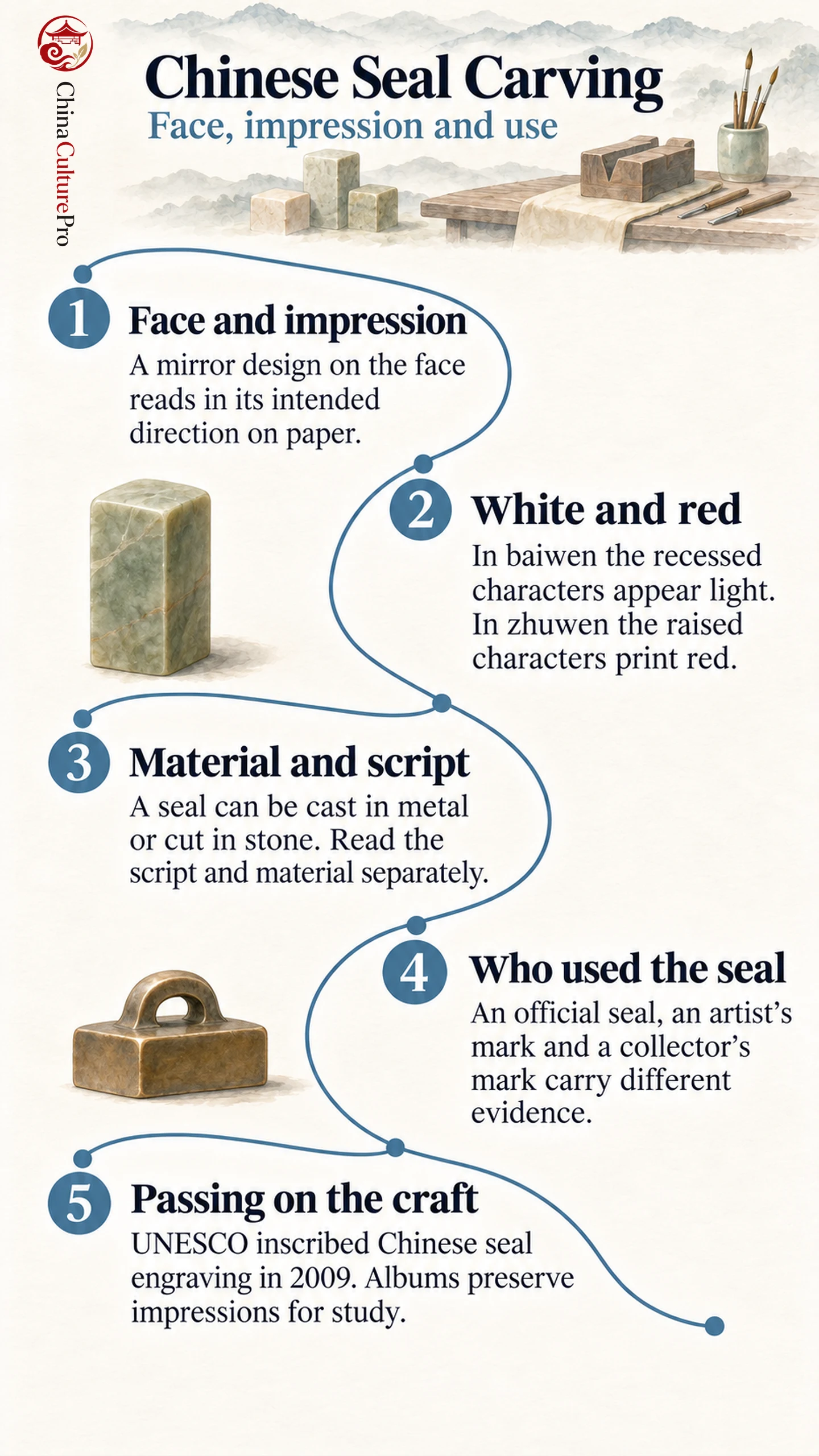
- Face and impression: The face carries the mirrored design. The impression shows it in reading orientation.
- Color: Recessed or raised characters determine which parts print red.
- Use: Official, personal and collecting seals serve different roles.
Read the script and the purpose of the mark separately.
A seal may be small enough to hold in a hand, yet its impression can change how a painting or document is read. Begin by comparing the seal face with the printed mark, then ask who used it and where it appears.
Why the Seal Face Is Reversed
The face of a seal and its impression are mirror images. A design sketched in reading orientation needs to be reversed on the block so the transferred characters face the intended direction. Compare a straight-on photograph of the face with an impression on paper. The impression reverses the design on the face when the two surfaces meet.[1]
Inside the border, the maker balances wide and narrow strokes, empty areas and the edges of each character. The letterforms draw on Chinese calligraphy and have to read at the size of the impression. The arrangement matters along with the wording.
White Characters and Red Characters
The names below describe the characters in a typical red impression. The raised areas transfer color, so the visible lettering depends on which parts of the face remain raised.[2]
| Impression type | Seal face | Result on paper |
|---|---|---|
| Baiwen (白文, báiwén) | Characters are recessed. | The raised ground prints red. The recessed characters appear light against it. |
| Zhuwen (朱文, zhūwén) | Characters stand in relief. | The raised characters print red against the light paper. |
If the background is red, follow the light strokes to read the characters. If the strokes are red, follow those strokes directly. Color and orientation are two different reading decisions.
Stone, Metal and the Choice of Script
A seal face can be cast in metal or cut in stone. In the Qin dynasty, small seal script (小篆, xiǎozhuàn) was associated with the standardization of writing. Later official and personal seals continued to vary in letterforms and layout. A cast Eastern Han seal in the Palace Museum uses Han seal script arranged in two horizontal rows.[2][3]
In the Ming period, Wen Peng (文彭, Wén Péng) was associated with the literati practice of cutting Qingtian stone (青田石, Qīngtián shí). One Ming seal attributed to him in Shanghai is ivory and bears a cursive signature on its side. The side inscription and the seal face have distinct jobs.[4]
A Qing court seal made of Tianhuang (田黄, tiánhuáng), a yellow stone associated with Shoushan in Fujian, gives another material example. Its record specifies a face measuring 3.6 cm on each side. Compare the material and surface with the recorded lettering before drawing a conclusion about its function.[5]
Official Seals, Literati Seals and Collectors’ Marks
The cast Eastern Han seal names the office of a kingdom administrator. Its title and institutional context matter to its interpretation. This connects a small object to the administration of the Han dynasty.[3]
A mark on Chinese painting can serve a different purpose. On the Home Again handscroll, the catalogue describes marks of the painter and later collector’s seals separately. The catalogue uses the positions and recorded ownership of the scroll to help interpret its marks.[6]
A person’s name or studio phrase can appear in a seal, while later viewers and owners can add their own marks. Read each impression in the context of its wording, position and other inscriptions. A similar color or outline supplies only part of that evidence.
A Living Practice of Design and Carving
In 2009 UNESCO inscribed the art of Chinese seal engraving on its Representative List of the Intangible Cultural Heritage of Humanity. The entry describes the work of transmitting design and engraving knowledge, including the role of the Xiling seal engravers’ society. The intangible cultural heritage listing concerns the art and its transmission. Albums of impressions also let students compare older compositions on paper and study how earlier makers arranged dense or open strokes.[2] That record of design complements the workshop knowledge used in Chinese traditional crafts.[1]
FAQs About Chinese Seal Carving
Why are the characters backward on a Chinese seal?
The block carries the mirrored design so that its impression can be read in the intended orientation.
What is the difference between baiwen and zhuwen?
In baiwen the characters appear light on a red ground. In zhuwen the characters themselves print red. The location of raised and recessed areas produces this difference.
Were all Chinese seals carved from stone?
Stone is one common material for carving. Surviving seals also include cast metal objects and examples made from other materials.
Does a red seal prove who painted a scroll?
A red impression can belong to an artist, a collector or another user. Attribution requires reading the particular mark with the painting and its documented history.
Fuentes
[1] UNESCO Intangible Cultural Heritage. Art of Chinese Seal Engraving
[2] HKUST Library. Big Picture in Tiny Space: From Ancient Qin-Han Seals to Modern Seal Carving
[3] The Palace Museum. Cast Copper Seal Reading Liwu Guo Xiang, Xin00026544
[4] Shanghai Museum. In the Depths of Seventy-Two Peaks
[5] The Palace Museum. Tianhuang Stone Seal Reading Qianlong Chenhan, Gu00166968
[6] The Metropolitan Museum of Art. Peach Blossom Spring: Gardens and Flowers in Chinese Painting