


Quick Answer: What Was Chinese Pidgin English?
Chinese Pidgin English was a contact language used in the China trade. It emerged around eighteenth-century Canton (广州, Guǎngzhōu) and was used in Whampoa and later in Hong Kong and other treaty ports. Its vocabulary drew heavily on English, and Cantonese influenced its sound patterns and grammar.[1][2]
- Who used it: Chinese merchants and other local intermediaries used it with European traders and their agents.[1][2][3]
- What it did: It gave speakers a shared way to communicate in settings such as trading houses and near the wharves.[1][2]
- How we know: Period phrasebooks, travel accounts and memoirs preserve examples that sometimes differ by source.[1]
The surviving writing helps reconstruct how the language worked. It captures particular speakers and situations, so one example gives a narrower view than the whole trade network.[1]
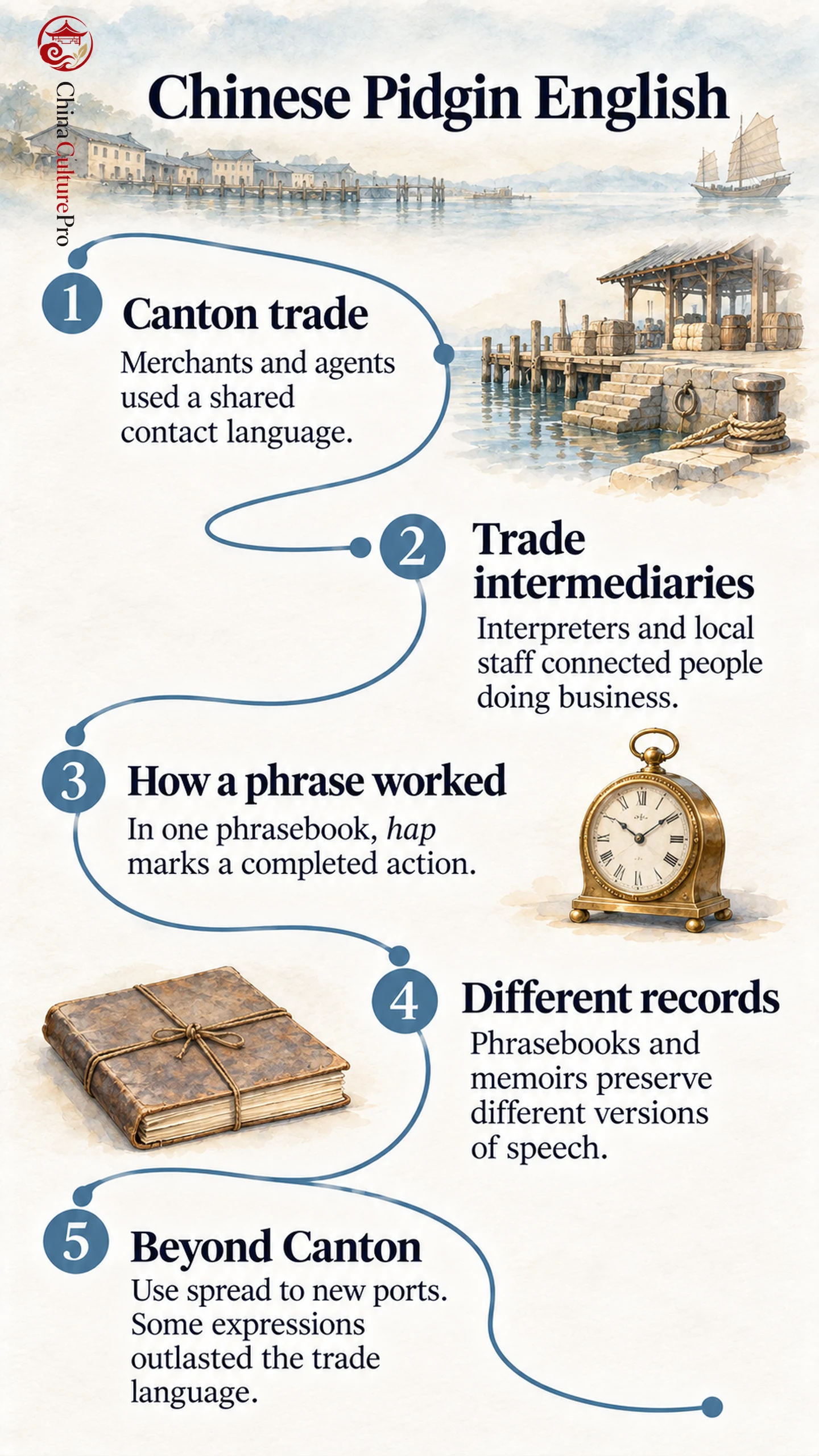
A nineteenth-century phrasebook recorded how to say that a clock had stopped. The words on the page look familiar to an English reader. Their arrangement reveals what happened when English vocabulary travelled through a trading network where speakers used more than one language.
Who Used It in the Canton Trade?
Canton’s foreign trading houses brought merchants, ship officers, clerks, servants and officials into repeated contact. Several roles were intermediaries. The licensed Chinese merchants known as hong merchants arranged business with foreign traders. The job of a “linguist,” as named in shipping documents, could include interpreting and handling paperwork and dealings with officials. A surviving 1838 cargo report for an American ship shows one part of that work.[2][3]
Researcher George Lang locates the early contact behind the pidgin among foreign trade agents and Cantonese-speaking staff whom hong merchants assigned to them. Working relationships created repeated occasions to use and adapt the same short expressions. The surviving record gives examples of those relationships without tracing a single inventor.[2][3]
What the Surviving Phrases Show
The Atlas of Pidgin and Creole Language Structures cites an 1862 phrasebook example, “That clock hap stop.” The meaning is “The clock has stopped.” In that sentence, hap marks the completed event and the verb remains stop. Another nineteenth-century source records “They wantshee too-muchee dollar for the art fishee,” a complaint about a price. The English-looking vocabulary is easy to recognise, and the clock example shows how a speaker could express completion with a separate word.[1]
The type of source affects what you can infer. Some phrasebooks represented the contact language with Chinese characters. English writers used their own ways of spelling what they heard. The survey finds differences between the surviving sources, including differences in how questions are formed. It treats humorous verse as weak evidence for ordinary speech.[1]
Where the Language Spread and What Survived
After the opening of new treaty ports from 1842, the language was also documented in trading centres such as Shanghai, Xiamen and Fuzhou. Its life followed the movement of people and the institutions that brought them together. The wider history of treaty ports and cultural exchange explains how that network changed.[1][3]
Use declined in the twentieth century as the trade settings supporting it changed. The survey notes that some expressions outlasted the pidgin in Hong Kong. The survival of a particular phrase is a different question from whether the trade language continued in regular use. The guide to Chinese loanwords in English follows the separate evidence for individual words and phrases.[1][4]
FAQs About Chinese Pidgin English
Was Cantonese important to Chinese Pidgin English?
Yes. Cantonese was its main local source of structural influence, and English contributed much of its vocabulary. The surviving sources show variation between speakers.[1][2]
Where can I read an authentic historical example?
The Atlas of Pidgin and Creole Language Structures gives examples linked to historical sources, including an 1862 phrasebook. Its notes identify the publication or collection behind each cited example.[1]
Fuentes
[1] Atlas of Pidgin and Creole Language Structures. Chinese Pidgin English Survey
[2] George Lang. A Brief Account of Chinese Pidgin English
[3] Massachusetts Historical Society. Boston Merchants and the China Trade
[4] ChinaSage. Pidgin English Language in China