
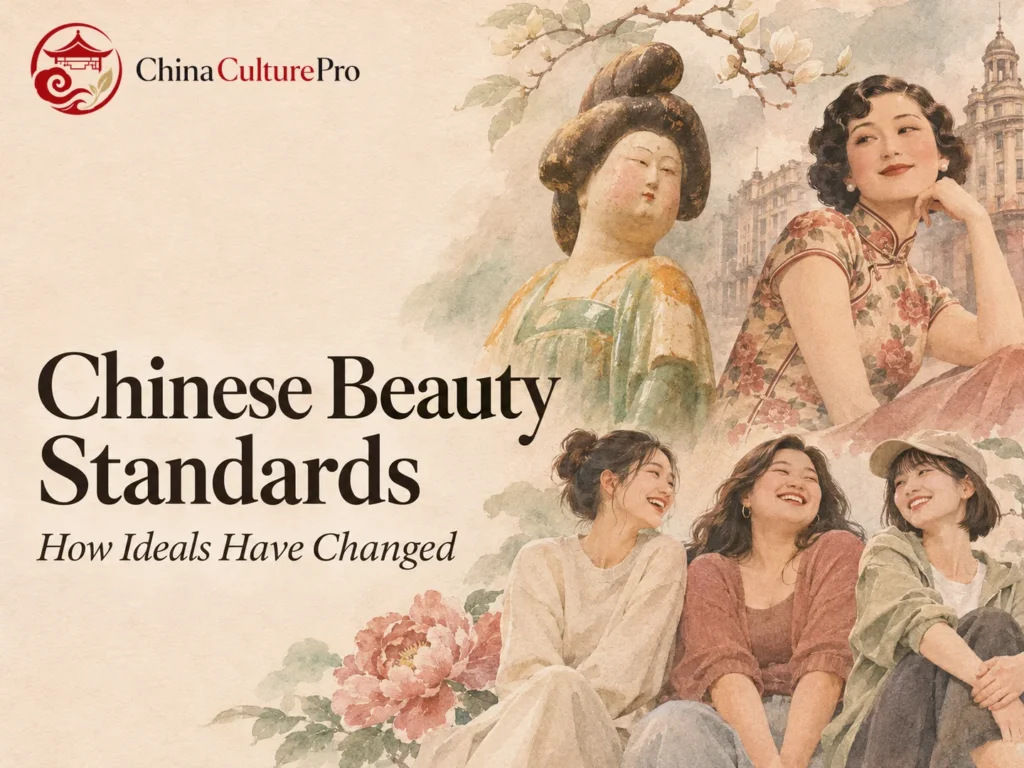

Quick Answer: How Have Chinese Beauty Standards Changed?
Chinese beauty ideals have changed with the people and media that gave them visibility. Some eighth-century Tang figures portray fuller faces and bodies at court. Early twentieth-century Shanghai advertisements picture a version of urban glamour. Today, social media can repeat a narrow look while giving users space to share other experiences. These examples trace changes in images of feminine beauty. [1][2][3][4][5]
- Tang court imagery: Some eighth-century ceramics portray fullness and elaborate styling as fashionable. [1][2]
- Shanghai print advertising: Illustrated calendars spread images of fashionable women while promoting products. [3][6]
- Social media: Studies of Xiaohongshu (小红书, Xiǎohóngshū) describe both narrow appearance ideals and attempts to broaden representation. [4][5]
Each example tells us what particular image makers made visible and who might have seen it.
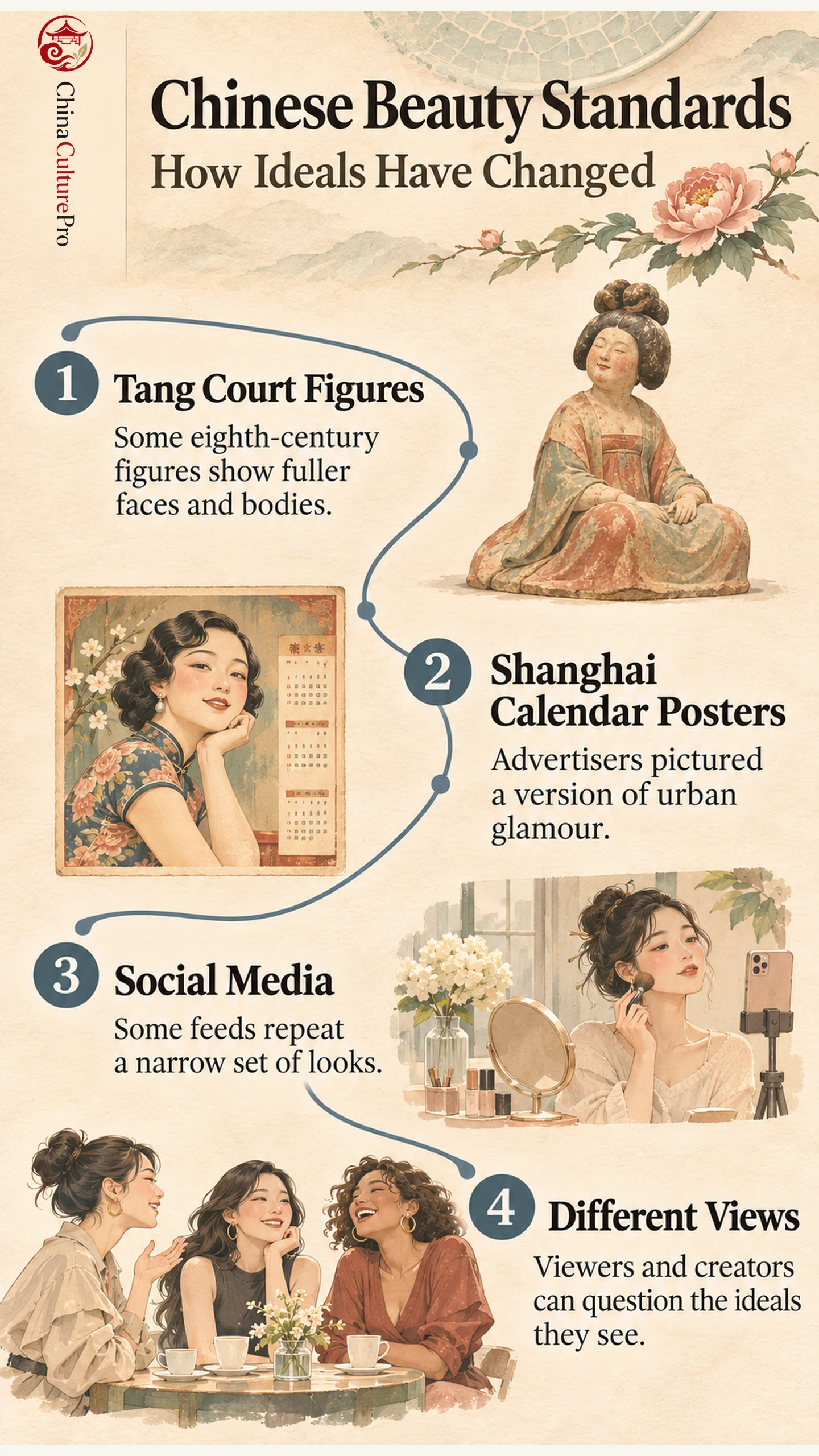
A ceramic court lady, a painted calendar model and a woman in a lifestyle post come from three settings where images serve different purposes. Looking closely at the image, the medium and whose viewpoint it preserves helps explain why there is no single beauty standard that describes all these settings. The comparison follows images of women from a courtly setting to commercial print and then to social media. [1][3][4]
Tang Court Figures and Changing Styles
An eighth-century ceramic figure at the Metropolitan Museum of Art shows a seated court lady with a rounded face and a broad silhouette. Contrasting glazes distinguish her jacket, sash and skirt. At the Kimbell Art Museum, a standing funerary figure has full cheeks, visible makeup and a high, elaborate hairstyle. In both works, pose, dress and grooming contribute to the image presented by the sculptor. The wider guide to traditional Chinese clothing explains how garments changed over time. [1][2]
A Central Academy of Fine Arts exhibition contrasts slender early Tang figurines with fuller bodies and looser clothing in later examples. That comparison shows variation within the Tang dynasty itself. A figure placed in a tomb tells us about the makers and patrons of a particular kind of object. The experience of women outside the settings represented by those figures is harder to recover from them. [1][2][7]
How Shanghai Calendar Posters Sold Urban Glamour
Shanghai calendar posters, called yuefenpai (月份牌, yuèfènpái), combined advertising, illustration and, commonly, a calendar. In the 1920s and 1930s, some put fashionable women at the center of advertisements for consumer goods. A direct gaze or a hand placed on a garment could draw attention to the styling. One study of the posters traces changes in how artists used hands and eyes to signal fashion. [3][6][8]
Many surviving examples from the 1930s feature a qipao (旗袍, qípáo). The models’ poses, illustrated clothes and polished settings presented a recognizable image of urban modernity. These prints record details of dress, such as the qipao’s silhouette or the pattern of its fabric. Those details show what advertisers and illustrators chose to put before customers. [3][6][8]
What Social Media Makes Visible Today
The circulation of images now includes platforms such as Xiaohongshu, where personal posts and shopping-oriented content can appear in the same feed. A 2026 analysis of 565 posts related to body positivity found that images of slim bodies and light skin were prominent in that sample. An ethnographic study also describes tension between participants’ attempts to question beauty norms and engagement that repeats familiar looks on the platform. These methods tell us about specific posts and users. [4][5]
Responses to those images vary. In a 2024 interview study, 24 women at universities in China discussed beauty ideals and body-positive social media. Participants generally welcomed the idea of valuing more kinds of bodies, and also described limits in the content they saw. A feed can hold both a repeated ideal and arguments about that ideal. That debate belongs in the broader picture of modern Chinese culture, where audiences can take part in producing images as well as seeing them. [4][5][9]
FAQs About Chinese Beauty Standards
Were fuller figures fashionable throughout the Tang dynasty?
Museum comparisons show variation. Some early Tang examples are slender, while fuller figures became prominent in certain eighth-century courtly and funerary depictions. [2][7]
What do Shanghai calendar posters reveal about beauty ideals?
They show how illustrators and advertisers used pose, clothing and fashionable settings to construct an image of modern urban femininity. [3][6][8]
Do social media posts represent what everyone in China finds beautiful?
A study of posts can show which images recur in its sample. Interview research can show how participants respond. Both kinds of evidence depend on who or what was studied. [4][5][9]
Fuentes
[1] The Metropolitan Museum of Art. Seated court lady
[2] Kimbell Art Museum. Court Lady
[3] University of Hawai‘i Press. Selling Happiness: Calendar Posters and Visual Culture in Early-Twentieth-Century Shanghai
[4] Southern Communication Journal. Body Positivity and Beauty Standards on Xiaohongshu
[5] Feminist Review. Escaping the spectacle? Young women’s ambivalence to gender aesthetics on Xiaohongshu
[6] Hong Kong Polytechnic University. Youth & Beauty: Calendar Poster and Qipao
[7] CAFA Art Museum. Spanning Thousands of Years
[8] Kyoto University of the Arts. On the Female Images in Shanghai’s Calendar Posters in the 1920s
[9] Frontiers in Psychology. Beauty ideals and body positivity