


Quick Answer: How Did Cantopop Develop?
Cantopop is Cantonese-language popular music, historically centered in Hong Kong. Cantonese recordings existed well before the genre’s breakthrough in the mid-1970s, when television themes and film songs reached mass audiences. In the 1980s, artists such as Anita Mui and Leslie Cheung turned concerts and screen appearances into part of pop stardom. The Four Heavenly Kings (四大天王, Sì Dà Tiānwáng) became a leading group of stars in the 1990s. [1][2][3][4]
- 1970s: Television themes and Sam Hui’s film songs brought everyday Cantonese into widely shared popular music. [1][2]
- 1980s: Hong Kong Coliseum shows made stage design, choreography and costume part of a record star’s public identity. [3][5]
- 1990s: The Four Heavenly Kings dominated much of the period’s star coverage, while singers and songs moved between Cantonese and Mandarin markets. [4][6]
Follow the records alongside the television shows, films and concerts that first carried them to listeners.
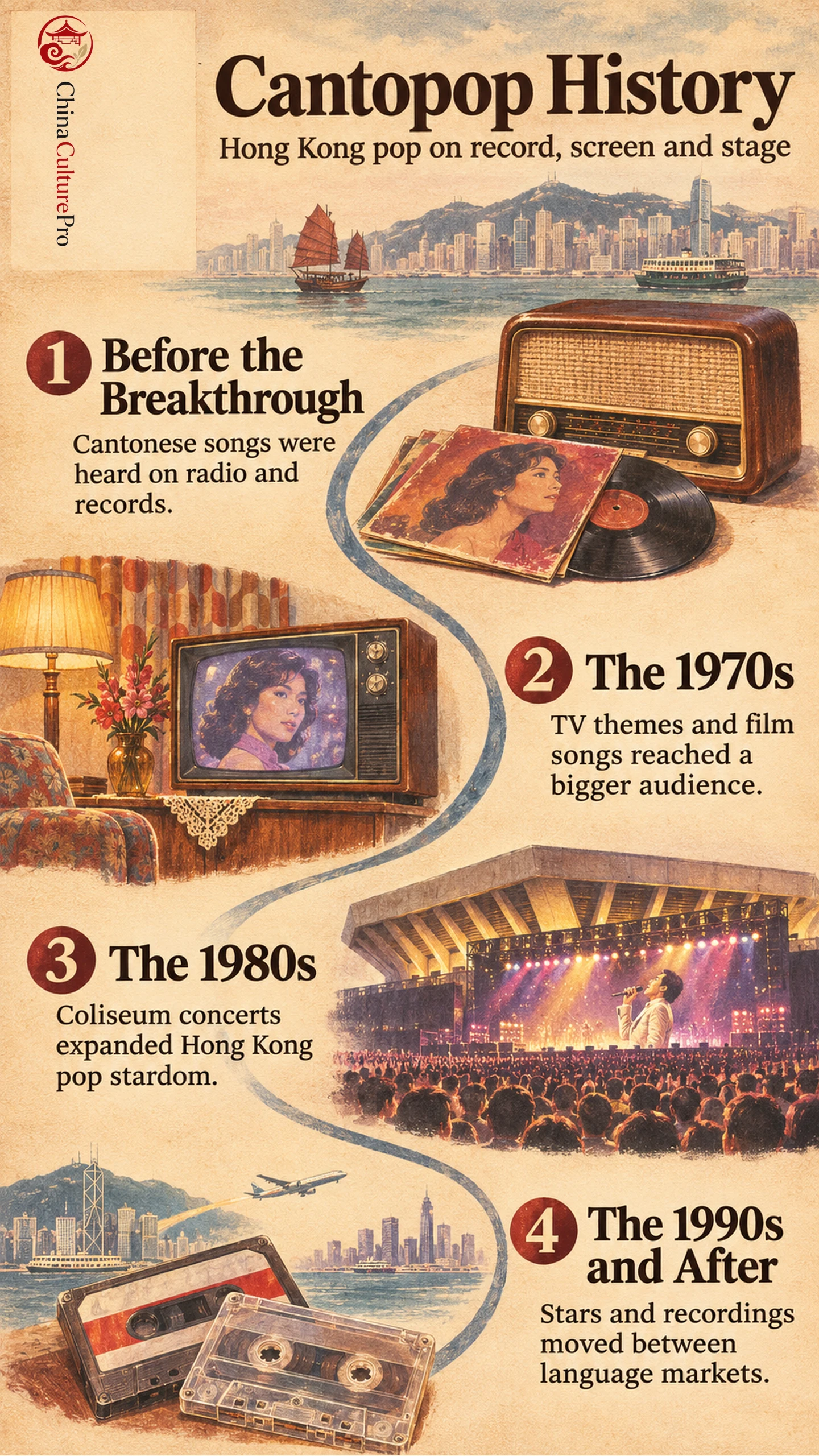
A Hong Kong television audience could hear the same theme each week and later buy it as a record. A cinema audience could encounter a Cantonese song through a comedy. Those routes mattered to Cantopop’s rise, and they explain why a history of the music also has to follow films, television schedules and concert stages. [1][2][3]
Before the Breakthrough
Hong Kong listeners already heard Cantonese songs in radio drama, advertising and other entertainment before the mid-1970s. The Hong Kong Heritage Museum’s historical exhibition included Cantonese records from the 1960s and a photograph of a teahouse performance from 1958. Yiu-Wai Chu notes that Mandarin and English pop had stronger prestige in the early period even though most residents spoke Cantonese. [1][2]
Cantonese also had a long history on stage. Cantonese opera belongs to that wider soundscape, with its own repertory and conventions. The growth of a record industry and the spread of broadcast entertainment gave Cantonese pop new settings in which to be heard. [1][2]
Why Television and Film Changed the 1970s
The Hong Kong Heritage Museum points to the television theme “The Fatal Irony” (啼笑姻緣, Tíxiào Yīnyuán) and the film song “Games Gamblers Play” (鬼馬雙星, Guǐmǎ Shuāngxīng) among the songs that gained an audience through broadcast repetition. A television theme could be associated with characters and a story for weeks. A film song could turn the voice and mood of a comedy into something listeners could take home. [1][2]
Sam Hui became closely associated with the turn toward vernacular Cantonese. His songs could use the speech of daily life to make a joke, describe social habits or comment on work. That connection between screen comedy and popular song was part of a wider exchange with Hong Kong cinema. [1][2][7]
The Coliseum and the 1980s Star System
In the 1980s, Anita Mui, Leslie Cheung and Alan Tam became major concert and recording stars. The Hong Kong Coliseum made large-scale shows a regular part of the business. Costumes, choreography and lighting gave a familiar record a different life on stage. The Heritage Museum’s exhibition on Mui used records, costumes and films to document that connection. [3][5]
The sound drew from more than one market. Hong Kong performers recorded Cantonese versions of songs from Japan, Europe and the United States as well as other Chinese-language markets. A familiar melody could reach a Hong Kong audience with Cantonese lyrics written for a different setting or performer. [3]
The 1990s and the Move Between Languages
The Four Heavenly Kings was a media label for Jacky Cheung, Andy Lau, Aaron Kwok and Leon Lai. Chu’s chronology places the label at a 1992 RTHK event. The nickname captured how those performers appeared across records, concerts and screens. [4][7]
The same industry operated across language markets. Faye Wong built her career in Hong Kong singing Cantonese and also recorded in Mandarin. Television exports carried theme songs to audiences in mainland China and Southeast Asia. The guide to Mandopop and Cantopop explains how to identify a recording by its language when an artist worked in both. [1][6]
What Changed After the Peak
As record sales fell and Mandarin markets grew, some Hong Kong labels and performers shifted more of their work toward Mandarin releases. Cantopop continued as music made for local audiences and as a catalog returned to in exhibitions, tribute shows and new recordings. Chu treats the period as a change in the music’s place in the wider market. [5][6][8]
Start listening with a song attached to a film or television series, then try a recorded concert from the Coliseum era. Hearing both gives you a sense of how the same language traveled through two very different listening settings. [1][3]
FAQs About Cantopop History
When did Cantopop become mainstream in Hong Kong?
The mid-1970s marked the breakthrough. Cantonese-language television themes and film songs helped the genre reach a larger local audience. [1][2]
Who were the Four Heavenly Kings of Cantopop?
The label referred to Jacky Cheung, Andy Lau, Aaron Kwok and Leon Lai. It became associated with their prominence in the 1990s. [4][7]
Is every Hong Kong pop song Cantopop?
Cantopop refers to Cantonese-language pop. Hong Kong artists also record in other languages, including Mandarin and English. [2][6][8]
Fuentes
[1] Hong Kong Heritage Museum. Riding a Melodic Tide: The Development of Cantopop in Hong Kong
[2] Yiu-Wai Chu, Hong Kong University Press. The Rise of Cantopop: The Mid- to Late 1970s
[3] Yiu-Wai Chu, Hong Kong University Press. An Age of Glory: The 1980s
[4] Yiu-Wai Chu, Hong Kong University Press. Hong Kong Cantopop: A Concise History, Chronology
[5] Hong Kong Heritage Museum. Timeless Diva: Anita Mui
[6] China Perspectives. Review of Hong Kong Cantopop: A Concise History
[7] The University of Hong Kong. Hong Kong Popular Culture Across Media
[8] Yiu-Wai Chu, Hong Kong University Press. After the Fall: The New Millennium