


Quick Answer: What Does Ben Mo Dao Zhi Mean?
Ben Mo Dao Zhi (本末倒置, běn mò dào zhì) means to reverse what is fundamental and what is secondary. It can describe giving a minor concern too much weight or doing something before its essential prerequisite. The image of roots and tips goes back to the Great Learning (大学, Dàxué).[1][2][3]
- Literal sense: Put the root and tip in each other’s place.[1]
- Modern sense: Mistake a secondary concern for the main priority.[3]
- English gloss: Use “put the cart before the horse” when the problem is sequence.[3]
To translate the idiom, work out whether the writer is criticizing the order, the priorities or both.
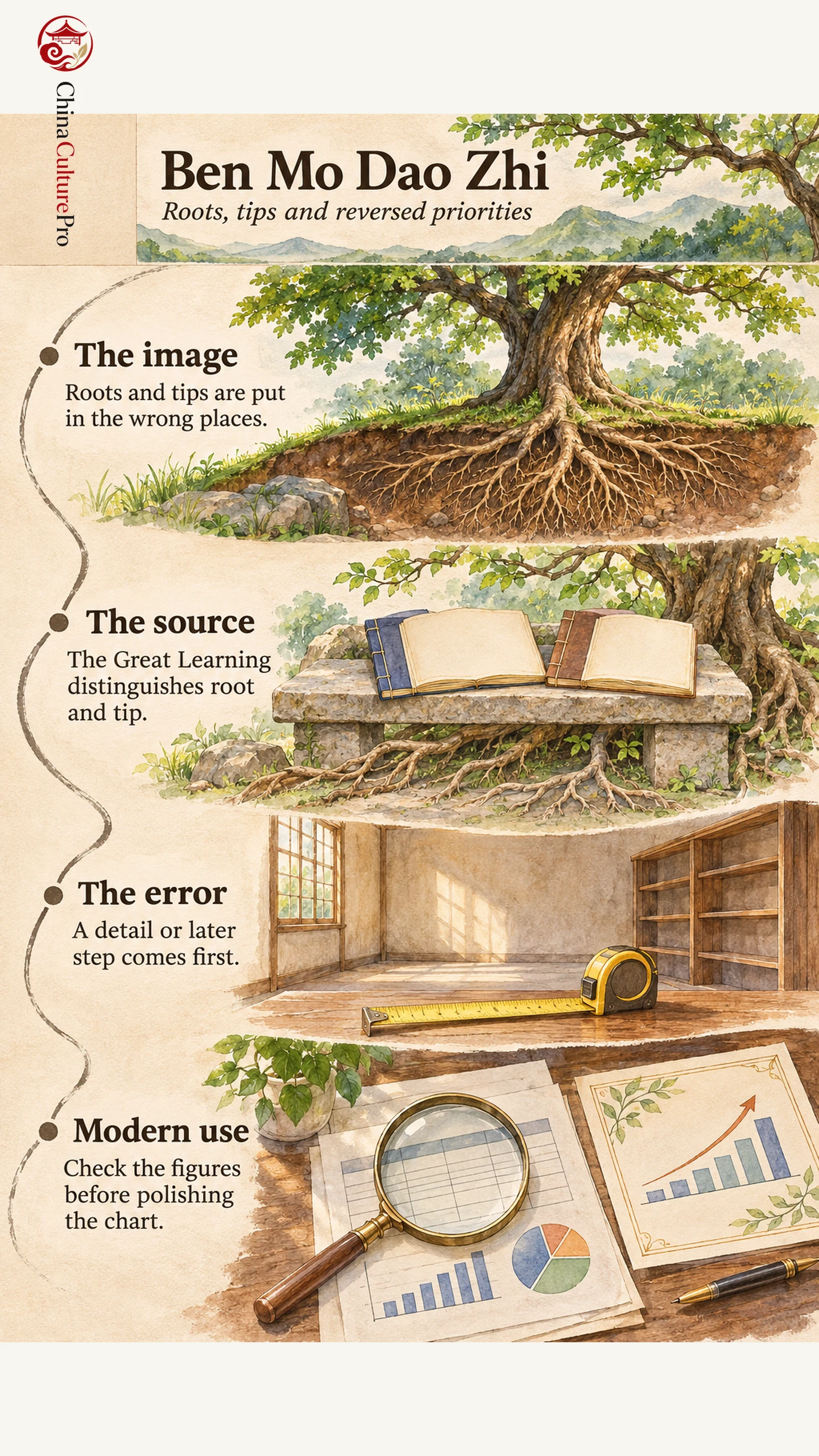
A report can have beautiful charts and unreliable figures. The polish matters only once the evidence is sound. Ben Mo Dao Zhi names this kind of reversal, when attention goes to what should come second.[1][3]
The Root and the Tip
Běn refers to the root or foundation, and mò means the tip or outer end. Dào zhì describes placing things the wrong way around. The image makes the relationship visible: roots sustain the branches, so tending the tips alone cannot make up for damage at the base.[1][2]
In an ordinary sentence, the foundation may be a goal, a prerequisite or the piece of evidence on which a conclusion depends. The tip may still be useful. The criticism is that a secondary concern has been allowed to drive the decision.[1][3]
The Great Learning and the Later Four-Character Form
The Great Learning, transmitted in the Book of Rites, says that things have roots and tips and affairs have beginnings and ends. It presents knowing what comes first as part of sound judgment. The following passage takes self-cultivation as a foundation for bringing order to the household and, further outward, to the state.[2]
The source passage gives the root-and-tip idea. The full four-character expression appears in later writing, including a letter by the Song thinker Zhu Xi. A letter by Lu Jiuyuan also uses the idiom in a discussion of what follows from a strong foundation. These examples show how the classical image became a compact criticism.[1]
How to Recognize Reversed Priorities
Sometimes the issue is order. Buying shelving before measuring the room is a simple example: the measurements should guide the purchase. In other cases the issue is how much weight each concern receives. A discussion can spend most of its time polishing a slide while giving little attention to whether the claim on it is true.[3]
Mai Du Huan Zhu (买椟还珠, mǎi dú huán zhū), the story of keeping the box and returning the pearl, illustrates a related mistake about value. Ben Mo Dao Zhi has a broader reach because it also covers a prerequisite being placed after the thing it should guide.[1][3]
How to Use Ben Mo Dao Zhi in a Sentence
A colleague might say 数据还没核实,就忙着美化图表,这不是本末倒置吗? The figures still need checking, but everyone is busy dressing up the charts. The question criticizes the order of work and the amount of attention given to presentation.[1][3]
In that context “you’re getting your priorities backwards” works in English. “Putting the cart before the horse” fits especially well when one task has to precede another. If the speaker is weighing importance alone, “mistaking the secondary for the essential” is more precise.[3]
FAQs About Ben Mo Dao Zhi
Is Ben Mo Dao Zhi about sequence or importance?
It can be either. A step may come too early, or a detail may receive more attention than the main concern.[3]
Is it the same as putting the cart before the horse?
The English idiom works when the sequence is wrong. If the criticism concerns importance, “get your priorities backwards” may fit better.[3]
Did the full phrase appear in the Great Learning?
The Great Learning contains the root-and-tip comparison. Later sources, including Song correspondence, contain the four-character form.[1][2]
Fuentes
[1] Taiwan Ministry of Education. Idiom dictionary entry for 本末倒置
[2] Taiwan Ministry of Education. The Great Learning source passage
[3] Taiwan Ministry of Education. Concise dictionary entry for 本末倒置