


Quick Answer: Who Are the Golden Horn and Silver Horn Kings?
The Golden Horn King (金角大王, Jīnjiǎo Dàwáng) and Silver Horn King (银角大王, Yínjiǎo Dàwáng) are two demon rulers who hold the Tang Monk and several companions captive in chapters 32–35 of Journey to the West (西游记, Xīyóu Jì). Their magical gourd and jade flask can take in anyone who answers a call. Sun Wukong (孙悟空, Sūn Wùkōng) has to outwit them to free the captives. At the end, the sage Laozi, called the Most Exalted Lord in the novel (太上老君, Tàishàng Lǎojūn), identifies the kings as his attendants.[1][2][3][4]
- Where they live: The two kings share a cave on a mountain and speak to one another as brothers.[1]
- How the gourd works: It responds to a person answering. A false name still works if the intended person replies.[2][3]
- Where to watch: Episode 12 of CCTV’s 1986 series covers the mountain encounter and the gourd.[5]
This guide discusses all four chapters, including who takes the two kings away and why they were on the mountain.
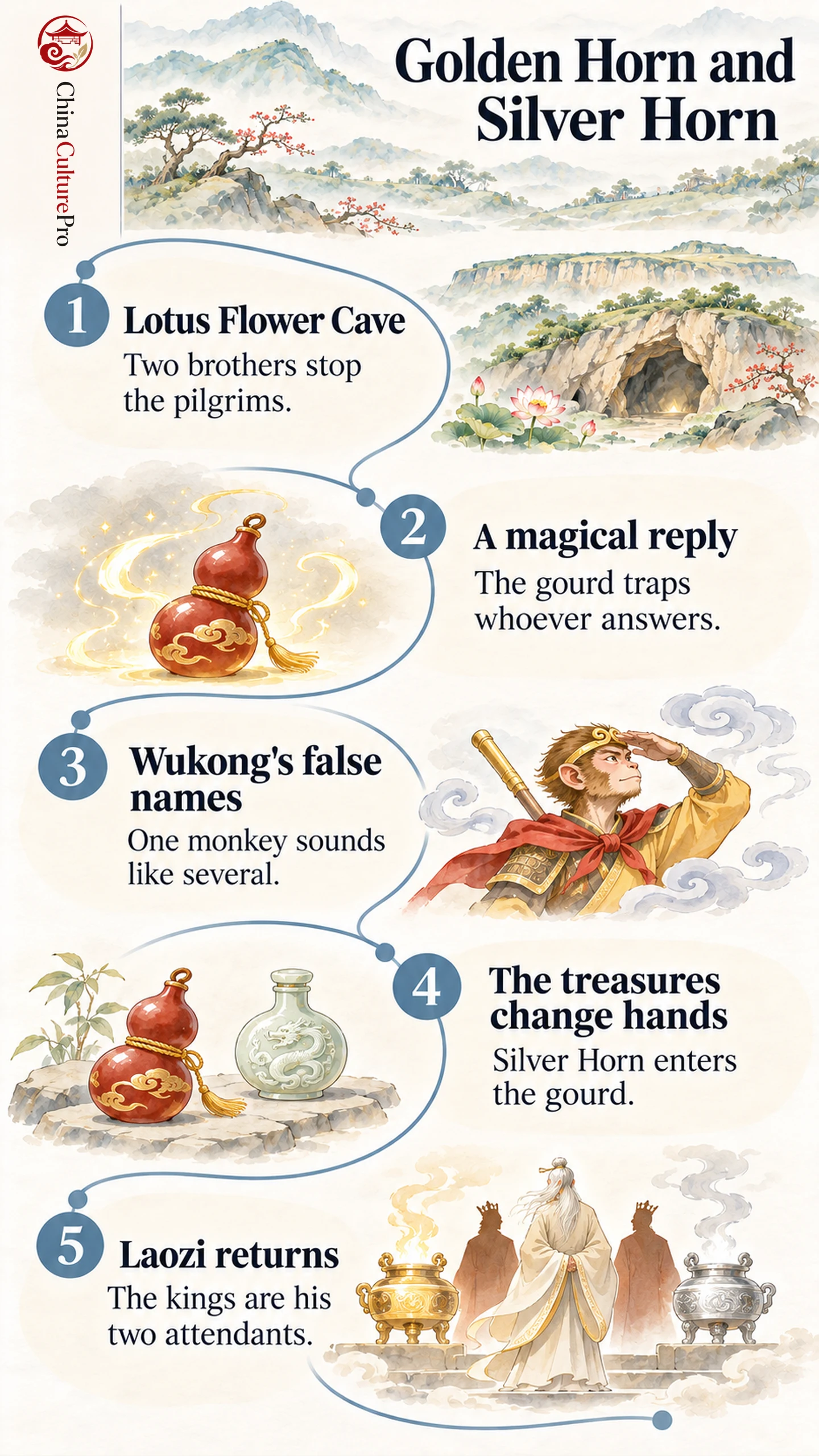
The kings’ treasures seem to give them the advantage. Their trouble begins when they have to decide who is answering them. The brothers can catch a person with a word. Still, knowing whom they are speaking to can keep them from being fooled. Wukong makes that easier to get wrong.
How the brothers stop the travelers at Lotus Flower Cave
The kings live at Lotus Flower Cave (莲花洞, Liánhuā Dòng) on Level-Top Mountain, also called Pingding Mountain. Golden Horn knows that the Tang Monk is traveling west and says that eating his flesh will grant long life. Silver Horn wants to set out immediately. Golden Horn insists that he first know what the pilgrims look like and shows him a picture of the group. The opening already makes the problem of recognizing someone part of the story.[1][7]
Silver Horn captures Pigsy and later presents himself as an injured traveler. The monk takes pity on him and tells Wukong to carry him. Silver Horn uses magic to pin Wukong under mountains, leaving the others exposed. The demon can now take the party to the cave. The ambush establishes that the kings can be as effective at disguising their intentions as Wukong is at disguising himself.[1][2]
Why Wukong keeps changing his name
Two servants of the kings explain that a red gourd and a jade flask can draw someone inside when that person answers a call. Wukong uses a counterfeit gourd to get hold of both vessels, but control of the treasures keeps changing. In chapter 34, Silver Horn still gets the chance to use the gourd against him. Wukong has presented himself as a different person using the same three characters rearranged. He guesses that the gourd may need his real name and risks answering. It takes him in. The reply is enough to trigger it.[2][3]
Wukong escapes by making the kings think the gourd has worked and slipping out when they open it. He later uses his other rearranged name and makes Silver Horn answer, catching him in the gourd. The joke goes on even after the capture. Pigsy explains to Golden Horn that Sun Xingzhe, Zhe Xingsun and Xingzhe Sun are all the same person. Every permutation leaves Golden Horn with an apparent new opponent. Pigsy, the prisoner, can see exactly how many opponents there really are. Later Wukong also calls to Golden Horn and catches him in the jade flask when he replies.[3][4]
What Laozi reveals and what television keeps
Laozi recognizes the gourd as his vessel for elixirs and the flask as his water container. Under their demon shapes are the attendants who tend his gold and silver furnaces. Wukong accuses him of failing to control them. Laozi then says Guanyin borrowed the attendants to test whether the pilgrims were committed to going west. Wukong is still annoyed because Guanyin had promised to help him in difficulties. Wukong takes the promise seriously enough to challenge the people who made the trial possible. His objection gives a story about right and wrong names a second question about who should answer for what happened.[4]
The 1986 television series brings the story together in episode 12, set at Lotus Flower Cave. CCTV’s programme note emphasizes the trapped pilgrims, Wukong’s reversal with the gourd and the return of the two attendants with Laozi. Readers who know that sequence from television can begin at chapter 32 in Anthony C. Yu’s second volume and follow the changing names through chapter 35. For the other figures on the road, see the Journey to the West characters guide.[1][2][3][4][5][6]
FAQs About Golden Horn and Silver Horn
Are Golden Horn and Silver Horn brothers?
They call each other brothers and rule the cave together. Laozi gives their earlier identities as two attendants, one for each of his furnaces.[1][4]
What does the magic gourd do?
The gourd draws in a person who answers its user’s call. In the novel, it captures Wukong even though he is using a false name.[2][3]
Do the two kings die?
Their defeat looks final to the characters in the cave. Laozi opens the vessels, releases two streams of vapor and restores the attendants to their former shapes.[4]
Fuentes
[1] Journey to the West. Chapter 32, the two kings of Lotus Flower Cave
[2] Journey to the West. Chapter 33, the gourd and jade flask
[3] Journey to the West. Chapter 34, Wukong tries a false name
[4] Journey to the West. Chapter 35, the two captives and Laozi’s explanation
[5] China Central Television. Journey to the West, episode 12
[6] University of Chicago Press. Anthony C. Yu’s revised Journey to the West, Volume 2
[7] Journey to the West Online. English chapter 32, Level-Top Mountain and Lotus-Flower Cave