
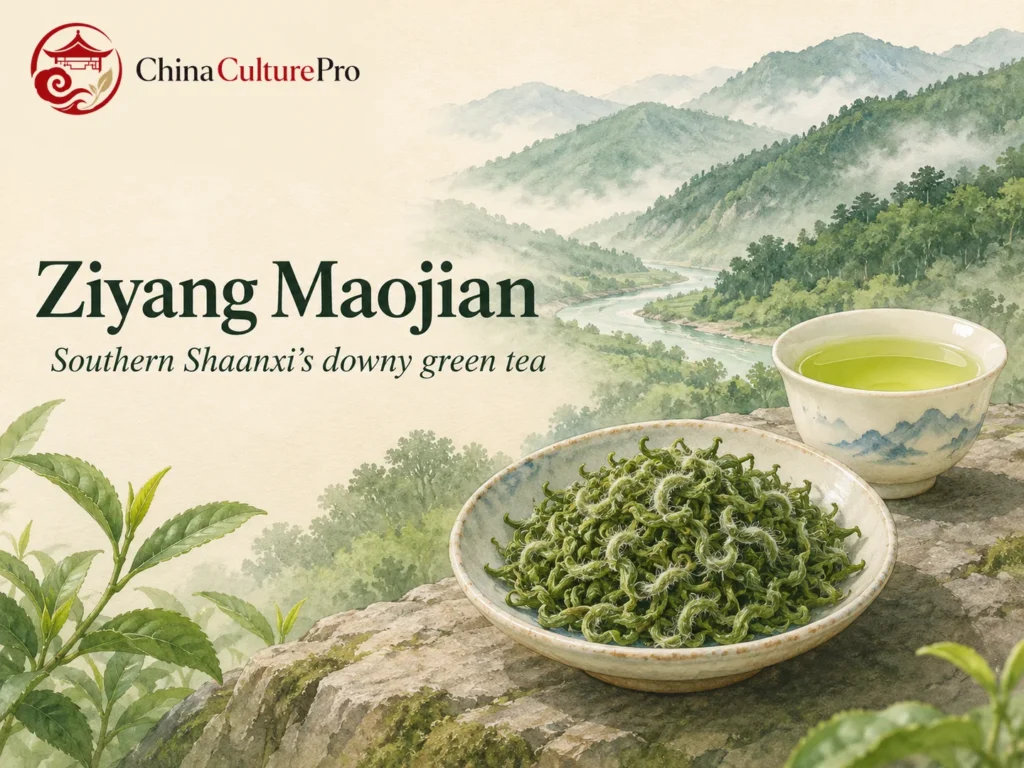

Quick Answer: What Is Ziyang Maojian?
Ziyang Maojian(紫阳毛尖,zǐyáng máojiān) is a green tea from the Ziyang area of Ankang in southern Shaanxi.
- Place: Its tradition is associated with the Han River and Daba mountain region.[1]
- Leaf: Hand working tightens the strands and brings out their fine white hairs.[1]
- Cup: A documented spring example is floral, fresh and mellow, with a sweet finish.[2]
- Label: Fuxi(富硒,fùxī) means selenium-rich; it is not a brewing method.[4]
Check the county, harvest and actual product rather than relying on the name alone.

The finished strands carry signs of their making, but neither the word Maojian nor a regional label tells the whole story of a particular cup.
Where Ziyang Is and How to Read the Label
One documented batch locates the tea in Shuangsheng Village, Ziyang County, Ankang, Shaanxi, and identifies local population material.[2]
The area’s selenium-related tea identity appears in local accounts of its soils and the development of regional branding. Treat “selenium-rich” as a separate product claim to examine, rather than as a flavor or a measure of what your own cup contains.[4]
When checking tea origin labels, keep the growing place, material and any compositional claims in separate columns of your notes.
The Hand-Making Tradition and the Finished Leaf
A recorded traditional route begins with picking and spreading the fresh leaves, then pan fixing and initial rolling. It includes sun drying and a covered resting stage before further hand working tightens the curled strands and exposes their white hairs. Subsequent drying and screening finish the tea. This is a specific hand-making account, rather than a compulsory sequence for every modern batch.[1]
The hand-making technique is recorded as a Shaanxi provincial intangible-cultural-heritage project. In this account, the covered rest softens the partly dried leaves.[1]
Flavor: Compare the Cup as Well as the Name
A study of 20 Ziyang Maojian samples found similar overall sensory scores but significant differences in the separate scores for liquor color and taste. An overall score can therefore conceal differences in the cup.[3]
The Shuangsheng Village example, harvested on March 24, 2024 with a bud-and-one-leaf plucking standard, is described through green liquor, floral fragrance, a mellow taste and lingering sweetness. These notes belong to that batch.[2]
When comparing spring-harvest labels, note the actual date and material as well as the seasonal term.
How to Brew a Documented Spring Example
The 2024 example’s published cup-style method uses 1 g per 80 ml at 85–90°C for 2 minutes. The following quantities scale that ratio arithmetically.[2]
- Put 4 g of leaves into a teapot or infuser cup with room for the full water volume.
- Add 320 ml of water at 85–90°C.
- Infuse for 2 minutes, then separate the liquor from the leaves and taste.[2]
Use the same brewing water when comparing batches. Record any adjustment rather than changing the leaf weight, temperature and time simultaneously.
FAQs About Ziyang Maojian
Is Every Maojian the Same Tea?
No. Read the full regional name. Here, Ziyang identifies the tea discussed; “Maojian” alone is not a complete origin.
Does Selenium-Rich Describe the Brewing Method?
No. It is compositional wording. It does not tell you how much leaf or water to use.
Does Every Ziyang Maojian Use Identical Processing?
Do not assume so. A recorded traditional hand process and a particular modern packet should be checked in their own contexts.
出典
[1] Shaanxi Provincial Art Museum, reproduced by Shaanxi Intangible Cultural Heritage Network. 紫阳毛尖传统手工制作技艺
[2] MyTeaPal. Zi Yang Mao Jian Green Tea (2024 Spring)
[3] Shuang Liang and colleagues. Quality Characters of Ziyang Maojian Tea Based on Sensory Evaluation and Non-targeted Metabolomics Analysis
[4] Ziyang County Government. 紫阳富硒茶叶的资源、生产和经营