


Quick Answer: Who Was Yuan Shikai?
Yuan Shikai (袁世凯, Yuán Shìkǎi, 1859–1916) was a late Qing official and military reformer who became president of the Republic of China. In December 1915 he accepted the proposed imperial crown. Provincial resistance helped force him to cancel the monarchy in March 1916.[1][2][4][5]
- Late Qing: His work training a new army and his senior posts gave him influence the Qing court needed in 1911.[1][2]
- Republic: He succeeded Sun Yat-sen as provisional president in 1912. He was then elected president in 1913.[2][3]
- Monarchy: The proposed new regime met organised resistance and was abandoned before a stable imperial government took shape.[4][5][6]
The transition was from the Qing to a republic in 1912. Yuan’s monarchy attempt came later and sought to establish a new regime under him.[1][2][4]
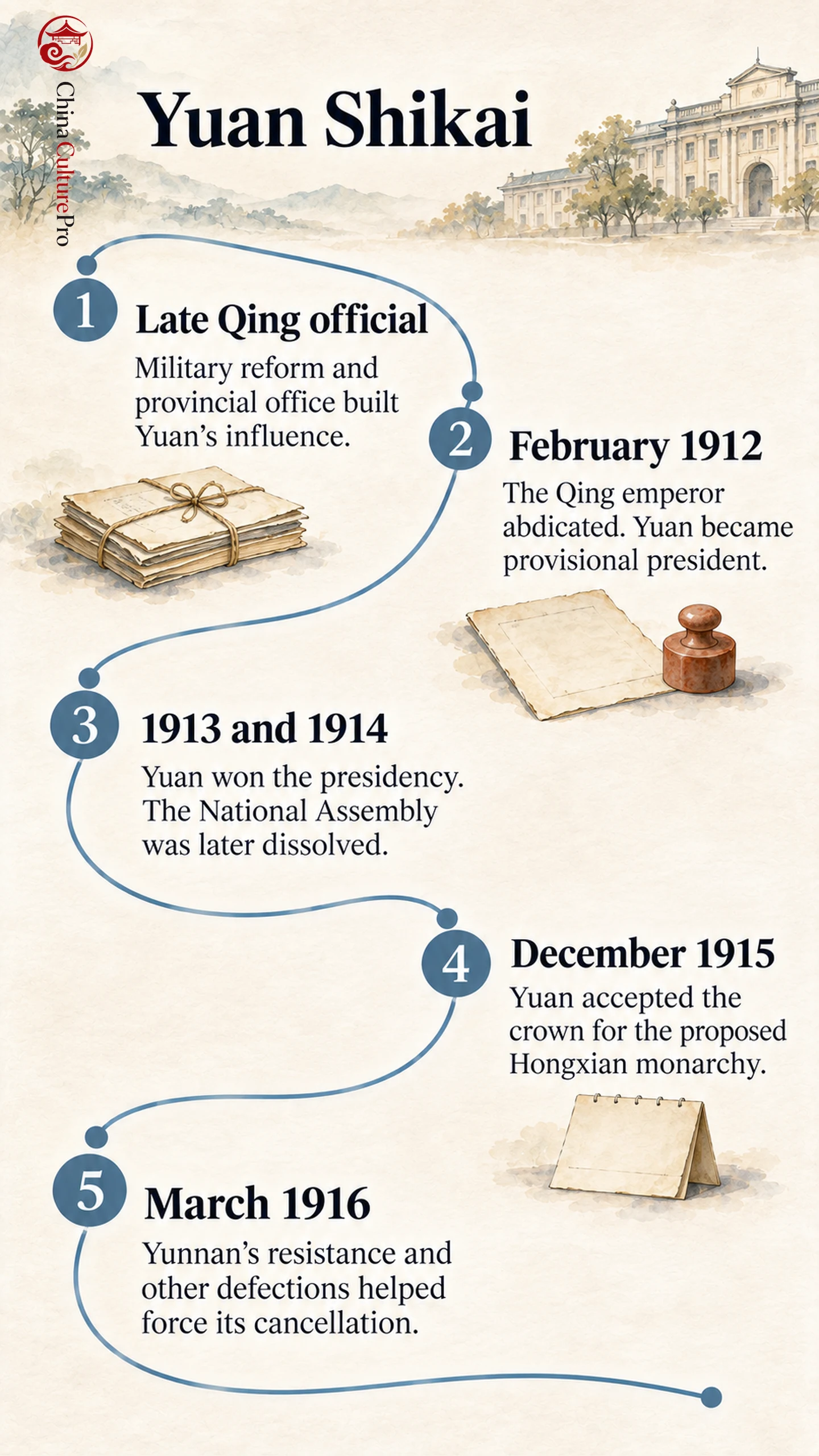
The same man who helped negotiate the Qing emperor’s abdication made a bid for an imperial crown less than four years later. Following the offices he held in between explains how he gained that power and why provincial opposition could undo his plan.
How Yuan Built Power Under the Qing
Yuan served the Qing in Korea before rising through military and provincial appointments. He became associated with training the New Army and later served as governor of Shandong and governor-general of Zhili. Those posts combined military organisation with authority in provincial government. The debate over late Qing constitutional reform provides the political setting for reforms taking place near the end of the dynasty.[1]
When the Wuchang Uprising began in 1911, the court turned to Yuan. His position gave him room to bargain with both the Qing and revolutionaries. The abdication agreement joined two questions: how the emperor would leave the throne and who would lead the provisional republic. The Qing emperor abdicated on 12 February 1912, and the provisional senate elected Yuan on 15 February.[1][2]
From Provisional President to a Stronger Presidency
Sun Yat-sen had headed the provisional government in Nanjing. Yuan’s election transferred that provisional office. In October 1913 the National Assembly elected him president, a distinct step from the provisional vote of 1912.[2][3]
Conflict followed over how to divide power between president and legislature. The National Assembly was dissolved in January 1914, and a revised provisional constitution was promulgated in May. Read alongside the broader cultural history of Republican China, these changes mark how early republican institutions were reorganised before Yuan’s imperial bid.[1][3]
Why the 1915 Monarchy Failed
Yuan accepted the crown in December 1915. The new era name was Hongxian (洪宪, Hóngxiàn). Adopting an imperial title and calendar gave the project official form, while his ability to secure acceptance across the provinces remained unresolved.[1][4]
Yunnan’s opposition led to the National Protection War (护国战争, Hùguó Zhànzhēng). Additional provincial defections and pressure from within and outside his government eroded his position. On 22 March 1916 the monarchy was cancelled. A contemporary diplomatic telegram reported that he was expected to remain president. He died on 6 June 1916 before the political conflict over his presidency had fully ended.[5][6]
FAQs About Yuan Shikai
Was Yuan Shikai president before he claimed the throne?
Yes. He was elected provisional president in February 1912 and elected president in October 1913. He accepted the proposed crown in December 1915.[2][3][4]
Did Yuan Shikai restore the Qing dynasty?
His imperial project was a new monarchy under his own leadership. The Qing emperor’s abdication had taken place in 1912.[1][2][4]
What ended Yuan Shikai’s imperial bid?
Yunnan’s resistance, further provincial defections and mounting political pressure helped force Yuan to drop the monarchy on 22 March 1916.[5][6]
出典
[1] Patrick Fuliang Shan. Yuan Shikai: A Reappraisal
[2] National Museum of China. Imperial Edict of the Abdication of the Qing Emperor
[3] U.S. Department of State, Office of the Historian. Review of Constitutional Evolution in China, 1912–14
[4] China Mission Year Book. The General Situation in China
[5] Modern China. The National Protection War and the Intellectual Foundations of Chinese Warlordism
[6] U.S. Department of State, Office of the Historian. Telegram Reporting the Cancellation of the Monarchy