
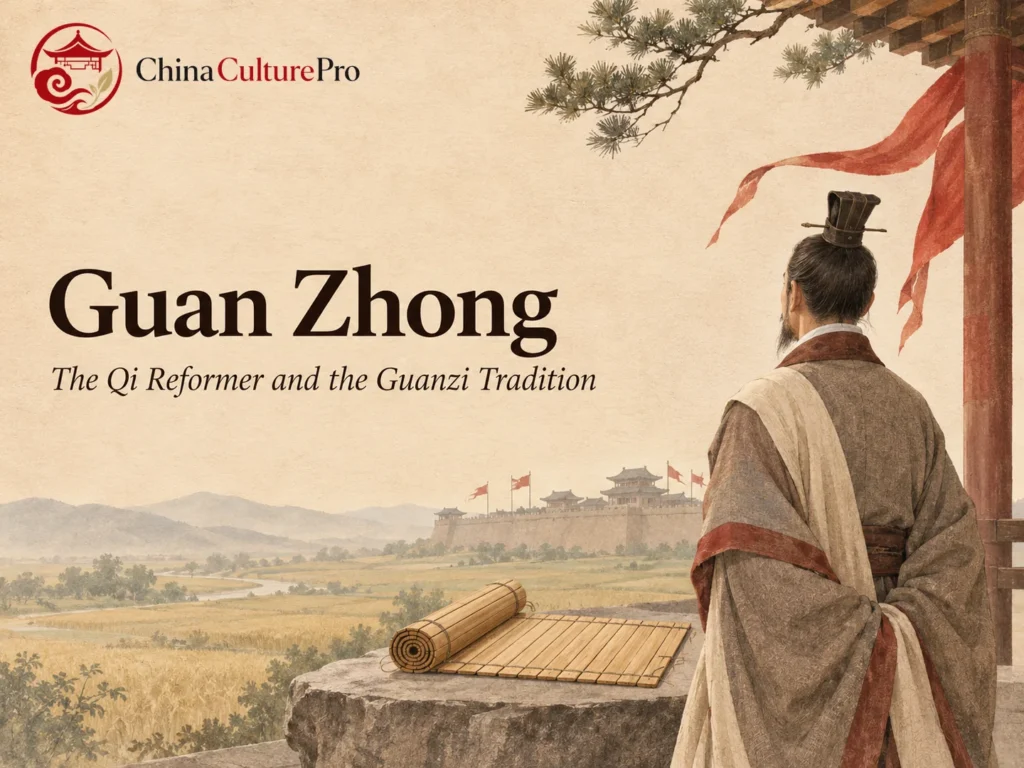

Quick Answer: Who Was Guan Zhong?
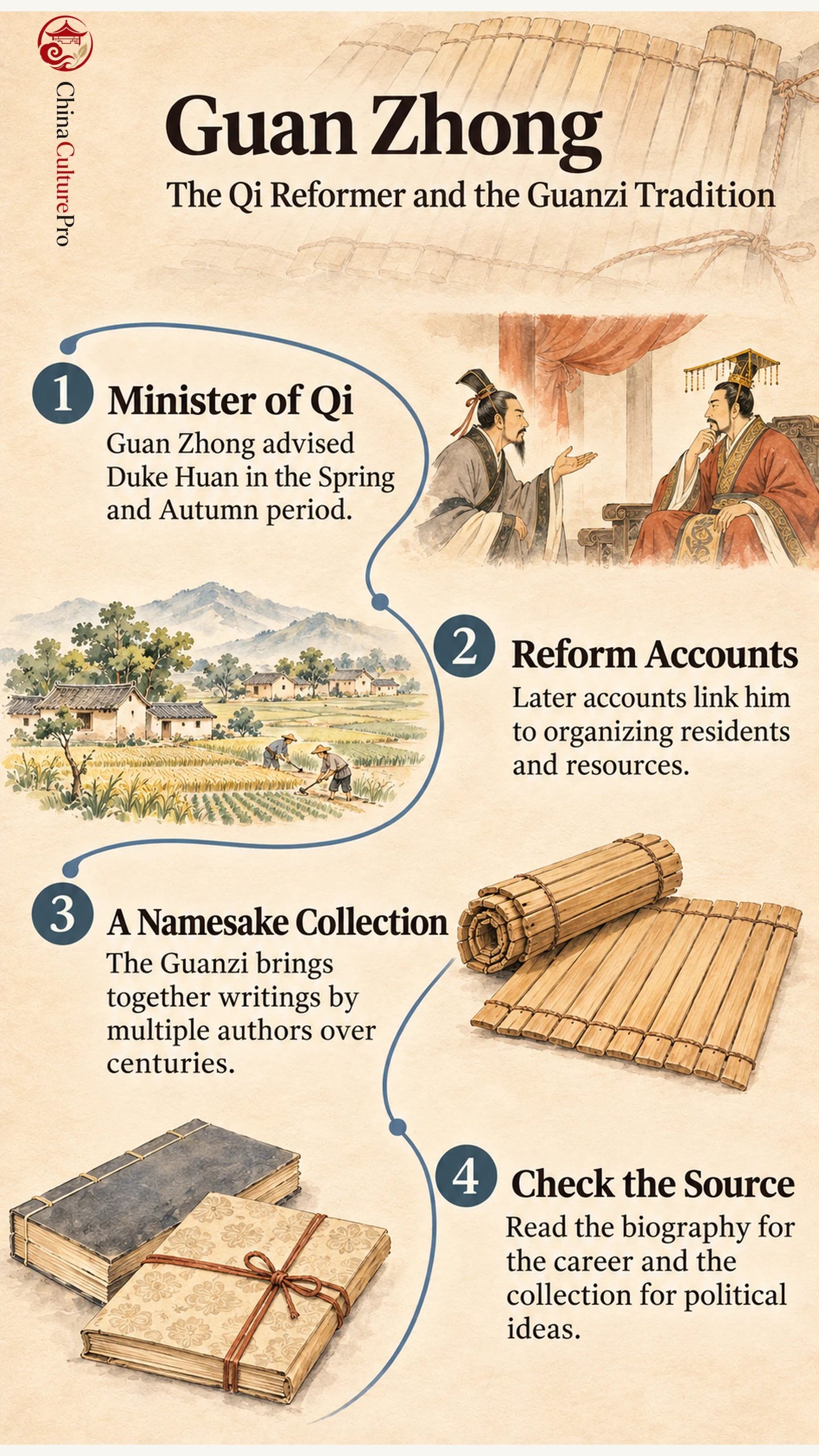
Guan Zhong (管仲, Guǎn Zhòng), who died in 645 BCE, served Duke Huan of Qi (齐桓公, Qí Huán Gōng) in China’s Spring and Autumn period. Later accounts credit him with administrative reforms and with helping Qi lead other states. The Guanzi (管子, Guǎnzǐ) takes his name and collects writings composed by multiple authors over centuries. [1][2][3][4]
- Political role: He became a minister after serving the losing side in a struggle for control of Qi. [1]
- Reform tradition: Early accounts connect him with organizing residents and resources to strengthen the state. [1][2]
- The book: Han scholar Liu Xiang edited the collection in the late first century BCE. [3][4]
Start with the Qi accounts for his career and the later collection for ideas associated with his name.
Guan Zhong’s name appears in a story about a former rival becoming a minister and on a book that discusses what makes a state governable. The link between the two made him a durable figure in Chinese political thought. To understand that link, begin with the Qi court and then ask when the writings associated with him were composed. [1][3][4]
How Guan Zhong Came to Serve Duke Huan
During the Spring and Autumn period, states within the Zhou world competed for influence. Qi was one of those states. In the biography written by Sima Qian, Guan Zhong served Prince Jiu while his acquaintance Bao Shuya (鲍叔牙, Bào Shūyá) served Prince Xiaobai. Xiaobai prevailed and became Duke Huan. The account says that Guan Zhong was detained after his patron lost, then brought into Qi’s government after Bao Shuya recommended him. [1]
The biography also tells of the two men sharing profits and of Bao understanding why Guan sometimes took a larger share. These stories explain why the two names became associated with friendship and recognition of talent. They come from a literary biography written centuries later. Read them for the way Sima Qian tells the story of the appointment, and distinguish that from the level of certainty possible about individual conversations. [1][4]
What Early Accounts Say About Reforming Qi
The Discourses of Qi portrays Guan Zhong advising Duke Huan to organize the capital and its surrounding territory, stabilize where people live, and arrange occupations. The same tradition links community organization and military recruitment. The proposals link where households lived and worked to the government’s ability to collect resources and mobilize people. Their practical details come to us through later accounts of the reform tradition. [1][2]
Sima Qian credits Guan Zhong’s use of Qi’s coastal resources and his attention to goods and wealth. The biography connects a stronger Qi to Duke Huan’s ability to convene other rulers. Within the chronology of early Chinese states, that standing is often described as leadership among the regional lords. The accounts help explain the reputation that gathered around the minister, even where a specific administrative practice is harder to date. [1][2]
The Analects also preserves a debate over how to judge his career. In Book 14, disciples question why Guan Zhong served the victor after Prince Jiu’s death. Confucius points instead to the order that Guan helped Duke Huan bring to relations among the states. The passage records an argument about loyalty and public benefit. It is evidence for how early thinkers remembered Guan Zhong. [7]
Why the Guanzi Carries His Name
The surviving Guanzi collection contains about 76 essays or chapters. W. Allyn Rickett’s translation introduction places the surviving material across several centuries, from the late pre-imperial period into the Han era. The texts have no single identifiable author. Liu Xiang gave the collection its received form in the late first century BCE. [3][4]
One early chapter argues that people are more likely to observe social norms when they have enough food and clothing. Other essays discuss agricultural timing, the management of goods, education, and ways to cultivate the mind. Such variety explains why scholars read the collection in more than one intellectual tradition. Some chapters are discussed alongside Chinese Legalist statecraft, while others are read for economic thought or self-cultivation. [3][4][5][6]
When the Guanzi makes a specific policy proposal, ask where in the collection it appears and what period scholars associate with that layer. To learn how later historians told the story of Guan Zhong’s appointment, start with the biography. Those two questions lead to complementary sources. [1][3][4]
FAQs About Guan Zhong
Was Guan Zhong a ruler of Qi?
He served as a minister to Duke Huan. The duke was the ruler and Guan Zhong was a leading adviser. [1][2]
Did Guan Zhong write the Guanzi?
The collection takes his name. Its chapters were written by various authors and edited into the surviving collection long after his life. [3][4]
Why do Guan Zhong and Bao Shuya appear together?
Sima Qian depicts Bao Shuya recognizing Guan Zhong’s abilities, then recommending him to the duke after they had served rival candidates for the dukedom. [1]
出典
[1] Sima Qian, Records of the Grand Historian. Biographies of Guan Zhong and Yan Ying, chapter 62
[2] Chinese Text Project. Discourses of Qi, Guoyu
[3] Princeton University Press. Guanzi: Political, Economic, and Philosophical Essays from Early China
[4] Cambridge University Press, Early China. The Development of Naturalist Thought in Ancient China
[5] Stanford Encyclopedia of Philosophy. Social and Political Thought in Chinese Philosophy
[6] Stanford Encyclopedia of Philosophy. Legalism in Chinese Philosophy
[7] Robert Eno, translation and notes. The Analects of Confucius, Book 14