

Quick Answer: Who Were Princess Jieyou and Feng Liao?
Princess Jieyou (解忧公主, Jiěyōu Gōngzhǔ) was a Han royal woman who married into the ruling family of the Wusun (乌孙, Wūsūn). Feng Liao (冯嫽, Féng Liáo), an attendant in her household, carried Han credentials and acted as an envoy. The Book of Han records Feng’s role in talks during a disputed Wusun succession.[1][2][3][4]
- Princess Jieyou: Her marriage connected ruling families, and she sent appeals to the Han court.[1][3]
- Feng Liao: She went on missions and later negotiated with a claimant to Wusun rule.[1][2]
- Settlement: A Han-backed arrangement recognised two rulers with different titles.[1][2]
The marriage and the envoy missions were connected. Each person’s position gave her a different way to communicate across courts.[1][3]
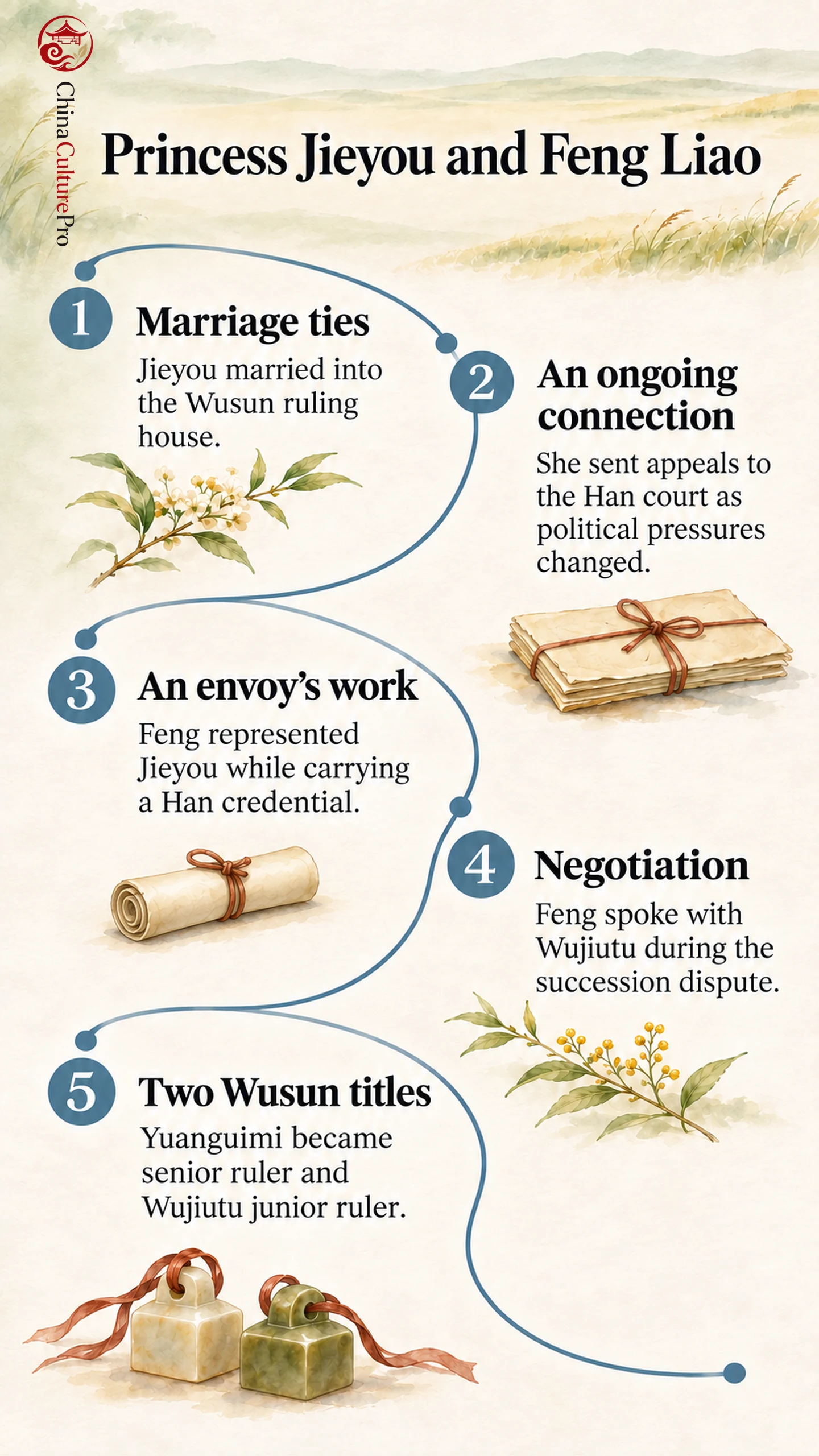
A Han marriage created a lasting connection to a ruling household far from the capital. An attendant in that household later used her own contacts to negotiate with a rival claimant. The two women show how differently two people in the same household could conduct diplomacy.
How Princess Jieyou Built Ties With the Wusun
Earlier missions associated with Zhang Qian helped establish Han contacts with the Wusun. The Book of Han records an earlier marriage involving Princess Xijun. After her death, the Han dynasty sent Jieyou, a granddaughter of the King of Chu, into a Wusun royal marriage. This belongs to the history of heqin (和亲, héqīn), diplomatic relationships maintained through marriage.[1]
Jieyou’s role extended beyond the initial wedding. As the political situation changed, she sent appeals to the Han court about pressure from the Xiongnu. Her children and their marriages connected several ruling households. The Book of Han, for example, records a daughter marrying the king of Kucha. The marriage tie opened channels that needed continued negotiation to work.[1][3]
What Feng Liao Did as an Envoy
The Book of Han says Feng Liao was literate and experienced in practical affairs. She represented Jieyou while bearing a Han envoy’s credential and travelled among walled states to distribute rewards and gifts. The account calls her Madam Feng and describes respect for her in those communities.[1][2]
Feng also married a Wusun general who knew a rival claimant, Wujiutu. During the succession dispute, the Han protector-general Zheng Ji called on her to speak with him. Her ties in the Wusun and her earlier service gave her a place in negotiations conducted across the two political networks. The court account says Emperor Xuan called Feng in to hear her report and then sent her back with two accompanying officials.[1][2]
What the Wusun Succession Settlement Changed
The Book of Han describes Han officials recognising Jieyou’s son Yuanguimi as the senior ruler and Wujiutu as the junior ruler. Each received a seal and ribbon. The account also records further work to settle the division of people and territory. The title settled one question. Officials still had to work out who and what each ruler would govern.[1][2]
FAQs About Princess Jieyou and Feng Liao
Were Princess Jieyou and Feng Liao both Han princesses?
Jieyou held the title of princess and married into the Wusun ruling house. Feng served in her household and became an envoy trusted with diplomatic work.[1][2]
Who did Feng Liao negotiate with?
The Book of Han names Wujiutu, a Wusun claimant. The resulting settlement gave him the junior title while Jieyou’s son Yuanguimi held the senior title.[1][2]
出典
[1] Book of Han. Volume 96B: The Western Regions and the Wusun
[2] Chinese Text Project. Book of Han, Annals of the Western Regions
[3] Hongyu Quan. Han Women’s Marriage Alliances and Diplomatic Roles in the Western Regions
[4] Ministry of Education Dictionary of Chinese Character Variants. Entry for 嫽