
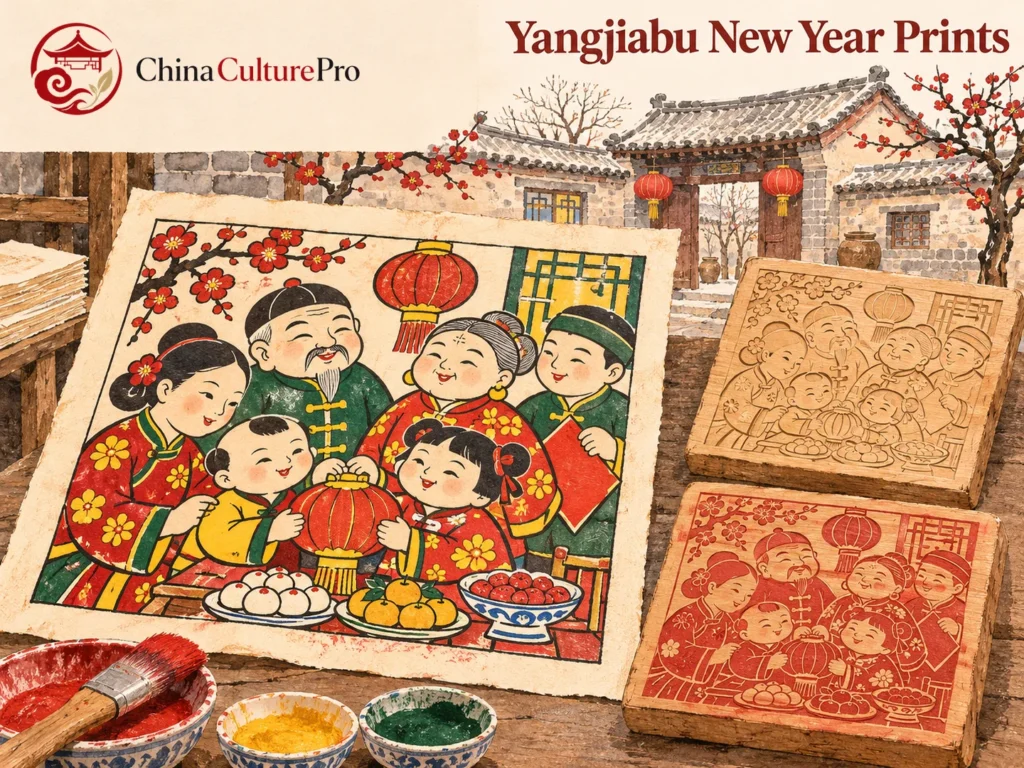

Quick Answer: What Are Yangjiabu New Year Prints?
Yangjiabu New Year prints (杨家埠木版年画, Yángjiābù mùbǎn niánhuà) are folk woodblock prints from Yangjiabu in Weifang, Shandong. Their bold forms and strong color suited household displays. Workshops made prints for doors, interior walls and the area around a heated platform called a kang (炕, kàng).[1][2][3]
- Printing: Separate blocks can build the outlines and areas of color.[2]
- Subjects: Prints show good wishes, folk stories, ordinary work and religious figures.[2][3]
- Placement: A print’s shape can reflect where it was meant to hang.[2][3]
China listed the Weifang craft in its first national batch in 2006.[1]
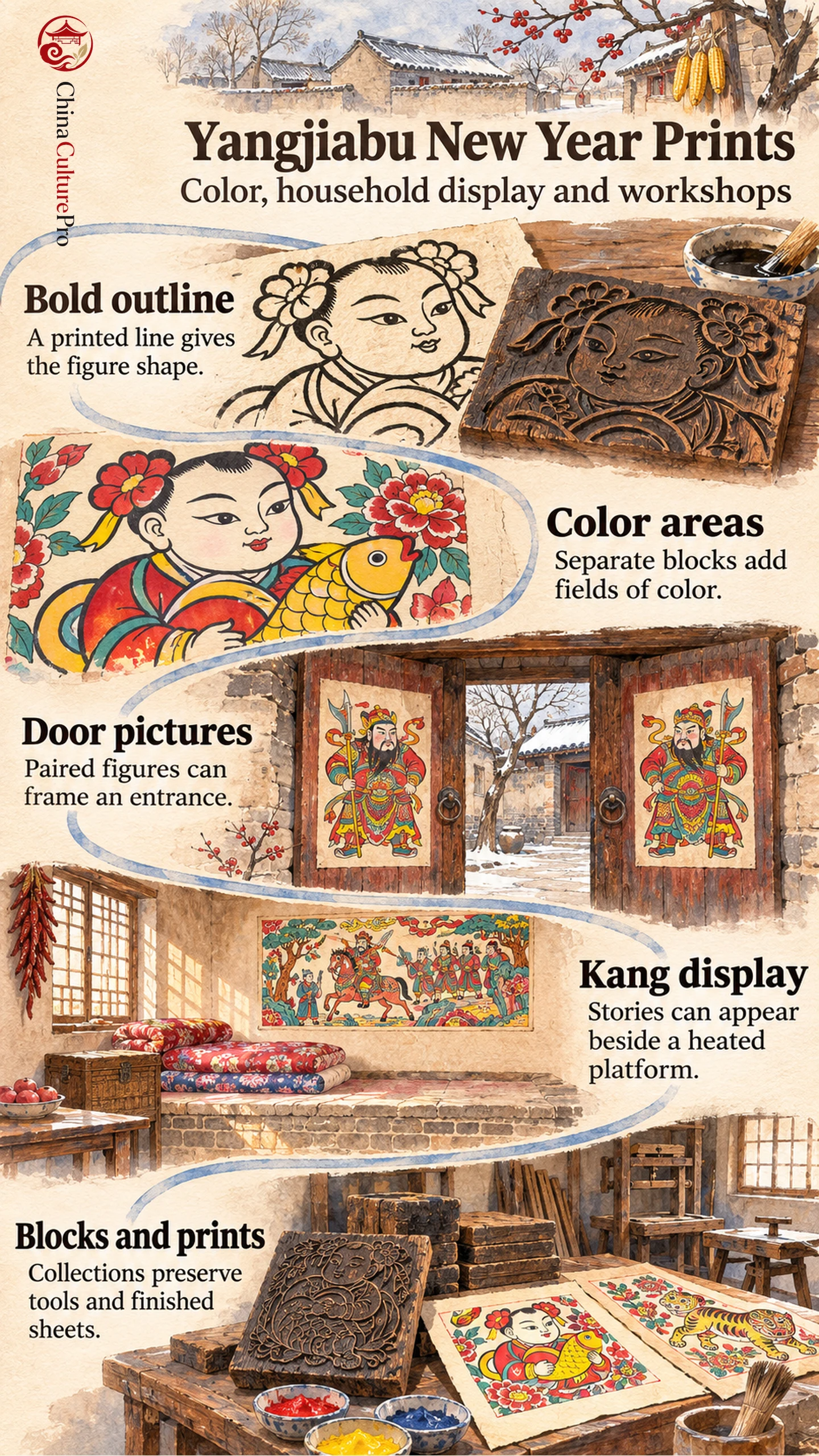
A figure with a large head and compact body remains easy to pick out against a bright field of color. The same graphic approach can serve a paired doorway image or a larger scene indoors. Yangjiabu accounts document both how the workshops made the prints and where households used them.[1][2][3]
How Workshops Build a Bold Printed Image
The local craft account describes drawing, carving and printing with more than one block. Printed lines carry the outline and separate color areas give weight to faces, robes and objects. Some images also receive hand-applied touches, such as color on parts of a face. Most of the image in a documented Yangjiabu color print can come from the repeated impressions.[2]
The account records rules of thumb about color contrast and making heads large in relation to bodies. A large face can make an expression easier to read when the sheet hangs at a distance. That choice also mattered when printed imagery was used in another local craft. The Weifang gazetteer describes cutouts from block-printed sheets mounted onto some Weifang kites.[2][6]
Doorways, Heated Platforms and New Year Subjects
| Place in the house | What can be displayed there |
|---|---|
| Doorway | Paired figures, including door gods (门神, ménshén) |
| Beside the kang | Scenes such as a New Year celebration or a story from opera |
| Main interior wall | A central image that can be read as a single composition |
| Window area | Decorative pictures documented as window or curtain forms |
The same room can contain prints of different subjects, and a subject can appear in more than one format. The national documentation lists depictions of farm work, auspicious plants and animals, and scenes from stories alongside protective figures. A named example is *Celebrating the New Year*, which appears among pictures intended for the area beside a kang.[2][3]
The register also includes *The White Snake* and *The Heavenly Maiden Scatters Flowers* among kang-side designs. A placement label can therefore describe how a picture was used without telling you whether its subject was a household celebration, a stage story or a figure from legend.[2]
The doorway group includes civil and martial figures as well as pictures for different kinds of doors. Chinese door gods give wider context for that imagery. Wuqiang New Year prints offer another regional example of organizing a print tradition by placement and purpose.[2][3]
Yang Luoshu, the Print Shop and the Block Collection
The national record names print shops in the Ming and describes expansion during the Qing. In the twentieth century, Yang Luoshu learned from his father and worked at Yangjiabu’s Tongshunde shop, specializing in block carving. A local research institute founded in 1979 also helped document and study the tradition.[1][4]
Beginning in 2016, Yantai Museum received 101 items or sets associated with Yang Luoshu’s collection and work, according to the Chinese Museums Association. The association records 16 blocks or sets of blocks, 75 prints or sets of prints, and ten albums. The objects preserve different parts of one shop’s working history. The national profile also identifies illustrated versions of the four classic Chinese novels among Yang’s representative works. Together, blocks and sheets show how a raised line on wood became a printed line on paper.[4][5]
FAQs About Yangjiabu New Year Prints
Are all Yangjiabu prints door pictures?
Door pictures are one group. The Yangjiabu record also describes prints for the kang area, the main room, windows and other places in a home.[2][3]
How are Yangjiabu prints related to Weifang kites?
The Weifang gazetteer records printed figures or animals cut from sheets and mounted on some kite frames. That technique links two trades in Yangjiabu.[2][6]
When was the craft nationally listed?
China listed Yangjiabu woodblock New Year prints in its first national batch in 2006. The record names Weifang, Shandong, as the submitting locality.[1]
出典
[1] China Intangible Cultural Heritage Digital Museum. Yangjiabu Woodblock New Year Prints
[2] China Intangible Cultural Heritage Digital Museum. Weifang Kites and New Year Prints
[3] National Library of China. Yangjiabu Woodblock New Year Prints
[4] China Intangible Cultural Heritage Digital Museum. Yang Luoshu
[5] Chinese Museums Association. Yangjiabu Prints and Blocks in the Yantai Museum Collection
[6] Shandong Local Gazetteer Archive. Weifang Kite Schools and Their Features