

Quick Answer
Xibe (锡伯族, Xībózú) bow making is a documented craft in the Ili region of Xinjiang, with Qapqal (察布查尔, Chábùchá’ěr) an important centre. The craft is connected to a community whose ancestors travelled west in the Qing dynasty and whose archery practices later included local competition. The national heritage inventory lists bow and arrow making and Xibe archery under separate entries.[1][2][3][4]
- Place: The national record ties the craft to Qapqal Xibe Autonomous County.[1]
- Object: The practitioner register distinguishes wooden bows and traditional horn bows.[2]
- Transmission: Maker accounts document learning from a parent and continuing the craft in public settings.[2][5]
An object label, maker biography and sports programme tell different parts of the history.[1][2][3]

The name on a museum label may be the same name that appears on a festival programme. For Xibe bows, that link runs from a local craft to archery as a sport and to the community’s memory of migration. Each record has its own date and context.[1][3][4][5]
How the Bow Became Part of Xibe Life in Qapqal
The heritage record for the migration describes Xibe troops and family members leaving Shengjing, present-day Shenyang, in 1764 under Qing orders to relocate to the Ili region. Archery was part of the military background in which the craft developed. The national entry describes the bow’s later place in local competitive life.[1][4]
The migration includes a family history as well as a political one. The Xibe Westward Migration Festival commemorates the departure and gives descendants a setting to remember the journey. The festival record places archery alongside other commemorative activities.[4]
What Heritage Records Say About the Objects
China’s inventory for bow and arrow making records Xibe practice as a 2008 extension of a broader craft entry. Its protection body is the culture centre in Qapqal. The entry places the objects in the life of the community and describes local changes in how they were used.[1]
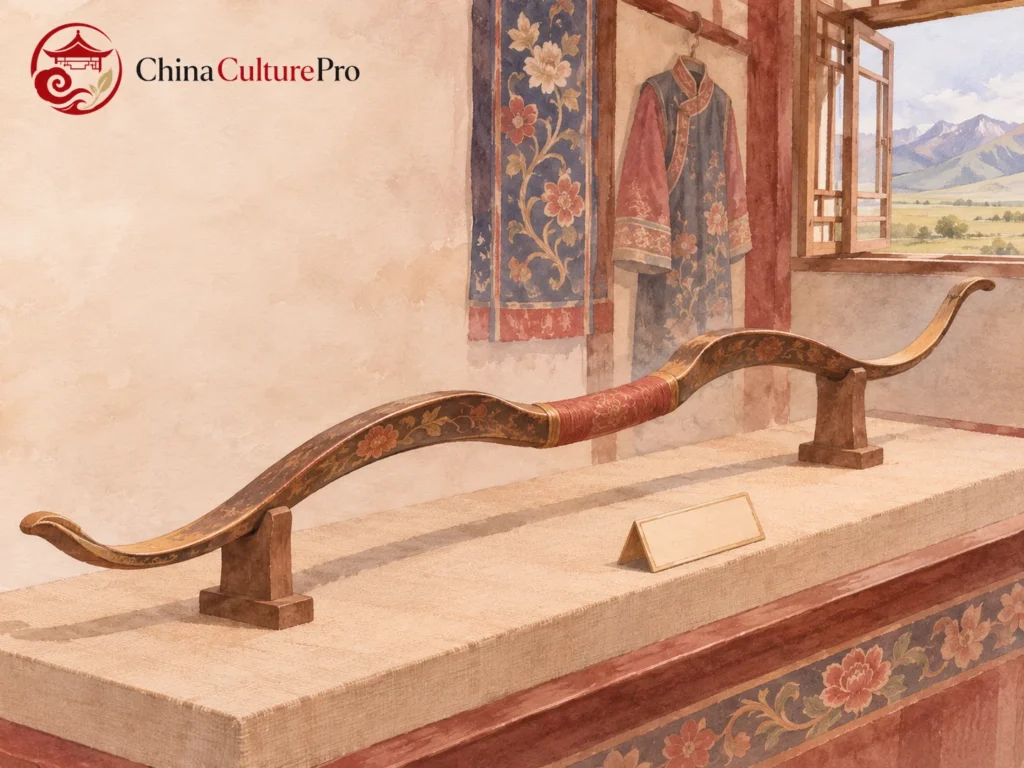
The record for practitioner Yi Chunguang refers to traditional horn bows, wooden bows and reproductions of historical bows associated with the Qing banner system. A label that names a reproduction helps distinguish its historical reference from the date of the object in front of you. Maker, period and documented use all help explain what the object represents.[2]
How the Craft Is Passed On
Yi Chunguang’s heritage biography describes learning from his father and continuing the practice as a recognised practitioner. The register connects him to historical objects by identifying the kinds of bows he reproduced.[2]
A China Daily report gives a later example in Qapqal. It describes Zhao Hu, a museum guide and archer who studied bow making with his father. His roles connect a family craft with a place where visitors learn about Xibe history. His example links the craft to a museum audience as well as a family workshop.[5]
Where the Craft and Sport Meet
Xibe archery entered the national inventory in 2021 as a separate extension under traditional sports, games and acrobatics. The archery entry records both competitive and ceremonial forms. A maker’s demonstration, a formal event and a target competition may each be presented under the general subject of archery.[3]
That distinction helps when reading a programme or visiting a museum. An exhibit can identify a craft practitioner and describe an object’s provenance. A festival can put archery in the company of other activities that remember the migration. A competition record will usually identify the sport and its participants.[1][3][4][5]
FAQs About Xibe Bow Making
Is Xibe Bow Making Listed as Intangible Heritage?
Yes. The national inventory added the Xibe bow and arrow making tradition to its craft entry in 2008. A separate Xibe archery entry followed in 2021.[1][3]
Are Xibe and Sibe the Same Name?
Yes. Xibe and Sibe are English spellings used for the community. The alternate spelling appears in English-language scholarship, which also identifies Qapqal Sibe Autonomous County.[5][6]
出典
[1] China Intangible Cultural Heritage Network. Xibe bow and arrow making
[2] China Intangible Cultural Heritage Network. Practitioner record for Yi Chunguang
[3] China Intangible Cultural Heritage Network. Traditional Xibe archery
[4] 中国無形文化遺産ネットワーク. Xibe Westward Migration Festival
[5] China Daily, Global Edition. Young people help preserve Xinjiang’s cultural heritage
[6] Cornell University eCommons. The Historical Phonology of Manchu Dialects, section on Sibe