


Quick Answer: What Is Sini Calligraphy?
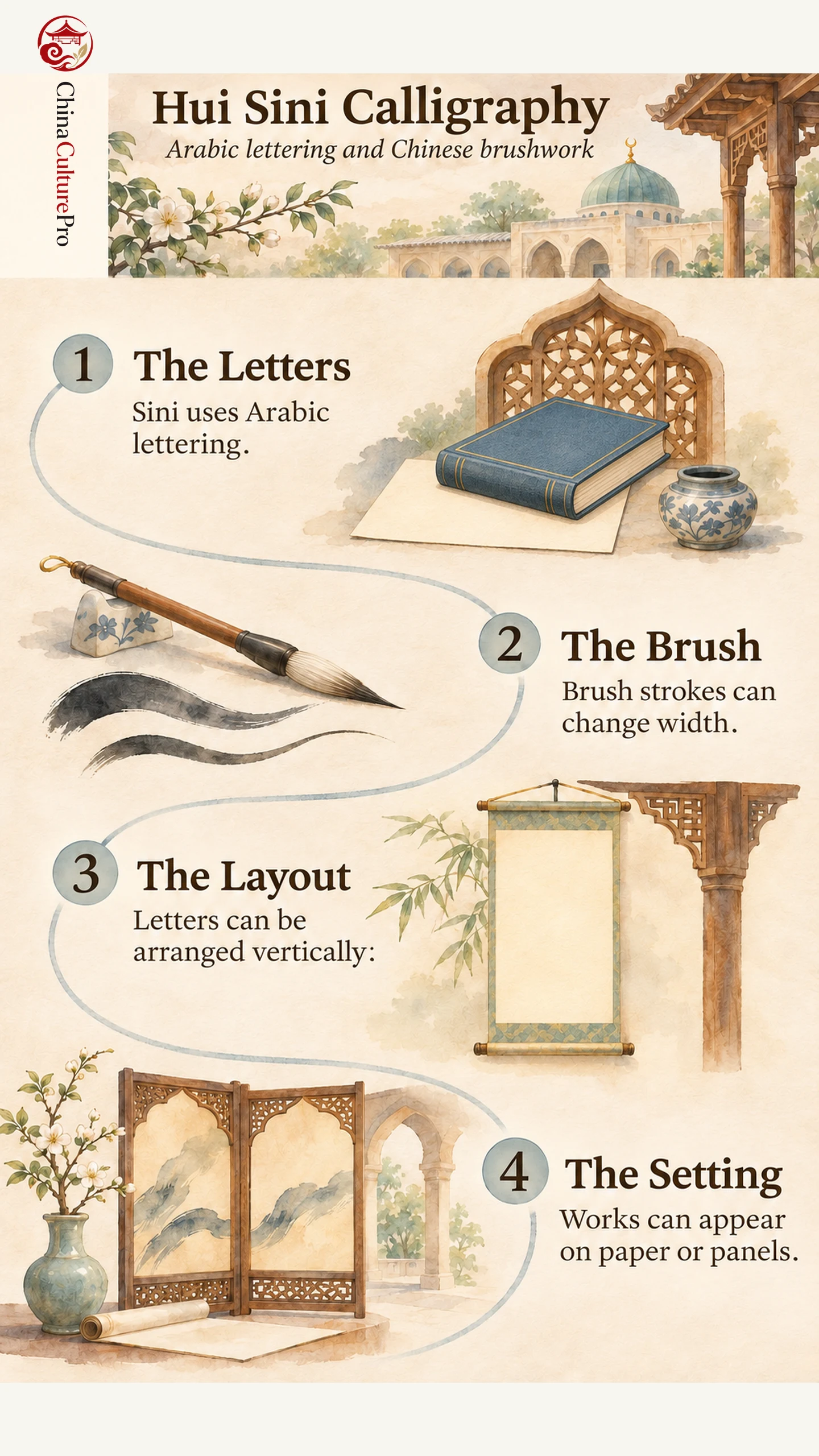
Sini is a Chinese tradition of Arabic calligraphy (阿拉伯文书法, Ālābówén shūfǎ) associated with Hui (回族, Huízú) and other Chinese Muslim communities. The name comes from an Arabic word meaning Chinese. Artists can use a Chinese brush to give Arabic letters a distinctive line and arrange them in different directions.[1][2][4]
- Brushwork can produce strong changes in stroke width.[1][2]
- A composition can read vertically or from right to left.[1][2]
- In one museum work, a single design reads as peace in both Arabic and Chinese.[2]
The language of the lettering and the visual arrangement are separate clues.
At a glance, the composition may look like a Chinese character. Look more closely at the strokes that make up the design. They can carry an Arabic reading too.
What to Look For in the Strokes
An ink brush can leave a full stroke that narrows as it lifts. Haji Noor Deen uses a brush of the kind associated with Chinese calligraphy. Sini works can retain right-to-left reading or arrange Arabic letters vertically. The layout tells you where to begin.[1][2]
How One Work Reads as Peace
Haji Noor Deen, also known as Mi Guangjiang (米广江, Mǐ Guǎngjiāng), made a work in the Asian Art Museum collection in which the shape of a Chinese character also contains Arabic lettering for peace. The Arabic part runs vertically. The composition gives the same idea two readings.[2]
Where Sini Calligraphy Appears
The brush style has appeared on paper and painted wooden panels, including display pieces in mosques. It gives lettering an architectural as well as a portable form. This is one point of connection between Chinese mosque architecture および Hui cultural traditions.[3][4]
Sini is also used more broadly in discussions of Chinese Islamic art. When a catalogue uses the term, its object description helps determine whether it names the script style or a wider artistic category.[4]
FAQs About Sini Calligraphy
Is Sini calligraphy in Arabic?
Its lettering is Arabic. Some compositions also build a Chinese reading into the same design.[2]
Does Sini always read vertically?
Artists can use vertical or right-to-left layouts.[1][2]
What tool gives the strokes their brush-like look?
A Chinese writing brush is documented in the practice of Haji Noor Deen.[1]
出典
[1] Museum for Islamic Art, Berlin. With Brush and Qalam: Chinese Arabic Calligraphy
[2] Asian Art Museum. Calligraphy by Haji Noor Deen
[3] University of Oxford Research Archive. The arts of the book and Chinese Arabic writing
[4] Middle East Institute. Islamic Calligraphy in China: Images and Histories