

Quick Answer: What Does Wok Hei Mean?
Wok hei(镬气,huòqì)is the fleeting, savory, lightly smoky aroma associated especially with well-executed Cantonese stir-frying. “Wok hei” is the Cantonese menu spelling; the pinyin here gives the Mandarin reading of the Chinese characters. It is often translated as “breath of the wok.”[1]
- A result: It describes a sensory quality, not a bottled seasoning.
- Several contributors: Hot pan contact, rapid evaporation, sauces and—in flame cooking—briefly heated or ignited oil droplets can contribute.
- A regional emphasis: It is particularly valued in Cantonese restaurant cooking, rather than a requirement for every Chinese dish.
- A short-lived impression: It is most noticeable when a suitable stir-fry is freshly served.
Visible smoke, a tall flame or blackened food does not by itself establish good wok hei. The goal is appealing aroma and properly cooked ingredients.

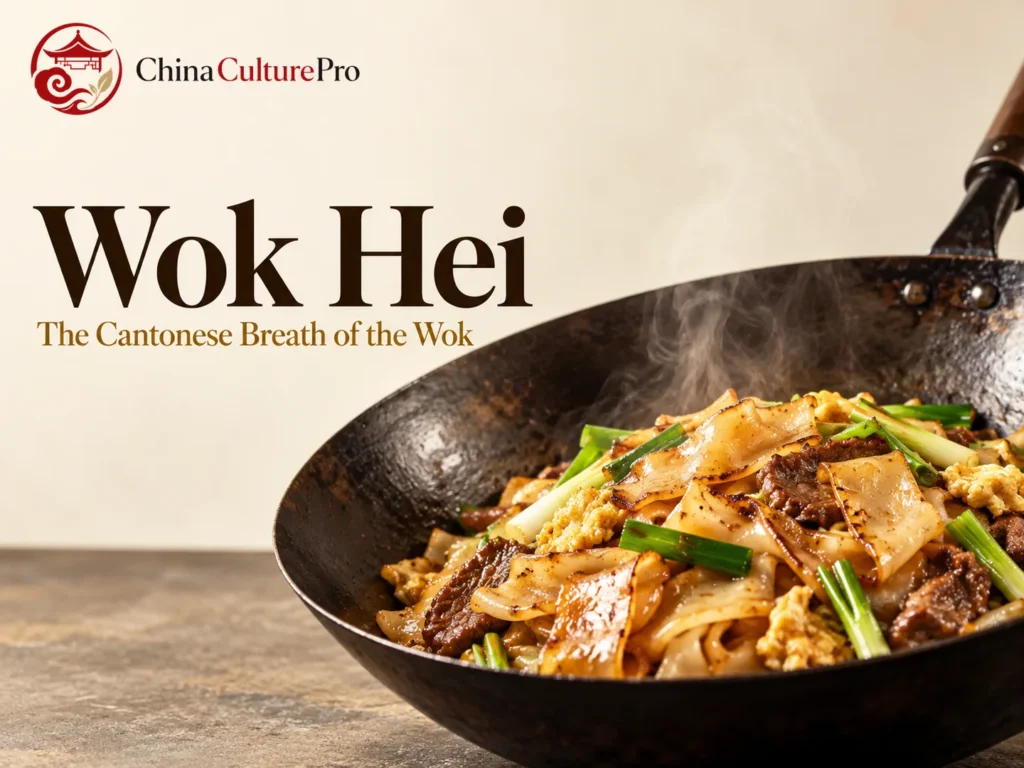
A plate arrives with fragrant noodles, a light toasted edge and a savory aroma that seems to fade as it cools. That experience helps explain wok hei more clearly than a photograph of a towering flame. The term describes what reaches the diner, not just what happens above the stove.
Recognizing Wok Hei in a Dish
Look for an integrated aroma: lightly smoky or toasted notes alongside the food’s own flavor and cooked seasoning. Wok hei should complement the dish. It is not a demand that every surface look dark, nor a reason for vegetables, seafood or meat to taste bitter.[1][5]
Aroma and texture work together. In a rice dish, distinct grains and a balanced coating of seasoning can accompany the fragrance. A greasy or wet plate may have been heated strongly without achieving the same result. Serve and taste the dish promptly; this is an especially immediate part of the meal.[5]
Heat, Moisture and the Sources of Aroma
Several processes overlap. A hot cooking surface and moving food help moisture escape quickly. When too much wet food enters at once, the pan cools and liquid accumulates; the ingredients spend more time cooking in accumulated liquid.[2][3]
Sauces are another source of aroma. Seasonings such as soy sauce can change flavor when they contact hot metal before being mixed through the ingredients. A seasoned pan, heat transfer and the way food moves through the hot space above it also contribute to the cooking environment.[2]
An open flame adds another possible contribution: tiny dispersed oil droplets can briefly ignite during professional tossing, adding smoky notes. This is different from merely browning food against hot metal. The combined effect should not be reduced to one ingredient, one reaction or a single visible burst of fire.[2]
Why Wok Hei Matters in Cantonese Cooking
Wok hei is especially associated with Cantonese cuisine, where timing and rapid wok work can be part of how a restaurant dish is judged. Fried rice and stir-fried chow fun are useful dishes in which to notice the quality, although the exact preparation matters.[1][3]
Fried rice illustrates why aroma alone is not the whole standard. Chefs also judge how the grains separate, how moist they remain and whether oil overwhelms the dish. Their ingredient sequences can differ while pursuing a comparable finished quality.[5]
This does not make wok hei an authenticity test for all Chinese food. Steaming, braising and other cooking methods pursue different results; even a stir-fry can be worthwhile without a pronounced smoky character.
What You Can Achieve in a Home Kitchen
A home cook can develop fragrant, well-textured stir-fries without reproducing every effect of a commercial wok station. Match the pan to the stove, prepare ingredients before heating, drain excess surface water and cook manageable batches. These choices address moisture and heat recovery more directly than simply setting the largest possible flame.[3]
Gas and induction differ physically: induction heats the compatible pan without an open flame, while a gas flame can interact with dispersed oil. High-temperature pan cooking can still create appealing aromas on induction. Separate the two targets: fragrant high-heat pan cooking is possible without gas; reproducing the open-flame contribution is a different question.[3][4]
For practical wok cooking at home, aim for controlled cooking rather than a fire display. Use cookware within its manufacturer’s limits, ventilate the kitchen and avoid deliberately heating oil until it smokes. Do not keep maximum heat throughout simply to chase an aroma.[6]
Wok Hei, Steam and Burnt Food: The Differences
Use the finished dish as the reference. These observations are related to high-heat cooking, but they are not interchangeable measures of success.
| Observation | What it does—and does not—tell you |
|---|---|
| Wok hei | A fleeting savory, lightly smoky aroma integrated with the cooked dish; judged alongside texture and seasoning. |
| Steam | Escaping water vapor. Some evaporation is part of cooking; a large cloud alone does not prove the desired aroma. |
| Burnt food or smoking oil | A sign to reassess the heat and ingredients, not a shortcut to flavor. Acrid bitterness and blackened residues are not the objective. |
FAQs About Wok Hei
Is Wok Hei an Ingredient?
No. It is a quality produced during cooking, rather than a powder, sauce or seasoning you add from a jar.
Is Wok Hei Just Burnt Food?
No. The desired impression is fragrant and integrated with the dish. Harsh bitterness or scorched ingredients should not be excused as wok hei.
Does Every Stir-Fry Need Wok Hei?
No. It is especially useful for describing certain Cantonese restaurant stir-fries. Other dishes and home preparations can succeed through different textures and flavors.
Can Induction Cooking Produce Wok Hei?
It can produce the high-heat aromas many cooks include under the term. It does not reproduce open-flame contact with oil droplets, so the complete sensory result can differ.
出典
[1] MICHELIN Guide. Kitchen language: what is wok hei?
[2] J. Kenji López-Alt. An updated guide to wok cooking and care
[3] J. Kenji López-Alt. Wok questions: heat, moisture and home cooking
[4] The Switch Is On. A cooking demonstration and interview with Martin Yan
[5] MICHELIN Guide. Chefs explain the qualities of fried rice
[6] Hong Kong Centre for Food Safety. Comparison of home cooking methods