


Quick Answer: When Is Dongzhi and How Is It Observed?
Winter Solstice, or Dongzhi (冬至, Dōngzhì), is a solar term usually dated December 21 or 22 in East Asia. Hong Kong’s calendar lists December 22 in both 2026 and 2027. Families and communities mark the occasion with reunion meals, festival foods and, in some places, offerings. [1][2][3][4]
- Northern China: Wheat dumplings (饺子, jiǎozi) are a familiar example. [4][5]
- Southern China and Singapore: Examples include glutinous rice balls called tangyuan (汤圆, tāngyuán). [5][6][7]
- Hong Kong: A family meal is a well-known way to mark the occasion. [8]
The solar term supplies the date; households choose how to observe it. [1][5][7][8]
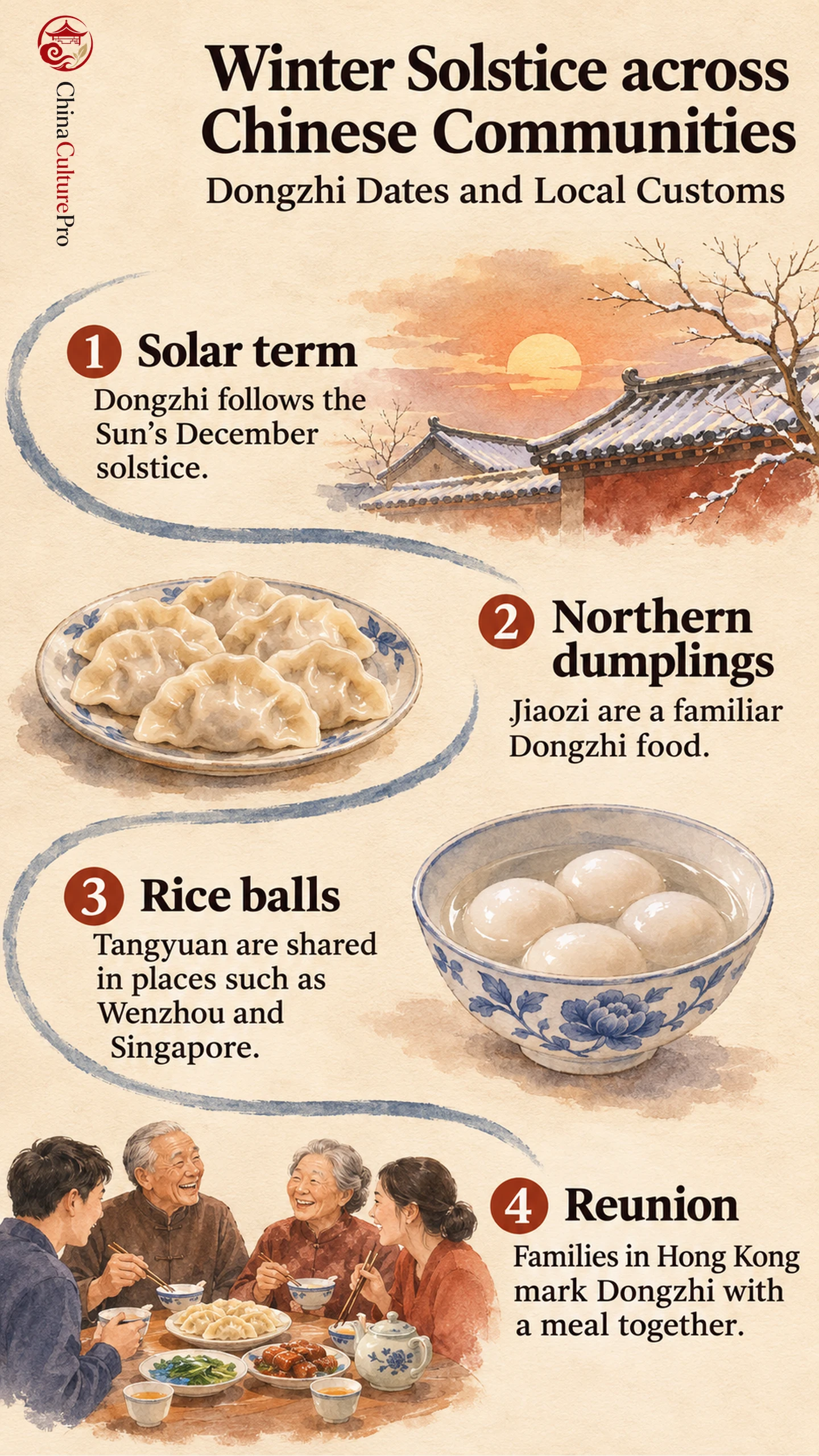
For some Singapore families, the smell of a bowl of sweet rice balls marks Dongzhi. In Hong Kong, the expression for observing the solstice can bring to mind a family dinner. The two customs travel with families even in places where December feels very different. [6][7][8]
The Date Comes from the Sun
Dongzhi begins when the Sun’s apparent ecliptic longitude reaches 270 degrees. It is the December solstice, when daylight is at its shortest across much of the Northern Hemisphere. The Hong Kong Observatory’s almanac places it on December 22 by Hong Kong time in 2026. Its 2027 calendar gives the same date. [1][2][3]
Dongzhi is one of the 24 solar terms. The day of a numbered lunar month can vary from year to year. The calendar uses the solstice to help anchor its month numbering: the lunar month containing the solstice is month eleven. [1][2][3][9]
What Families Put on the Table
In northern China, jiaozi are a familiar Dongzhi food. A 2025 report showed children in Tangshan, Hebei, making dumpling-themed crafts around the observance. In Wenzhou, the same report showed children eating tangyuan. These events show how a holiday food becomes part of teaching the custom to children. [4][6]
The menu can vary within southern and eastern China. A cultural guide published by Shanghai describes tangyuan in Shanghai, wontons in Suzhou and rice cakes in Hangzhou. The Hangzhou example includes giving the cakes to relatives and using them as offerings. [5]
Reunion and Remembrance in Hong Kong and Singapore
In Hong Kong, the Cantonese expression zo dung (做冬, zou6 dung1) refers to observing Winter Solstice. A Hong Kong government account describes relatives coming together for the meal and talking about earlier family life. The meal gives relatives a reason to set aside an evening together. [8]
Singapore Chinese Cultural Centre records winter-solstice bowls of tangyuan as a way for families to gather. The centre’s exhibition also describes older observances involving offerings to deities and opera performances in villages. The family meal is one expression of the festival’s wider history. [7][10]
FAQs About Dongzhi across Chinese Communities
Is Dongzhi always on December 22?
The date can move with the year and time zone. In the Hong Kong Observatory’s tables it falls on December 22 in 2026 and 2027. [1][2][3]
Does every family eat the same food at Dongzhi?
Documented examples include jiaozi in northern China, tangyuan in Wenzhou and Singapore, and other local dishes such as wontons in Suzhou. Many families emphasize the meal together. [4][5][6][7][8]
出典
[1] Hong Kong Observatory. The 24 Solar Terms
[2] Hong Kong Observatory. Hong Kong Observatory Almanac 2026
[3] Hong Kong Observatory. 2027 Gregorian–Lunar Conversion Table
[4] Xinhua / State Council Information Office. People across China Mark Winter Solstice
[5] China Daily / Shanghai Municipal Government. Things You May Not Know About Winter Solstice
[6] Xinhua / State Council Information Office. Winter Solstice in Wenzhou
[7] Singapore Chinese Cultural Centre. My Little Cookbook, Tangyuan
[8] Hong Kong Information Services Department. Hong Kong Letter
[9] Purple Mountain Observatory. Explanation of the Chinese Calendar Standard
[10] Singapore Chinese Cultural Centre. Winter Solstice Exhibition Panels