

Quick Answer: What Is True vs Mean Solar Time?
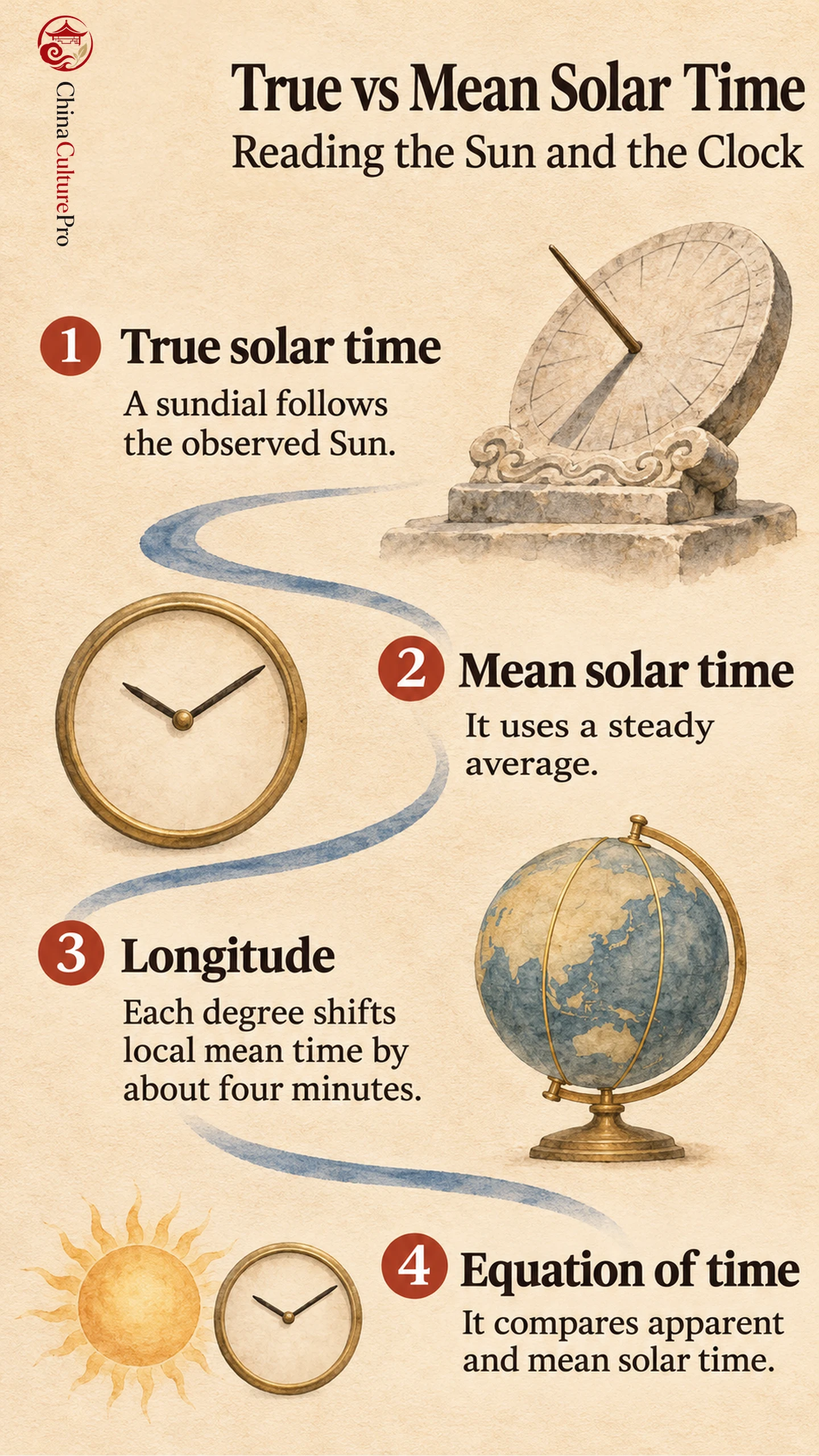
True solar time (真太阳时, zhēn tàiyáng shí), also called apparent solar time, follows the observed Sun. Mean solar time (平太阳时, píng tàiyáng shí) uses a steady average. Civil time is the clock time shared across a zone. A Chinese sundial shows local apparent time, which can differ from both local mean time and the civil clock. [1][2][3]
- True solar noon: It occurs when the Sun crosses the local meridian. [1]
- Longitude correction: A site west of the zone meridian has an earlier local mean time by about four minutes per degree. [1][3][4]
- Seasonal correction: The equation of time (时差, shíchā) gives apparent minus mean solar time in the U.S. Naval Observatory convention. [1][4]
For a clock-to-Sun comparison, account for both longitude and the date. [1]
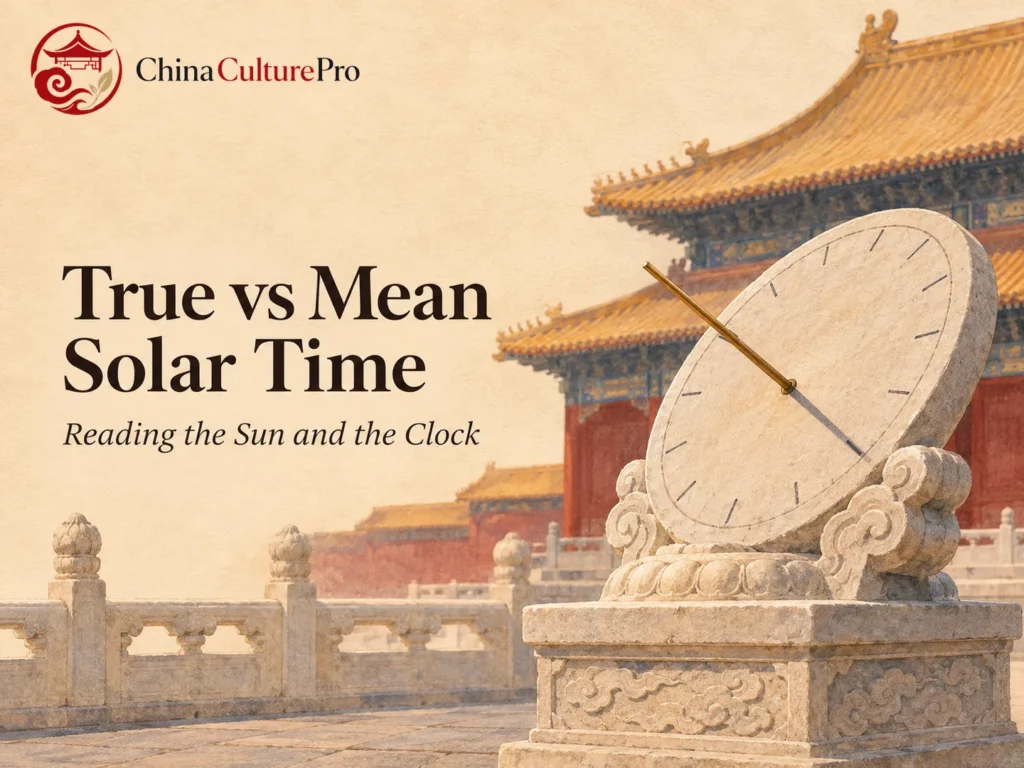
An equatorial sundial (赤道式日晷, chìdàoshì rìguǐ) stands on the raised platform of the Hall of Supreme Harmony in Beijing’s Forbidden City. Its shadow tells time by the local Sun. A watch set to the zone time uses the same clock reading across the zone. The difference between its reading and the dial changes with the date. [1][2][5]
What a Chinese Sundial Measures
In an equatorial sundial, the dial is parallel to Earth’s equator and the shadow-casting rod is aligned with Earth’s axis. The rod’s shadow marks the Sun’s apparent movement across the dial. True solar noon is the Sun’s crossing of the local meridian, which runs north to south through the observer’s location. [1][2]
The interval between successive apparent noons varies slightly over the year. Earth’s tilted axis and uneven orbital speed contribute to that variation. Mean solar time averages the Sun’s daily motion. Over the course of a year, a sundial can run ahead of or behind local mean time, with the difference reaching roughly a quarter of an hour. [1]
How Longitude and the Date Change the Reading
Purple Mountain Observatory explains that Beijing time (北京时间, Běijīng shíjiān) uses the standard meridian at 120 degrees east for the UTC+8 zone. A location at 115 degrees east lies five degrees west of that meridian. At four minutes per degree, its local mean solar time is about 20 minutes behind the zone clock. [1][3][4]
At 12:00 on that zone clock, local mean solar time would be about 11:40. Suppose the date’s equation of time is plus 10 minutes, using apparent minus mean. The sundial would then read about 11:50. In this example the longitude changes the reading by minus 20 minutes and the seasonal correction adds 10. The plus 10 is hypothetical. Use the equation of time for the date you are comparing. [1][4]
Reading Traditional Hours Alongside Modern Clocks
Historical Chinese timekeeping used double hours (时辰, shíchén). The noon period, wu (午, wǔ), is conventionally shown as 11 a.m. to 1 p.m. in modern time charts. On an apparent-solar dial, the middle of the noon period marks local solar noon. The modern clock equivalents in a chart give the approximate span of the named period. [2][5][6][7]
A source may describe a shadow reading, a water-clock reading or a later clock reading. The two corrections in the worked example apply when translating a modern zone-clock reading into local apparent time. To interpret a dated historical record, first establish the original system and location. [1][5][6]
FAQs About True and Mean Solar Time
Is solar noon always at 12:00 on a watch?
It is 12:00 in local apparent solar time. On a civil clock its time depends on the site’s longitude within the zone and the equation of time for the date. [1][3]
Do I add or subtract the equation of time?
With the U.S. Naval Observatory convention, add the signed value to local mean solar time to obtain apparent solar time. Check the sign convention used by the table. [1]
出典
[1] U.S. Naval Observatory. The Equation of Time
[2] Palace Museum. Equatorial Sundial
[3] Hong Kong Observatory. Local Time
[4] Purple Mountain Observatory. Basic Almanac Terminology
[5] United Nations Office for Outer Space Affairs. Ancient Chinese Navigation Technology
[6] Palace Museum. Qing Horizontal Sundial
[7] Shigu District Government. Reading the Twelve Double Hours