


Quick Answer: What Is Twin Pines, Level Distance?
Twin Pines, Level Distance(双松平远图,Shuāngsōng píngyuǎn tú) is an ink-on-paper handscroll by Zhao Mengfu(赵孟頫,Zhào Mèngfǔ), dated approximately 1310 and kept in New York’s Metropolitan Museum of Art.[1]
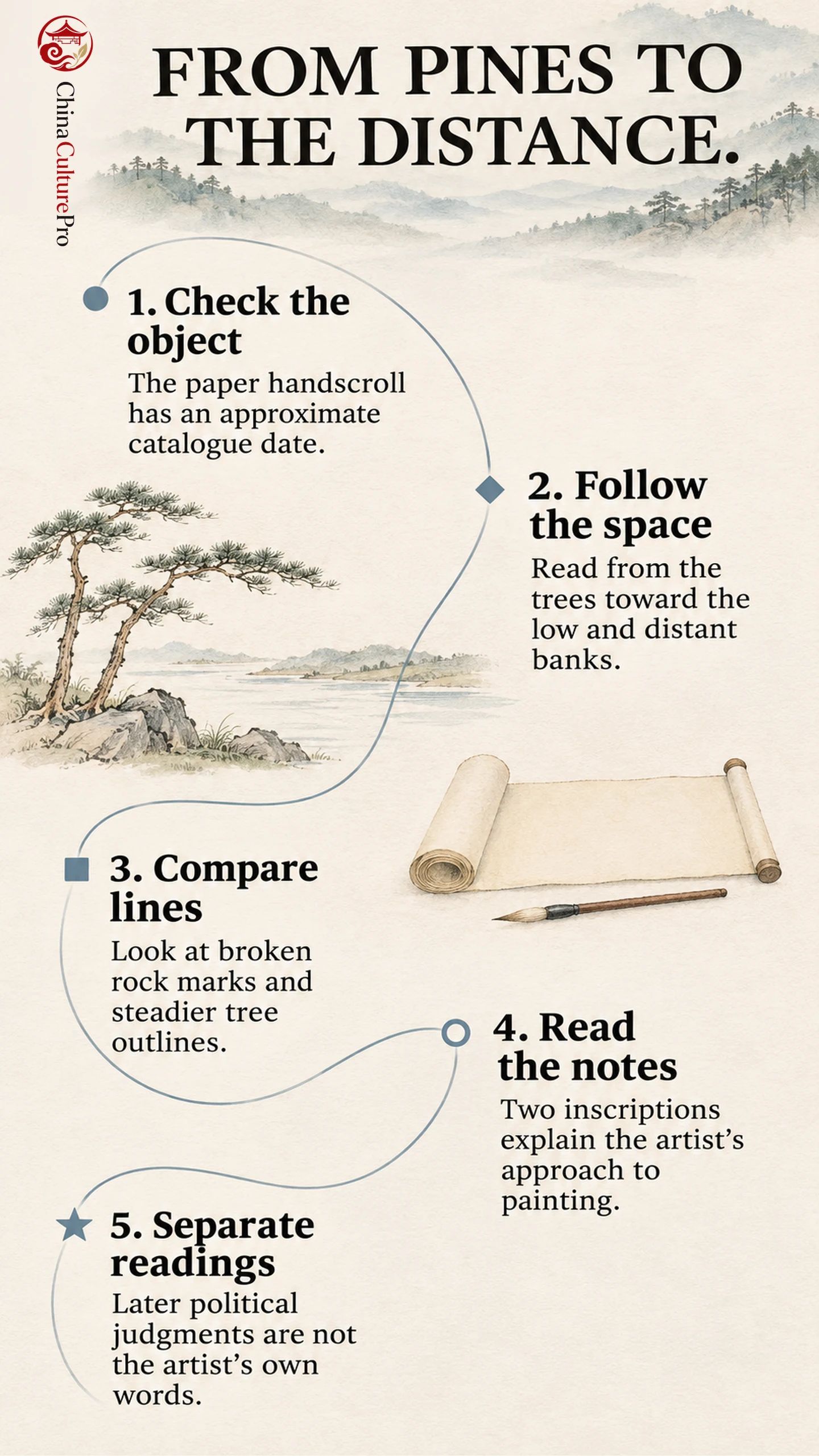
- Reading direction: Begin with the trees at the right and continue toward the low distance at the left.
- Brushwork focus: Compare the pines’ outlined trunks with the broken marks on the rocks.
- Written evidence: Two inscriptions by the artist identify the subject and explain an approach to painting.
The approximate catalogue date should not be mistaken for a year written in those inscriptions.
Two pines stand on a rocky bank, with most of the river left open around them. A small boat and distant ridges prevent that openness from becoming an empty background. At the far left, writing enters the landscape itself. This spare arrangement makes the relationship between picture and handwriting central to looking, rather than a detail to consider afterward.
The Ink-on-Paper Handscroll and Its Approximate Date
The painted image measures 26.8 × 107.5 cm and has the accession number 1973.120.5. The mounted object is substantially longer. Its material is paper, and its date is given as about 1310.[1]
Those distinctions matter when comparing photographs. An image of the landscape, a detail of an inscription and a view of patterned mounting fabric are parts of the same object’s documentation, but they do not show the same thing. The width of the entire mounted scroll is not the width of the painted scene.
The horizontal format also establishes a viewing sequence. Rather than starting in the middle as if looking through a window, follow successive stretches from right to left. The guide to Chinese hanging scrolls and handscrolls explains the physical basis for this changing field of attention.
Reading from the Pines toward the Low Distance
Begin at the right with the cluster of rocks supporting the two trees. One trunk rises more directly, while the other bends outward before its branches spread. Small bare twigs appear between the larger forms. The pines are distinct, but their proximity joins them into a single foreground group.
Move left along the bank. Its outlines stretch outward and become thinner, allowing a large interval of open paper to separate foreground and distance. Farther back, long low contours carry small clusters of vertical marks. These quieter forms do not compete with the foreground trees’ height.
A tiny boat sits within the open water. It is easy to overlook, yet its small scale makes the surrounding interval feel larger. Look from the boat back to the rocks, then toward the distant bank. The space becomes legible through their relationships, without requiring an evenly detailed surface throughout.
This is a useful example of Chinese landscape painting in which a few emphatic forms organize an extensive view. “Level distance” describes the low, outward reach across the scene; it does not mean that all its elements occupy one flat plane.
Calligraphic Lines in Rocks and Trees
The rocks have angular edges and dark strokes interrupted by pale breaks. Their handling is associated with flying white(飞白,fēibái), while the steadier outlines of the trees are compared with seal script(篆书,zhuànshū).[1] These are comparisons between ways of using the brush, not claims that the rocks and trunks are written characters.
Inspect the large rock beside the trees. Its darker upper edge does not continue as one uniformly solid band. Smaller broken marks describe parts of its surface, while much of the interior remains light. The outline can be forceful without turning into a fully shaded model of a boulder.
The trunks offer a different rhythm: paired edges, internal bark marks and curving branches. Fine needles radiate from small clusters rather than merging into broad foliage washes. Comparing those marks is more revealing than simply calling the entire picture monochrome. The guide to Chinese painting techniques provides further context for line, texture and ink strength.
The Artist’s Two Inscriptions and Earlier Models
The short inscription beside the pines says that Zi’ang(子昂,Zǐ’áng), Zhao’s courtesy name, playfully made the work. The longer inscription at the left describes painting as something pursued alongside calligraphy.[2]
Its argument looks backward. Zhao recalls the difficulty of encountering exceptional Tang paintings, then contrasts the brush intention(笔意,bǐyì) of earlier masters with that of more recent painters. He does not claim to equal the ancients; he claims a difference from his nearer contemporaries. The text ends by saying that the painting was requested by Dong Yeyun(董野云,Dǒng Yěyún).[2]
The inscriptions give the economical drawing a stated artistic context. The painter explicitly compares his work with earlier brush traditions. The writing also occupies space over the distant landscape instead of remaining entirely outside it. Reading painting inscriptions and seals separately from the image would miss that interaction.
Survival as an Interpretation, Not a Fixed Code
Pines can carry associations of endurance. A political interpretation connects this pair with Zhao’s survival under Yuan rule and the persistence of Chinese culture, but that is a possible reading rather than a confession written into the painting.[1]
Later responses reveal how politically charged his reputation could become. Tong Xuan(童轩,Tóng Xuān), writing afterward, praised Zhao’s talents while questioning his service to Yuan rulers as a descendant of the Song imperial family.[2] That judgment belongs to a later reader, not to the artist’s own inscription.
Keep these layers distinct: visible trees, Zhao’s argument about brush traditions and subsequent judgments about his career. Together they enrich the work’s history. They do not turn two pines into a code with only one permitted interpretation.
FAQs About Twin Pines, Level Distance
Is 1310 written on the scroll?
The artist’s two inscriptions are undated. About 1310 is the catalogue dating, not an inscribed year.[1][2]
Why is so much of the image left open?
The open interval separates the nearby trees and rocks from the distant banks. The small boat helps make that space readable.
Is this Wu Zhen’s Twin Pines?
No. Wu Zhen’s Twin Pines is a different painting. The artist’s name and collection help distinguish shortened titles.
出典
[1] The Metropolitan Museum of Art. Twin Pines, Level Distance, 1973.120.5
[2] InscrChArt, Miami University Libraries. Twin Pines, Level Distance: inscriptions and colophons