

Quick Answer: What Is Three Variations on Yangguan?
Three Variations on Yangguan (Yangguan Sandie, 阳关三叠, Yángguān Sāndié) is a work associated with the guqin (古琴, gǔqín) and a farewell poem by the Tang poet Wang Wei (王维, Wáng Wéi). It is heard as both a qin song (琴歌, qíngē) and an instrumental piece.[1][2][5]
- Poem: Wang Wei sees a friend off on a journey west past Yang Pass.[1][2]
- Score: A University of Pittsburgh recital identifies a qin source dated 1491.[3]
- Listening: The Smithsonian records Yi Zhou’s qin performance as The Three Farewells of Yang Guan.[5]
Use the performer and score credits to distinguish sung and instrumental settings.
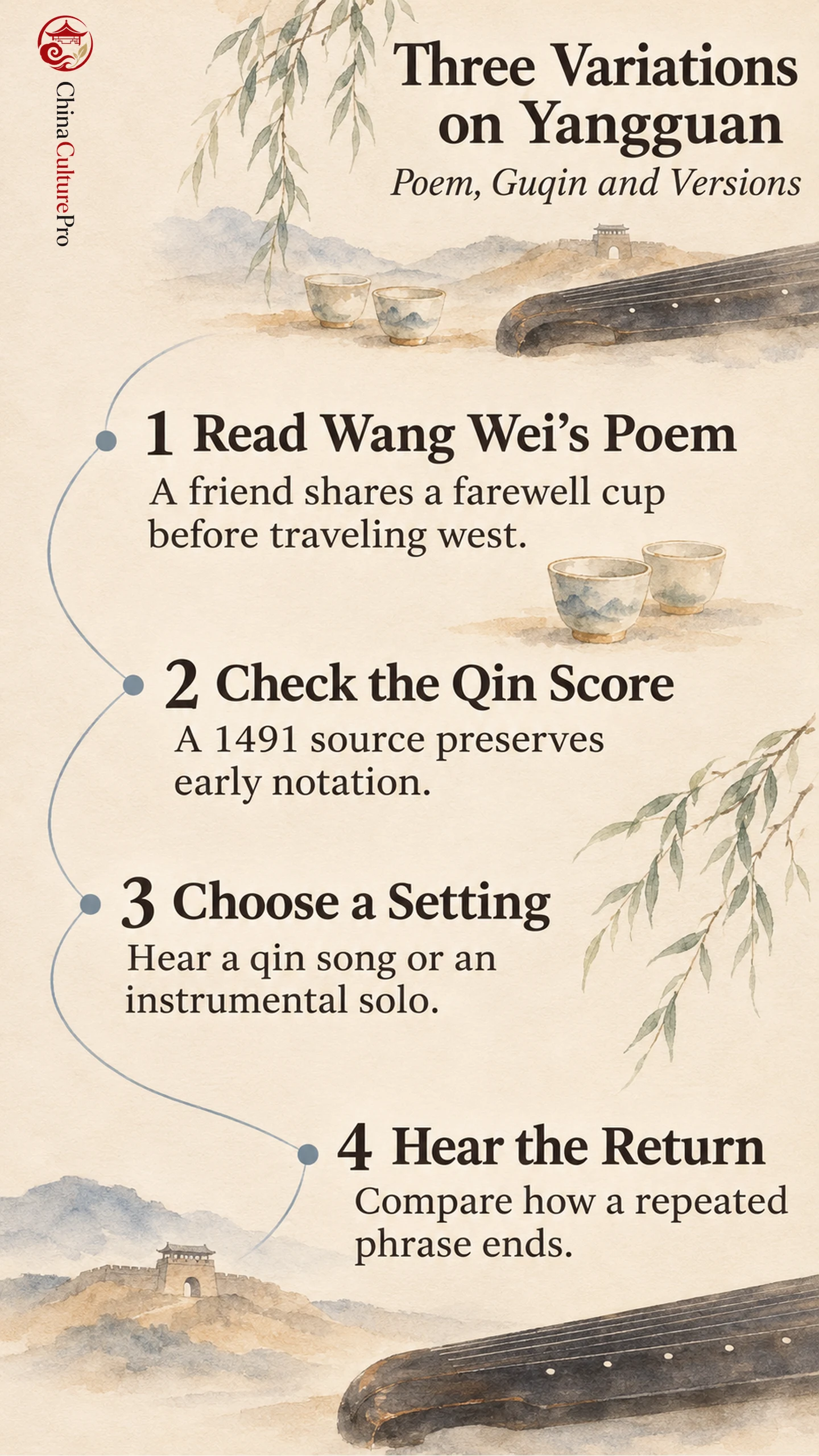
The farewell begins with a simple gesture. A friend is asked to share one more cup before leaving. In a sung rendition, words carry the moment. In a solo qin version, a phrase can return and make the hesitation audible.
The Farewell in Wang Wei’s Poem
The poem also appears as Song of Weicheng および Seeing Yuan the Second Off on a Mission to Anxi. Morning rain and fresh willows set the scene. Then the invitation to share another cup turns the poem toward the distance between the two friends. The parting connects with other Chinese friendship and farewell poems and with the wider work of Wang Wei.[1][2]
What the Qin Scores Preserve
A University of Pittsburgh recital identifies a 1491 source in Zheyin Shizi Qinpu. The Chinese University of Hong Kong archives a score from a later edition of Qinxue Rumen compiled by Zhang He. Use the handbook name to distinguish versions with the same musical title.[3][4]
The familiar title refers to threefold repetition, but the words and musical organization differ among surviving sources. Comparisons document versions that repeat and vary lines in different ways. When a recording includes a score credit, use it to identify the setting you are hearing.[2][7]
Find a Sung or Instrumental Setting
| Recording | Performer | Catalog location |
|---|---|---|
| Smithsonian Han Tang Ensemble concert | Yi Zhou, qin | 21:25 to 25:50 |
| Tsinghua University’s Plum Blossom CD | Yang Lining, guqin | Track 2, 4:50 |
The Smithsonian program lists Three Variations on Plum Blossom as the next, separate track. Tsinghua’s disc also includes both works under separate entries.[5][6]
Listen for the Return of a Phrase
In a sung version, notice where a repeated line sounds more urgent or slows before its ending. Then hear a solo guqin recording and listen for how the pluck, timing or pitch changes when a phrase returns. For another qin piece shaped by separation, try Memories of an Old Friend. Songbie offers a later song with a different melody and source history.
FAQs About Three Variations on Yangguan
Who wrote the poem associated with Yangguan Sandie?
Wang Wei wrote the Tang poem also known as Song of Weicheng.[1]
Is Yangguan Sandie always sung?
Qin-song settings use the poem or expanded words. It is also performed as a guqin solo.[2][5][7]
Is it the same piece as Three Variations on Plum Blossom?
They are separate works with distinct titles and material. Both appear as individual tracks in the Smithsonian and Tsinghua listings.[5][6]
出典
[1] Chinese Text Project. Complete Tang Poems: Song of Weicheng by Wang Wei
[2] Association for Asian Studies. The Qin: China’s Most Revered Musical Instrument
[3] University of Pittsburgh Department of Music. Lecture-Recital on the Qin
[4] Chinese University of Hong Kong Library. Parting at Yang Guan: Archive Score
[5] Smithsonian National Museum of Asian Art. Traditional Chinese Music: The Han Tang Ensemble
[6] Tsinghua University Library. Three Variations on Plum Blossom CD
[7] Silkqin. Yang Guan Qu and Other Settings of Wang Wei’s Poem