


Quick Answer: What Is Rain Lashing the Plantains?
Rain Lashing the Plantains (Yu Da Ba Jiao, 雨打芭蕉, Yǔ Dǎ Bājiāo) is a work in the Cantonese instrumental repertory. Early sources preserve a pipa (琵琶, pípá) version in which short plucks suggest drops falling on broad leaves.[3][4]
- Early print: A festival note names Yau Hok-chau’s enlarged 1921 collection.[1]
- Versions: Programs list a five-piece ensemble, a qinqin (秦琴, qínqín) setting and other arrangements.[1][2][6]
- Listening cue: Follow the short notes and the space between them.[5]
Check the lead instrument and arrangement before comparing two versions.
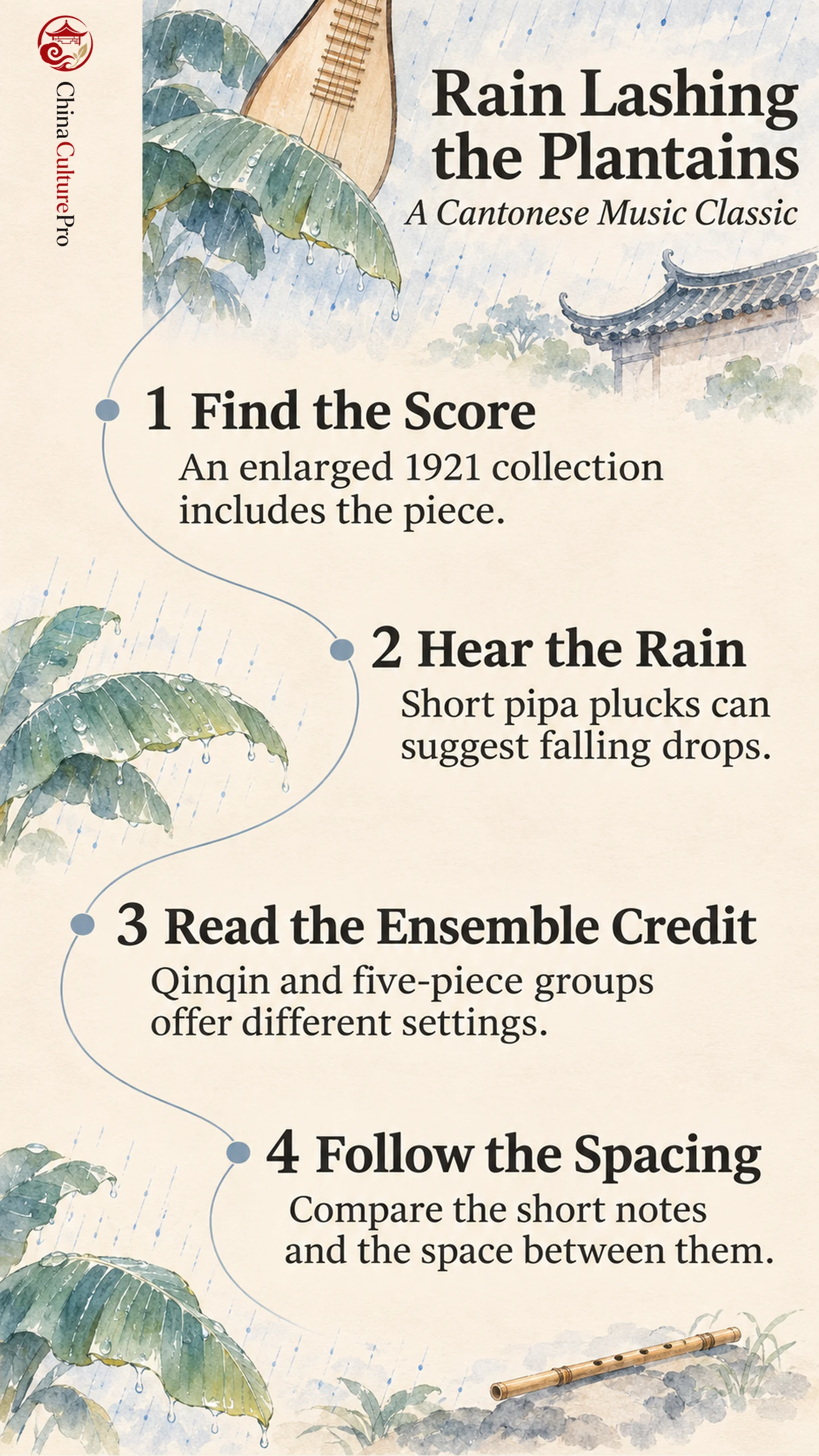
Listen for the rain effect in the spacing of the notes. A few separate plucks give the ear a chance to pick out each attack. When the figures arrive closer together, they can suggest a steadier shower.
Early Scores and Differing Credits
The Macao International Music Festival cites the enlarged 1921 collection compiled by Yau Hok-chau. A score study identifies a 1916 printed source as well. Hong Kong program notes also cite the 1934 pipa collection associated with Ho Lau-tong and He Yunian. Use the edition year to identify a source when an archive lists more than one score.[1][3][4]
The Macao program credits the work as traditional. Hong Kong Chinese Orchestra notes attribute it to Ho Lau-tong. When looking up a particular performance, match the Chinese title and the score or arranger credit on the program.[1][2]
Why the Plucks Sound Like Rain
An individual pipa note can begin with a crisp pluck and fade quickly. Short separated notes and compact phrases evoke the patter described in the Shawan fieldwork report. Listen for changes in the gaps between notes as well as their speed.[5]
Different program descriptions hear a melancholy touch in a pipa version and a lighter quality in ensemble renditions. Try comparing how much resonance fills the gaps in each setting.[3]
From Pipa to Cantonese Ensembles
Macao’s program lists a Cantonese soft-bow five-piece group.[1]
Hong Kong Chinese Orchestra programs a version led by Yuen Shi Chun on the seven-lu qinqin, with end-blown bamboo flute, yehu and percussion. Windpipe Chinese Music Ensemble has a program credit for Pan Yongzhang’s string-and-wind arrangement.[2][6]
For a Jiangnan comparison, hear how flute and strings share the line in an arrangement of Purple Bamboo Melody. In the rain piece, compare those melodic handoffs with the way short notes imitate falling drops.
Compare the Density of a Phrase
Pick a sequence of short notes and hear whether each one remains distinct. Try the same passage in another version and listen for a bowed or sustained sound behind it. Then compare how a sustained Cantonese melody moves in Autumn Moon Over a Calm Lake or how short figures keep the pulse in Step by Step Higher.
FAQs About Rain Lashing the Plantains
Who wrote Rain Lashing the Plantains?
Programs differ. Macao lists traditional music, while a Hong Kong Chinese Orchestra note attributes the work to Ho Lau-tong.[1][2]
Is the tune always played on pipa?
Its early pipa scores are joined by versions for a qinqin-led group and other ensembles.[1][2][6]
What is another English title for the piece?
Several concert programs use Rain Lashing on the Plantain. The Chinese title is Yu Da Ba Jiao.[2][3]
出典
[1] Macao International Music Festival. Contemporary Meets Tradition: Programme Notes
[2] Hong Kong Chinese Orchestra. Favourite Tunes in Cantonese Music 2021
[3] Hong Kong Leisure and Cultural Services Department. The Flowing Water and the Drifting Clouds: Programme Notes
[4] Huain. A Study of the Origins of Rain Lashing on the Plantain
[5] Guangzhou University Guangfu Culture Research Centre. Fieldwork Report on Music in Shawan
[6] Hong Kong Arts Events Databank. Echoes of Home: Music of Greater Guangdong