

Quick Answer: What Is The Sword Stained with Royal Blood?
The Sword Stained with Royal Blood (碧血剑, Bìxuè Jiàn) is a wuxia (武侠, wǔxiá) novel by Jin Yong (金庸, Jīn Yōng). It follows Yuan Chengzhi (袁承志, Yuán Chéngzhì), the fictional son of a late Ming commander. His family history brings him into the conflicts of the period, and the discoveries he makes on Mount Hua draw him into another man’s unfinished story.[4][5]
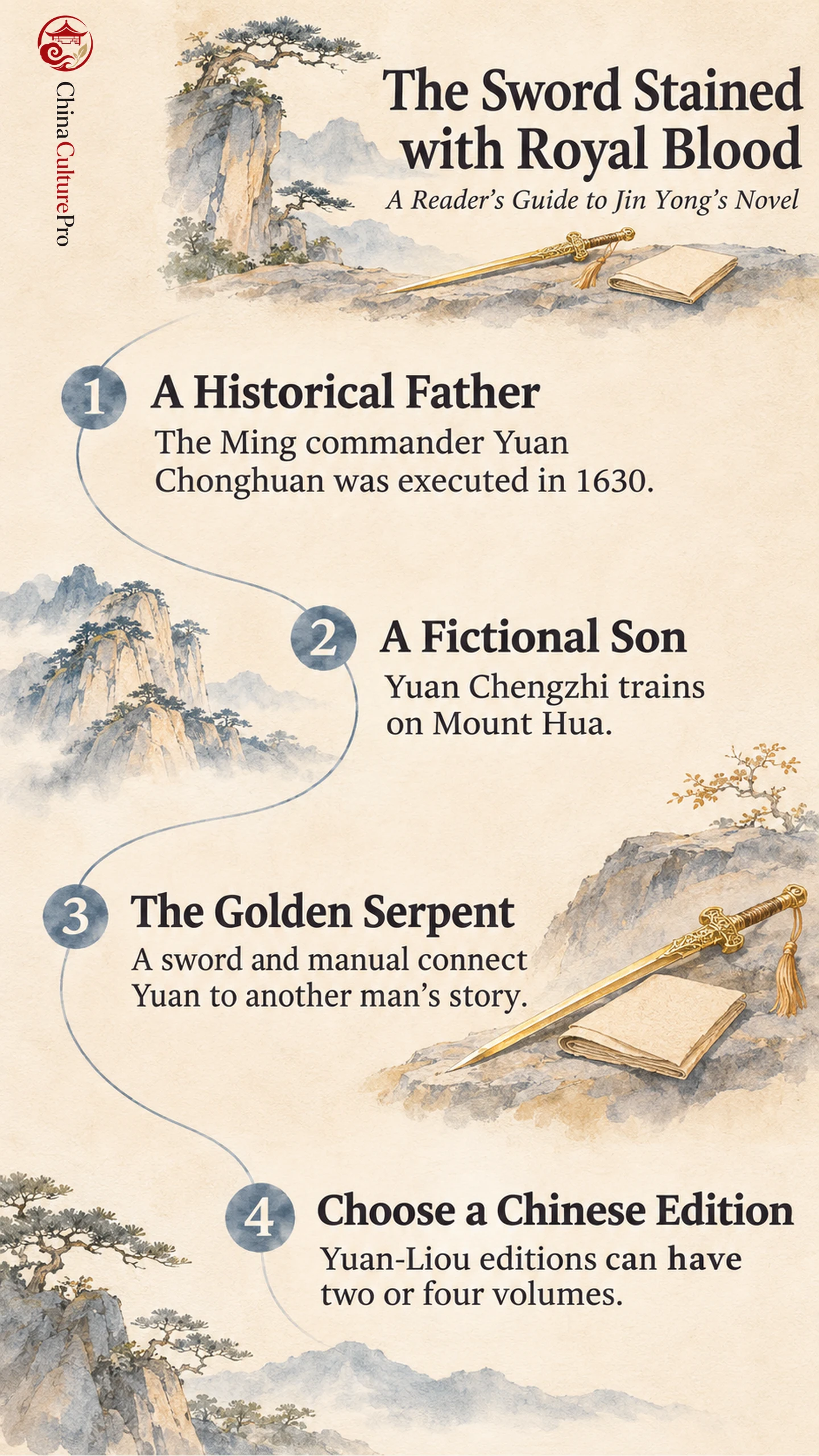
- The historical figure: Yuan Chonghuan (袁崇焕, Yuán Chónghuàn) was a Ming military commander executed in 1630.[3]
- The swordsman of the past: Xia Xueyi (夏雪宜, Xià Xuěyí), the Golden Serpent Gentleman (金蛇郎君, Jīnshé Lángjūn), leaves behind the Golden Serpent Sword (金蛇剑, Jīnshé Jiàn) and material that Yuan studies.[5][6]
- The newspaper serial: Hong Kong Commercial Daily published the story from January through December 1956.[1]
- The editions: A two-volume Yuan-Liou book and a four-volume revised large-print set are separately documented.[2][7]
This guide covers Yuan’s early discoveries and the historical setting. It leaves the later relationships and military outcomes for the novel.
A book in the mountain cave looks like a way to learn how someone fought. As Yuan Chengzhi works through its problems, it also becomes a way to find out what that person wanted. The note accompanying the treasure map asks its finder to seek out a woman.[5][6]
The same habit of reading past the object helps with the novel as a whole. The name Yuan inherits already means something to his father’s followers. The manual brings him into another history whose meaning he has to work out for himself.
Who Are Yuan Chonghuan and Yuan Chengzhi?
Yuan Chonghuan helped defend the Ming frontier in Liaodong against the Later Jin. He was executed under the Chongzhen emperor in 1630.[3] The Ming dynasty is the historical frame for those events. His military career gives Jin Yong a starting point for an imagined family story.
Yuan Chengzhi, the protagonist, trains under Mu Renqing in the Mount Hua martial school. His father’s death shapes what others expect of him as he grows up and enters the world beyond the school.[4][5]
The parent’s reputation reaches people long before the son has had a chance to make his own.
Some editions include Jin Yong’s separate biographical essay on Yuan Chonghuan after the novel.[2] The book’s two parts invite different kinds of attention. In the story, ask how knowing the father’s fate changes someone’s treatment of the boy. In the essay, follow the author’s account of the commander and the court that judged him.
What the Golden Serpent Leaves Behind
The cave on Mount Hua gives Yuan access to the earlier swordsman’s belongings and a way to study his techniques.[5]
As Yuan works through the manual, he wonders whether its elaborate techniques tell him something about the swordsman who devised them.
Chapter four shows the reading becoming more personal. Yuan discovers a note that asks whoever finds the treasure to give a share to Wen Yi (温仪, Wēn Yí). Other instructions help him make sense of passages in the manual.[6]
Watch how the two kinds of writing sit beside one another. One gives him something to practice. The other makes him wonder why the writer cared about someone in a distant place.
Later recollections give Xia more than one history. Jin Yong uses people who knew him to fill in what the cave and its objects can tell Yuan.[4] A sword can preserve something about its owner’s skill. It takes another person’s memory to explain why that owner inspires very different loyalties.
Why the Late Ming Setting Matters
After Yuan leaves the mountain, he encounters people digging for food and hears a song that welcomes a rebel leader.[6] The reader has just spent time with a boy learning rare techniques. On the road, the people he meets need food, and some think a new ruler might change what is available to them.
Li Zicheng (李自成, Lǐ Zìchéng), the rebel leader, becomes an important figure in Jin Yong’s fictional version of the fall of the Ming. Yuan-Liou notes that the later revision expands the account of Li’s rule and the choices made around him.[2] Keep the distinction between a historical name and a particular scene written for the novel.
If you have read The Book and the Sword, both books use dynastic conflict to give personal allegiances wider consequences. The earlier setting here puts Yuan in a collapsing Ming world. The Qing dynasty provides context for the new political order toward which the story moves.
How to Find the Novel and Identify Its Adaptations
Search for 碧血劍 or 碧血剑 with 金庸. CiNii’s Yuan-Liou records use The Sword Stained with Royal Blood for one Chinese edition and The Blue Blood Sword for a revised edition. Both records describe two-volume books.[7][8] Yuan-Liou’s revised large-print version is numbered one to four.[2]
Two films can appear under similar English wording. The Hong Kong Film Archive identifies Chang Cheh’s 1981 film as an adaptation of Jin Yong. The National Museum of Taiwan History catalogues a poster for a separate 1993 Hong Kong film with the same English title.[9][10] Look at the year and medium as well as the name when choosing a result.
For the novel, start with the chapters on Yuan’s upbringing and the cave. Those scenes help you place the historical and martial threads before they cross. Readers working through Jin Yong’s novels can compare the inherited manual here with the inherited musical score in The Smiling Proud Wanderer. The comparison shows two ways a written object can change hands in wuxia fiction.
FAQs About The Sword Stained with Royal Blood
Was Yuan Chengzhi a historical person?
Yuan Chengzhi is the fictional son in Jin Yong’s story. Yuan Chonghuan, the Ming commander who appears as his father, was a historical person.[3][4]
Is The Blue Blood Sword the same novel?
Yes. CiNii lists The Blue Blood Sword as the alternate title for a revised Chinese edition of 碧血劍 by Jin Yong.[8]
How many volumes does the Chinese book have?
The count depends on the printing. CiNii documents two-volume Yuan-Liou editions, and Yuan-Liou lists a four-volume revised large-print set.[2][7][8]
出典
[1] Hong Kong Commercial Daily. Jin Yong and the Hong Kong Commercial Daily
[2] Yuan-Liou Publishing. Bi Xue Jian, Revised Large-Print Edition
[3] Encyclopedia of China. Yuan Chonghuan
[4] Jin Yong Wuxia Network. Bi Xue Jian, Revised Edition Overview
[5] Jiujiu Library. Bi Xue Jian, Chapter Three
[6] Jin Yong Wuxia Network. Bi Xue Jian, Chapter Four
[7] CiNii Books. Bi Xue Jian, Yuan-Liou Second Edition
[8] CiNii Books. Bi Xue Jian, Yuan-Liou Revised Edition
[9] Hong Kong Film Archive. When the Wind Was Blowing Wild
[10] National Museum of Taiwan History. Poster for The Sword Stained with Royal Blood