
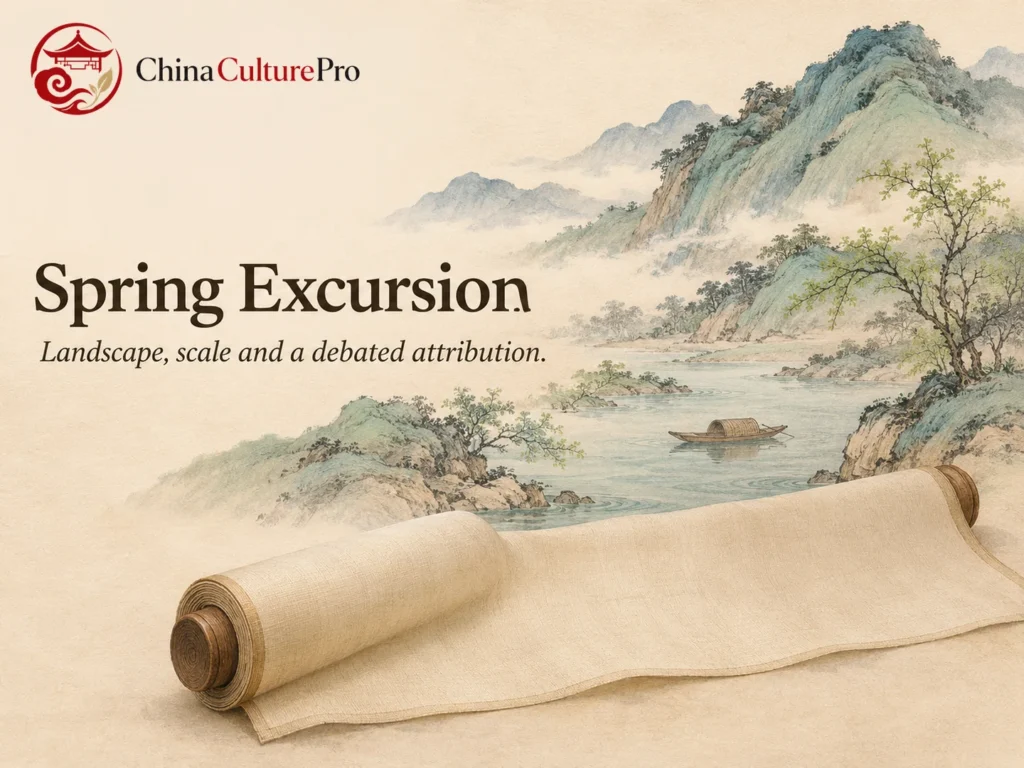

Quick Answer: What Is Spring Excursion?
Spring Excursion(游春图,Yóuchūn tú)is a coloured silk handscroll traditionally attributed to Zhan Ziqian(展子虔,Zhǎn Zǐqián), the painter associated with the Sui period. It is held by the Palace Museum, Beijing, whose account acknowledges debate over its authorship and date.[1]
- Subject: A spring outing among water, hills, trees and buildings.
- Composition: Small figures and a boat occupy a much larger landscape.
- Viewing focus: How paths, shorelines, colour and scale connect the scattered activities.
Its historical importance does not make the traditional attribution an undisputed identification.
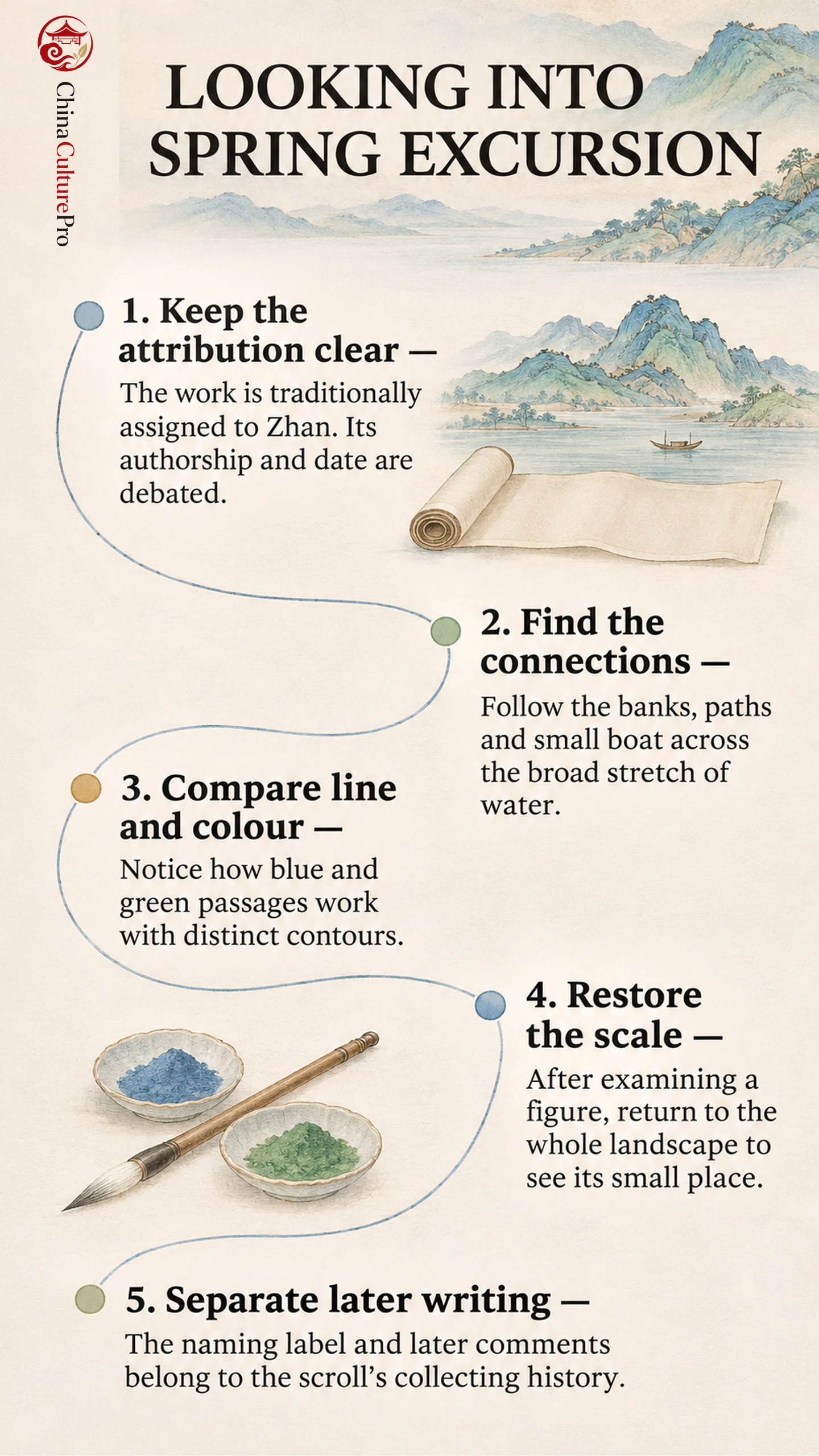
A wide stretch of water separates a low tree-covered bank from a cluster of blue-edged hills. A small boat lies between them, while paths offer another way into the landscape. This Chinese landscape painting guide follows those connections before turning to the later writing that helped establish the picture’s identity.
The Silk Handscroll and Its Traditional Attribution
The Palace Museum’s collection entry lists colour on silk, measuring 43 × 80.5 cm, under collection number 新00146610.[1] Those are the measurements given on that entry, rather than a length calculated from a reproduction containing additional mounting material.
Art historian James Cahill treats the work as attributed to Zhan and raises the possibility of a tenth- or eleventh-century copy. His wording is a question of dating, not a securely established replacement date.[2] The distinction matters when a caption calls the picture a Sui masterpiece: an inherited attribution and the physical date of a surviving object are separate matters.
The painting is often presented as a landmark of early landscape. Approach that importance through what is visible—an extensive setting, small human activities and a developed relationship between land and water—without requiring an absolute claim that this is the earliest surviving example. Its handscroll format also invites attention to how individual passages fit within the whole.
Following the Shore, Boat and Mountain Paths
Begin with the water between the banks. It occupies a broad central area, while the land forms irregular boundaries around it. The small boat provides a point to find within that openness; it does not fill the scene or establish a single commanding human presence.
Then turn toward the right-hand hills. Blue accents trace their broken contours, and trees punctuate the slopes below them. Roofs appear among the landforms, partially enclosed by vegetation and changes in height. Following these interruptions makes the hillside more than a single mass behind the water.
Along the lower bank, paths and small figures suggest routes through the scene. Some stretches are easy to follow; others disappear behind trees or a projecting form. Let those interruptions guide a return to the larger landscape instead of treating every passage as a continuously mapped walking route.
The lower-left trees create a different edge to the water. Their branching forms spread over the bank, offering a counterweight to the more elevated hills opposite. Compare both sides before returning to the boat: the water connects the activities while also keeping their settings apart.
Blue-Green Colour and Outlined Forms
Blue-green landscape(青绿山水,qīnglǜ shānshuǐ)describes the colour tradition relevant here. The museum identifies mineral blue and green pigments in the mountains and trees, with other colours used for figures, horses and architecture.[1]
Look at the relationship between colour and contour. Blue passages emphasize edges and ridges, while fine lines give individual trees and landforms their boundaries. Distinct outlines and coloured passages remain prominent across the scene.
Cahill discusses it as an early form of line-and-colour landscape, noting the clarity of individual elements even when they are represented at a distance.[2] That observation offers a useful comparison within the painting: notice how a small, bounded detail remains legible against the broad surrounding field.
The painting-techniques guide provides wider context for line, pigment and ink. For this work, however, begin with their visible interaction rather than assuming that “landscape” always means monochrome brushwork.
Small Figures in a Larger Landscape
The people are easy to miss in a reduced image. Once located, they establish a scale against which the trees, paths and hills become extensive. Enlarging one group makes its activity easier to examine, but also removes the relationship that made it appear small.
Alternate between a detail and the whole. At the closer scale, ask where a figure stands in relation to a path or bank. At the wider scale, ask how much space separates that activity from the next one. The small boat becomes another measure of the water it occupies.
The figures distribute human presence across the landscape rather than gathering it into a single portrait-like centre. Their importance comes partly from that distribution: the scene contains places to move, pause and look, while the land and water remain the larger subject. Small scale alone does not prove a fixed symbolic message about human insignificance.
Labels, Colophons and Later Collecting
The museum’s collecting-history account states that the original picture has no artist’s signature, seal or title. The naming inscription attributed to Emperor Huizong(宋徽宗,Sòng Huīzōng)is on the front mounting, identifying the work with Zhan. It is later evidence for the attribution, not the painter signing his own picture.[3]
The same account identifies a 1630 colophon by Dong Qichang(董其昌,Dǒng Qíchāng)and a 1776 inscription by Emperor Qianlong(乾隆帝,Qiánlóng Dì). It also records the collector Zhang Boju(张伯驹,Zhāng Bójū)acquiring the work in 1946 before its subsequent transfer to the museum.[3]
In the reproduction, written passages and red impressions surround the landscape. They document encounters with an already existing object. The guide to painting inscriptions and seals helps separate those additions from the scene itself. A later date beside the painting should not automatically become its creation date.
FAQs About Spring Excursion
Is the attribution to Zhan Ziqian certain?
No. It is traditional, and the museum acknowledges debate about both authorship and date.[1][3]
Why are the people so small?
Their scale places human activities within the larger landscape; compare them with the surrounding paths, trees and water.
Is Spring Excursion painted only in ink?
No. It uses colour on silk, including mineral blue and green.[1]
出典
[1] Nie Chongzheng, Palace Museum, Beijing. Spring Excursion, Collection Entry
[2] James Cahill, University of California, Berkeley. Lecture 4B: Tang Landscape Painting
[3] Li Shi, Palace Museum, Beijing. Spring Excursion: Inscriptions, Attribution and Collecting History