
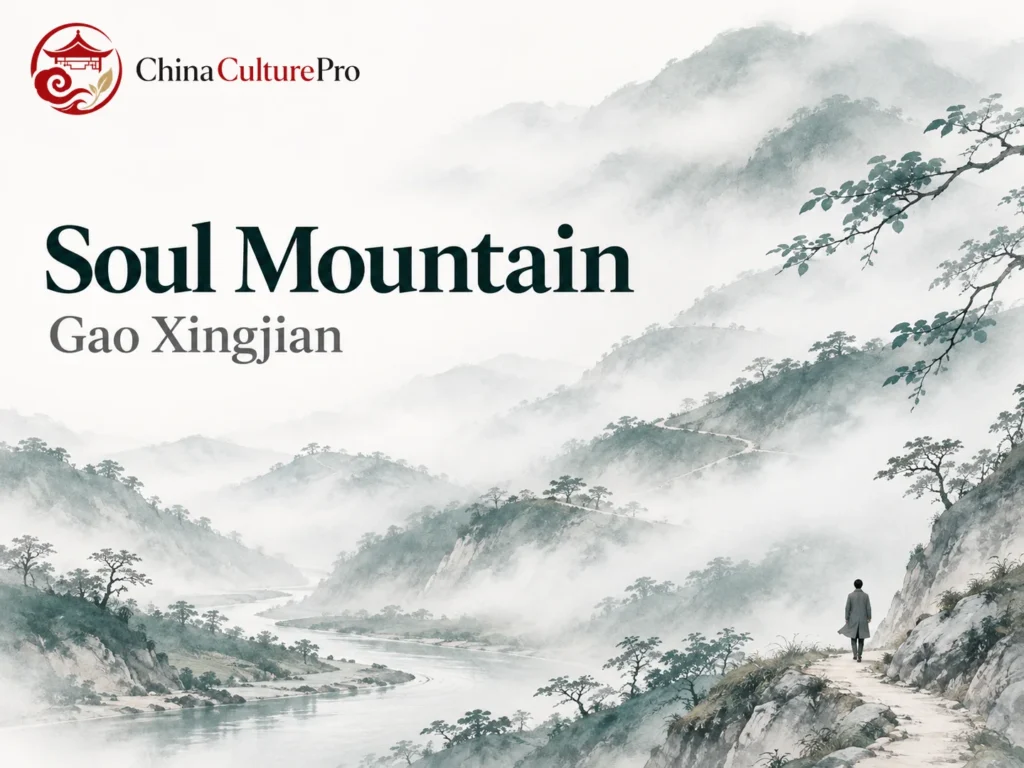

Quick Answer: What Is Soul Mountain About?
*Soul Mountain* (灵山, Língshān) is a 1990 novel by Gao Xingjian (高行健, Gāo Xíngjiàn). A traveler addressed as “you” sets out to find a mountain he hears about by chance. Another strand follows an “I” through southern and southwestern China, gathering scenes of travel, stories and memories.[1][2][3]
- The journey: The search leads through villages, waterways and mountain country.
- The voices: “I” and “you” carry much of the book. “She” and “he” complicate their relationship.
- The structure: Chapters move among encounters, recollection, folklore and reflection.[1][3][4]
A change of pronoun is often a better clue to the next scene than a change of place.

At the start, the book places the reader inside an unfamiliar town by addressing its traveler as “you.”
How the Two Journeys Begin
In the opening chapter, “you” arrive in a town on the way to Lingshan. A memory supplies the reason. The lids of two tea cups rattle against each other on a train. The moment gets two strangers talking, and one of them names a mountain the other has never heard of. The quest starts with curiosity about an unfamiliar name. The reader reaches the town before hearing the story of how he learned to look for it.[1][5]
The “I” strand has a different impetus. A diagnosis of lung cancer is reversed. Having believed he would die, the traveler takes to the road. Gao drew on his own travels through southern and southwestern China. The two narrative routes give him room to work with both observation and invention.[2][3][4][9]
How to Follow I, You, She and He
| Voice | What it often does |
|---|---|
| I | Recounts journeys, remembered events and encounters from inside the traveler’s experience. |
| 酉 | Pursues Lingshan and gives the speaker someone to address. |
| She | Appears in conversations with “you” and brings a different pressure to those exchanges. |
| He | Appears less often and creates another degree of distance. |
In chapter 52 the “I” voice reflects on why it addresses “you” and how “she” enters the conversation. You can use that chapter to reread earlier exchanges. They can sound like dialogue between two people and also like a way for one person to hear a thought from outside himself.[3][6]
The voices need not do the same work in every chapter. A speech addressed to “you” can invite a response. The same address can also let a person examine his own experience from one remove.[3][4][6]
What Travel and Folklore Do in the Novel
The traveler listens to people he meets and notices local songs, legends and ways of speaking. Some chapters stay with a conversation or a place long enough to sound like travel writing. Others use rumor, an imagined encounter or a story that has been told before. A song can carry an account of a place that the traveler could not give from his own experience. A story heard on the road can make the place harder to explain even as it gives him more to remember.[1][2][4]
An account of what one person hears can remain incomplete. It need not settle what a whole community believes. Gao uses that uncertainty to keep the encounters particular and to let the traveler’s loneliness survive in a book full of other voices.[4][7]
How to Read Soul Mountain in English
Look for Mabel Lee’s translation, published in 2000. The novel has 81 chapters. When a section feels hard to place, ask who is speaking and whether the scene is being witnessed, remembered or told as someone else’s story. Chapter 52 gives a point of return once you have heard several of the voices.[1][3][8]
For a different Chinese work that lets travel and recollection share the page, see Shen Fu’s Six Records of a Floating Life. It arranges the same life by subject, while Gao can change the voice from which a life is seen.
FAQs About Soul Mountain
Is Soul Mountain a real place?
Lingshan is the name of the traveler’s elusive destination in the novel. The route draws on real landscapes and experiences, while the search gives the fiction a question to keep open.[1][2][4]
Did Soul Mountain win the Nobel Prize?
Gao Xingjian received the 2000 Nobel Prize in Literature for his body of work. He discusses writing *Soul Mountain* in his Nobel lecture.[7]
出典
[1] Linking Publishing. Soul Mountain, anniversary edition and contents
[2] Zheng Cai. Cold Literature, a study and chronology of Gao Xingjian’s fiction
[3] Xiaoyan Liu. On Foot, a comparative study of Soul Mountain
[4] Unitas. Gao Xingjian on returning to Soul Mountain
[5] Gao Xingjian, translated by Mabel Lee. Soul Mountain, opening sample
[6] Gang Gary Xu. Pronouns and subjectivity in Gao Xingjian’s fiction
[7] Nobel Prize Outreach. Gao Xingjian’s 2000 Nobel lecture
[8] WorldCat. Soul Mountain, Mabel Lee’s 2000 English translation
[9] HarperCollins. Soul Mountain, reading group guide