


Quick Answer: What Is the Chuci?
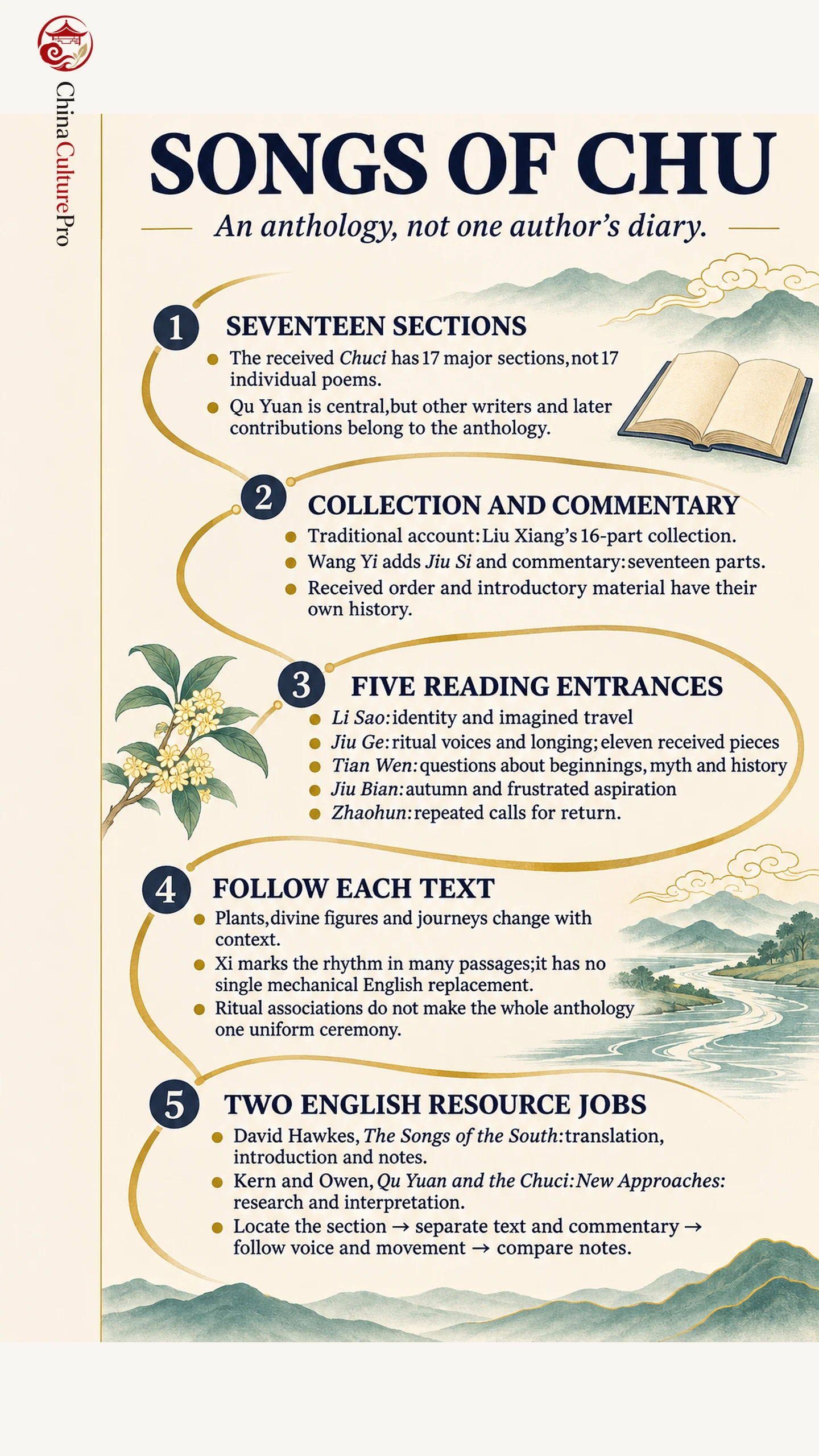
The Chuci (楚辞, Chǔcí), known in English as Songs of Chu or The Songs of the South, is an early Chinese poetry anthology strongly associated with Qu Yuan (屈原, Qū Yuán), but containing works linked to several writers and periods. The familiar received collection has seventeen major sections, some containing multiple pieces.[1][2][9]
- Choose by reading interest: Long imaginative journeys, ritual voices, questions, autumn lament and a call for a soul’s return offer different entrances.
- Separate poem and commentary: Author labels, prefaces and explanatory notes help shape how a text is received.
- Read beyond one biography: The collection is larger than a single writer’s life story.
Seventeen sections do not mean seventeen individual poems, and the collection’s cultural associations do not establish one uniform origin for every text.
A reader opening the Chuci encounters more than one kind of poetry. A cultivated first-person speaker can travel through a mythic world; another work questions the origins of heaven and earth; a different voice urges a wandering soul to return. The anthology’s variety is a better starting point than a single label. For the traditional poet’s life and later remembrance, see Qu Yuan; for the wider verse tradition, begin with Chinese poetry.
An Anthology Shaped by Collection and Commentary
The collection includes works traditionally attributed to Qu Yuan and Song Yu (宋玉, Sòng Yù), alongside later contributions. It developed through collecting, imitation, interpretation and editing, rather than arriving as the intact manuscript of one author.[2][3]
The conventional bibliographic account associates Liu Xiang (刘向, Liú Xiàng) with a sixteen-part collection. Wang Yi (王逸, Wáng Yì) subsequently added Jiu Si (九思, Jiǔ Sī), or Nine Longings, and supplied commentary in the tradition known as Chuci zhangju (楚辞章句, Chǔcí Zhāngjù). The seventeen-part received shape belongs to that longer editorial history.[2]
These names explain roles, not a simple chain in which every surviving detail remained unchanged. Earlier bibliographers already discussed differences in ordering and the placement of introductory material. A modern edition therefore combines poems with a history of how they were arranged and explained.[2]
The Book of Songs (诗经, Shījīng) offers another major early anthology to explore. Compare particular texts and their arrangements rather than reducing two collections to rigid opposites such as rational versus emotional, or northern versus southern. The Chinese literature overview connects these early traditions with later writing.
Five Starting Points in the Collection
| Text or sequence | What to follow |
|---|---|
| Li Sao (离骚, Lí Sāo), often translated as Encountering Sorrow | An elaborate first-person identity, moral commitment, frustration and extraordinary journeys.[4] |
| Jiu Ge (九歌, Jiǔ Gē), or Nine Songs | Shifting voices, divine encounters, longing and ritual settings across eleven received pieces.[5] |
| Tian Wen (天问, Tiān Wèn), or Heavenly Questions | Questions about beginnings, the cosmos, myths and the conduct of historical figures.[6] |
| Jiu Bian (九辩, Jiǔ Biàn), often called Nine Arguments | Autumn’s changes become language for disappointment, isolation and frustrated aspiration.[7] |
| Zhaohun (招魂, Zhāohún), or Summoning the Soul | Repeated calls for return contrast threatening spaces with the attractions of home.[8] |
The first work introduces a speaker through ancestry, naming, inner qualities and adornment. Fragrant plants help sustain that self-presentation as the poem moves through conflict and imagined travel. Read the changing scenes alongside the speaker’s insistence on value. A plant need not have one permanently fixed equivalent in a biographical code.[4]
The song sequence requires a different approach. Its received pieces address divine figures and develop anticipated meetings, separation and desire. They also include commemoration of fallen warriors and a closing ritual piece. The title Nine Songs is not a literal count of the surviving eleven, and treating every voice as the same autobiographical speaker obscures the differences among pieces.[5]
The questioning work opens by asking who transmitted knowledge about the remote beginning. It moves through celestial arrangements, mythical events and human actions, repeatedly demanding how or why. Notes can identify a reference, but they should not make the poem’s succession of questions disappear beneath a summary of answers. It is not simply a catalogue of myths accepted without interrogation.[6]
The autumn lament, traditionally associated with Song Yu, begins with distress at the season’s atmosphere, plants shaking loose and declining, and the feeling of departure. Cooling weather becomes inseparable from a speaker’s difficulty finding recognition. Attend to both the observed changes and the human predicament; reducing it to “autumn always means sadness” loses the crafted connection.[7]
The soul-summoning poem organizes a different contrast. Its returning call warns against dangerous regions and then evokes a place of comfort, abundance and entertainment. The repetition helps hold an extensive imaginative geography together. Questions of authorship and interpretation remain, so a page’s author label should not be used to settle them. Read the work as a literary text with ritual associations, rather than as an instruction manual for conducting a ceremony.[3][8]
Voices, Ritual Language and Imaginative Worlds
The recurring particle xi (兮, xī) is one visible feature of many passages. It participates in the rhythm and articulation of lines; it is not a word that can be replaced mechanically by the same English expression every time. Line lengths and patterns vary across the anthology, making one universal metrical description misleading.[4][5][7]
Names of plants, gods, places and marvelous beings also contribute to the poetry’s texture. In one context an aromatic plant belongs to self-adornment; elsewhere plants help make an elaborate setting. A divine journey may reshape distance and movement, while repeated names or sounds create links across a passage. Read the local relationship before imposing a single symbolic dictionary on every occurrence.[4][5][8]
Ritual and religious contexts matter especially for some works, but the anthology also includes argument, lament, questioning and later literary responses. Modern scholarship has challenged attempts to explain all its poetry through one shamanic model. That is a reason to distinguish texts and evidence, not to remove their divine figures or ritual language from view.[3][10]
The mythology guide provides background for some figures, while literary allusions follows the later reuse of earlier language. Keep such background subordinate to the words and movement of the passage being read.
English Editions and a Reading Route
David Hawkes’s The Songs of the South is an English translation with an introduction and notes, explicitly framed around Qu Yuan and other poets. It is a useful way into the anthology’s variety. Identify the edition as well as the translator, since later printings can carry a different publication date.[9]
Qu Yuan and the Chuci: New Approaches, edited by Martin Kern and Stephen Owen, serves another purpose. Its research essays examine authorship, textual composition, imagery and interpretation. Choose it for those questions rather than assuming it is a straightforward replacement for a complete translated anthology.[10]
Use four checks with either resource:
- Locate the section: Identify the title and whether it names a single long poem or a sequence of shorter pieces.
- Separate text from explanation: Distinguish the poem’s words from a preface, commentary, author label or translator’s note.
- Follow voice and movement: Ask who speaks, who is addressed and how repetition, questions or changes of scene organize the passage.
- Compare an annotated rendering: Use notes to examine difficult references, alternative readings and the limits of an English title.
Modern Mandarin pinyin (拼音, pīnyīn) helps identify names and pronunciation; the pinyin guide explains its notation. The classical books guide helps with choosing editions. Start with one complete shorter piece or an annotated section of a long poem, then compare a different literary mode.
FAQs About Songs of Chu
Is Chuci the same as The Songs of the South?
The Songs of the South and Songs of Chu are English titles used for the anthology known as Chuci. Check the translator and contents when identifying a particular edition.[1][9]
Does Chuci contain seventeen poems?
Its familiar received form has seventeen major sections. Several sections contain sequences, so the number of individual pieces is greater; Nine Songs alone has eleven received pieces.[1][5]
Did Qu Yuan write every work?
No. The collection includes works linked to different writers and periods. Attribution of particular early texts also involves questions that go beyond their traditional labels.[2][3][9]
Are the poems all shamanic songs?
No single description covers the entire collection. Ritual associations are important for some texts, while others work through questioning, lament, imaginative travel or later literary response.[3][5][6][10]
出典
[1] Chinese primary collection via Wikisource. Chuci: received contents
[2] Qing imperial bibliographers, primary text via Wikisource. Chuci zhangju: bibliographic notice
[3] Martin Kern, Princeton University. Reconstructing Qu Yuan
[4] Chinese primary text via Wikisource. Li Sao
[5] Chinese primary text via Wikisource. Jiu Ge
[6] Chinese primary text via Wikisource. Tian Wen
[7] Chinese primary text via Wikisource. Jiu Bian
[8] Chinese primary text via Wikisource. Zhaohun
[9] Penguin Classics, David Hawkes. The Songs of the South
[10] Brill, Martin Kern and Stephen Owen. Qu Yuan and the Chuci: New Approaches