


Quick Answer: What Is the Site of Xanadu?
The Site of Xanadu preserves Shangdu (上都, Shàngdū), Kublai Khan’s early capital and later the Yuan dynasty’s summer capital. In present-day Inner Mongolia, raised wall lines, building mounds and waterworks survive within the grassland landscape. UNESCO inscribed the archaeological property in 2012. [1][2]
- Urban plan: Palace City and Imperial City formed a formal core. The Outer City extended around parts of it. [1][2]
- Seasonal government: UNESCO dates its first-capital phase to 1263–1273 and its Yuan summer-capital phase to 1274–1364. [1]
- What survives: Archaeology and the landscape show walled enclosures, traces of camps and hunting space, and a canal associated with water control. [1][2]
Today the long wall lines and surrounding land give a clearer impression of the site than any image of a complete palace.
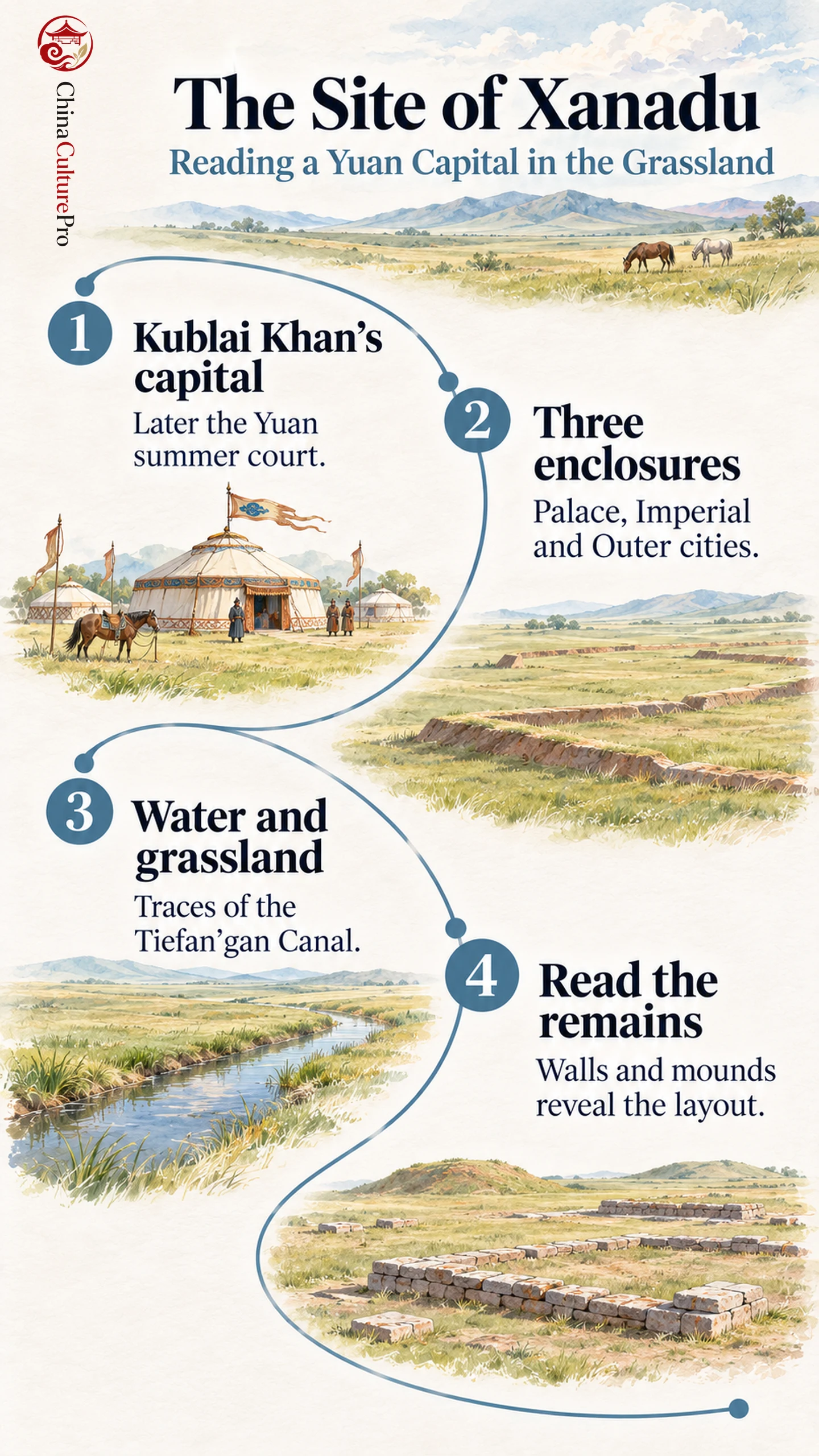
A low ridge across the grass can be a former wall. If you follow several such earthworks, an imperial plan starts to appear. The spaces beyond the walls tell parts of the story that a palace building alone would miss.
Reading Xanadu’s Three Enclosures
| Enclosure | Position and form | What this reveals |
|---|---|---|
| Palace City | Inner enclosure with mounds marking former structures. [1][2] | A court center within a larger city. [1][2] |
| Imperial City | Planned around the palace section with a north–south organizing axis. [1][2] | A formal urban arrangement that extended beyond the residence. [1][2] |
| Outer City | Added space west and north of the central arrangement and traces of camps. [1][2] | Larger areas suited to practices associated with a Mongol court. [1][2] |
Grassland covers much of the archaeological site. Walls, building mounds and surviving earthworks reveal an overall layout even where buildings no longer stand. The archaeological setting also includes tomb areas and traces of neighborhoods outside gates. [1]
The Place of Shangdu in Kublai Khan’s Court
Kublai Khan had an adviser, Liu Bingzhong, design the city in 1256. It was a capital designed and used in different phases. Its court functions changed as Dadu, at present-day Beijing, became the principal capital. Shangdu’s later summer role helps explain why a formally planned city could stand within a landscape also suited to encampment and hunting. [1][2]
This was a place of government within the Yuan dynasty. The form of the city brings two kinds of evidence together: formal planning and an extensive open setting used by the court. [1][2]
Reading Water and Landscape as Part of the City
ICOMOS identifies hills to the north and water to the south among the features that influenced the city’s placement. UNESCO describes traces of the Tiefan’gan Canal as evidence of large water-control works. The canal remains outside the main enclosures belong to the history of how the city functioned. [1][2]
A modern name on a map and a historical capital name may record different periods. A guide to the China Historical GIS explains how to look for names and time ranges in historical datasets. For another dynastic site, the Shenyang Imperial Palace preserves a Qing court ensemble with standing buildings. [1][3]
FAQs About the Site of Xanadu
Are Xanadu and Shangdu the same historical place?
Xanadu is a familiar English name for the historical city called Shangdu. The archaeological property preserves the site of that city. [1]
Was Xanadu always a summer capital?
It served first as Kublai Khan’s capital. UNESCO distinguishes that earlier role from the city’s later use as the Yuan dynasty’s summer capital. [1]
Can you still see the original city layout?
Yes. Earthworks, building mounds and other visible remains preserve evidence of the overall city plan. Many former structures survive only as traces. [1][2]
出典
[1] UNESCO World Heritage Centre. Site of Xanadu
[2] ICOMOS. Evaluation of the Site of Xanadu Nomination
[3] UNESCO World Heritage Centre. Imperial Palaces of the Ming and Qing Dynasties in Beijing and Shenyang