


Quick Answer: What Is Qing Imperial Household Department?
The Qing Imperial Household Department (内务府, nèiwùfǔ) ran much of the imperial family’s household. It managed personnel, stores, estates, buildings and workshop production. Its offices gave the court the capacity to order things, pay for them and keep track of what happened to them.[1][2]
- Personnel: The department administered hereditary service personnel attached to the court.
- Supplies: Its offices managed materials, accounts and palace expenditure.
- Production: Workshop records connect commissions with materials, labour and finished objects.
The department’s powers centered on the imperial household. Its accounts and jurisdiction could still intersect with other offices.
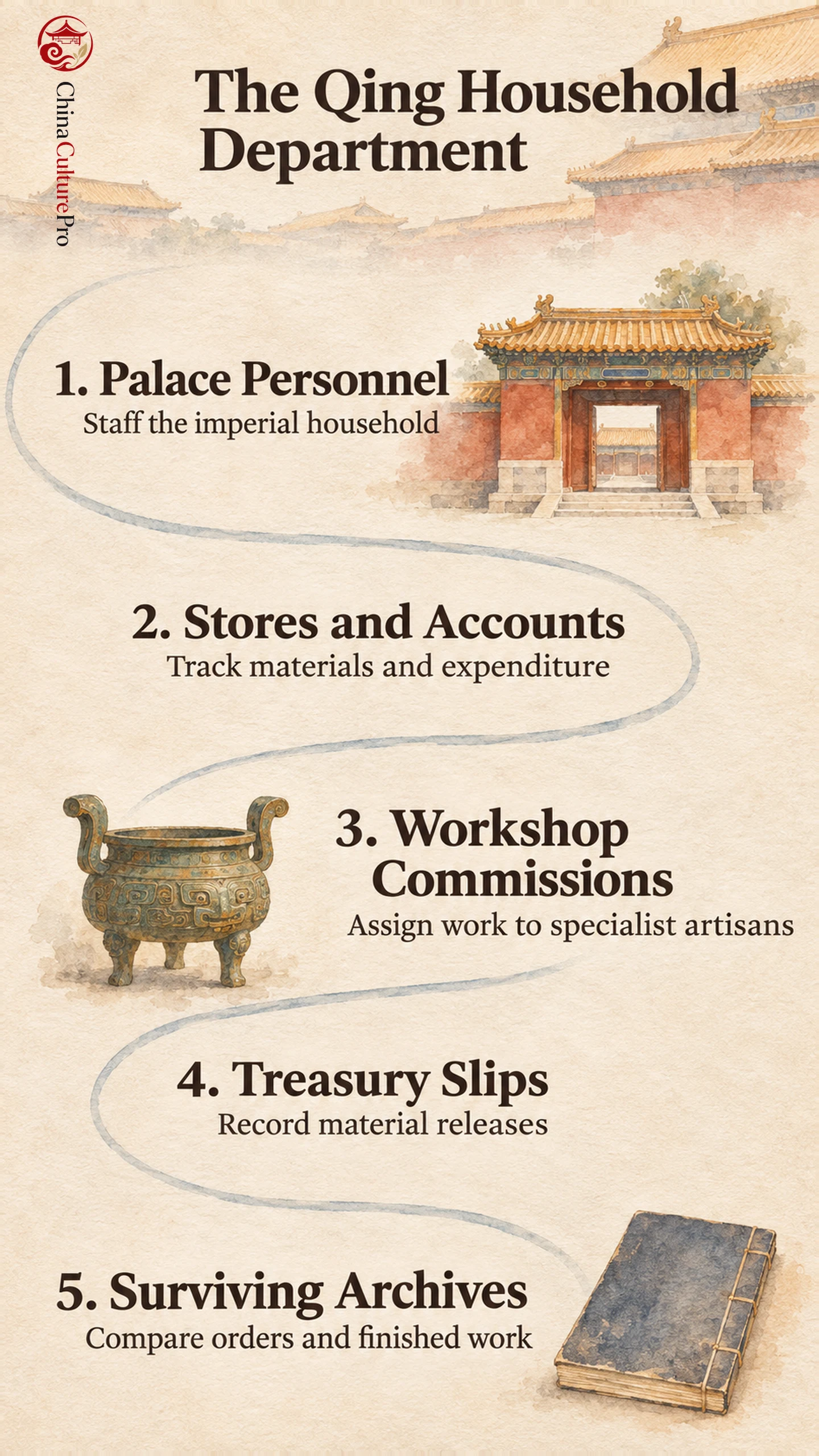
An object in a Qing palace collection may be the end of a paper trail. Before it reached a room in the palace, officials could approve the commission, release materials and document the work.
Who Ran the Imperial Household?
The department administered booi (包衣, bāoyī), hereditary service personnel of the imperial Upper Three Banners. Their assignments and rank varied. Some could hold senior positions. The arrangement connected palace service to the banner institutions of the Qing dynasty.[1][2]
Different offices handled accounts, construction, ceremonies and other work. The palace buildings were part of a larger administrative network that could draw on workshops and estates. The history of the Forbidden City gives the spatial context for activity carried out inside the palace.
From the Storeroom to the Workshop
The Imperial Workshops (造办处, zàobànchù) turned orders into finished goods. Bringing a commission to completion could require clerks to allocate a task, calculate expenditure and authorize a release from stores. Skilled artisans and the offices that kept accounts performed different parts of the work.[3]
A surviving 1736 treasury slip issued to the Copper Workshop shows one piece of that chain. A slip documents the transfer or authorization it records. Matching it to a finished object can still require a work register, inscriptions or other evidence about its production.[3]
What the Archives Record
Kangxi-era records include Manchu-language documents of different types. Some summarized completed business for the emperor. Others recorded orders, correspondence or rations and payments. The format helps establish who created a record and what it was meant to track.[4]
Start by asking whether the record is an order, an account or a report that work was completed. A proposed commission and a delivered object can leave separate records. Reading them side by side makes changing instructions, material substitutions and shared responsibility easier to trace.[3]
FAQs About Qing Imperial Household Department
Was the Neiwufu One of the Six Ministries?
It was a distinct imperial household administration. Its duties in areas such as finance and construction served the court and complemented wider government functions.
Why Do Museum Researchers Use Its Workshop Records?
The records help identify materials, commissions and changes made during production. They can also supply dates that a finished object itself does not carry.
出典
[1] 故宮博物院。 Imperial Household Department
[2] Renmin University of China. Qing Imperial Household Department Incoming Documents
[3] Martina Siebert, Kai Jun Chen and Dorothy Ko, editors. Making the Palace Machine Work, Chapter 3
[4] Li Wenyi. Kangxi-Era Manchu Archives of the Imperial Household Department