

Quick Answer: What Is The Donglin Movement?
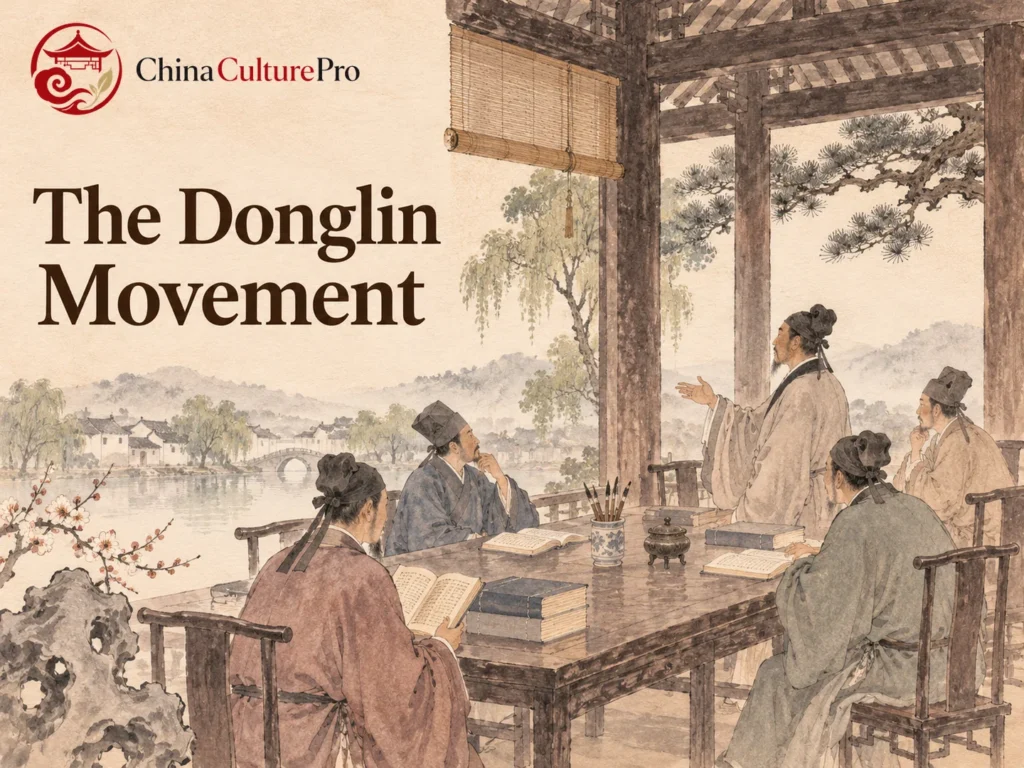
The Donglin movement took its name from the Donglin Academy (东林书院, Dōnglín Shūyuàn) in Wuxi. Gu Xiancheng (顾宪成, Gù Xiànchéng) and fellow scholars revived the academy in 1604. Their meetings brought ethical study, scholarship and discussion of government into contact. The name later carried political meanings that extended beyond those meetings.[1][2][3]
- Place: The academy was a center for lectures and manuscript circulation.
- Network: Connections reached officials and scholars beyond Wuxi.
- Conflict: Court opponents could apply the label Donglin to people they accused of acting together.
A later accusation of belonging to Donglin says something about the politics of the accusation. Check other evidence for a person’s actual ties to the academy.
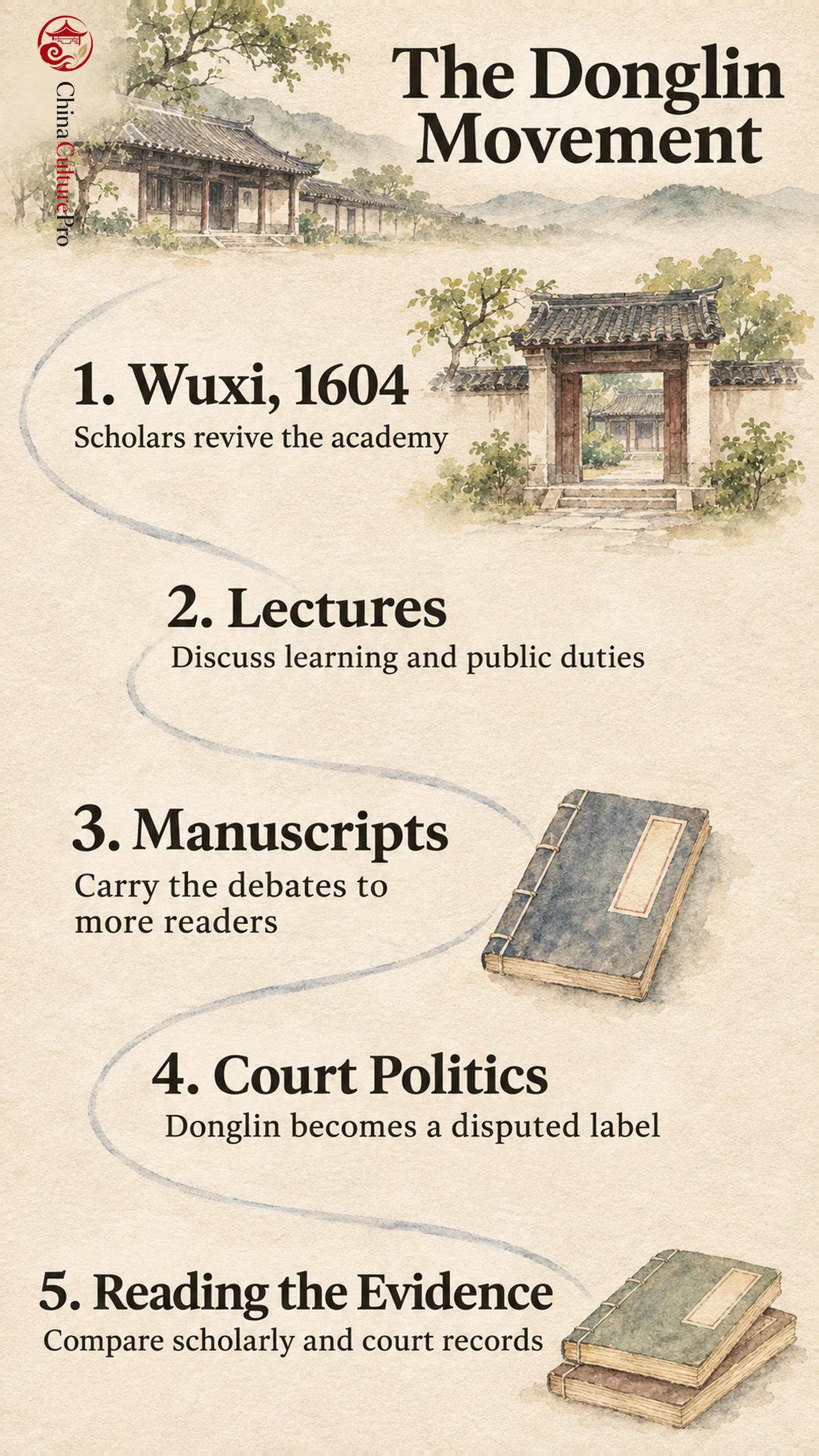
A lecture at Wuxi could have a second life in manuscript. As lectures and letters circulated, arguments about scholarly conduct moved beyond the people who first heard them.
The Academy at Wuxi
Gu and his colleague Gao Panlong (高攀龙, Gāo Pānlóng) helped make the revived academy a place for regular meetings. Study of the classics and disagreements over moral cultivation made it part of the wider world of Chinese academies. Debate about who should serve in government tested how those ideas worked in practice.[1][2]
Some participants identified strongly with the teachings associated with Cheng Yi and Zhu Xi. Their actual ideas could also show the influence of competing schools. Treat a shared institutional affiliation as a starting point for reading their arguments.[2]
When Donglin Became a Court Label
Late in the Ming dynasty, names associated with Donglin appeared in disputes about appointments and responsibility for government decisions. The eunuch Wei Zhongxian (魏忠贤, Wèi Zhōngxián) and his supporters targeted men identified with the network during the Tianqi reign. Among the officials caught up in the persecution was Yang Lian.[3]
The political label reached beyond people who had attended lectures in Wuxi. To assess an individual case, distinguish documented correspondence or cooperation from a hostile claim about factional allegiance.
Why the Evidence Comes in Different Forms
Manuscript circulation shows scholars sharing texts and maintaining relationships. Court memorials and later official history describe appointments, attacks and punishments. A manuscript can help trace intellectual exchange. An accusation lodged at court can show what a rival was trying to prove.[1][3]
The Qing-compiled History of Ming offers a retrospective account, written with the consequences in view. Its account of conflict is easier to interpret when you put it alongside records produced by the scholars and officials themselves.[1][3]
FAQs About The Donglin Movement
Was Donglin a Political Party?
Histories often call it a faction. Donglin encompassed overlapping scholarly and political ties. Its label also took on a life of its own among opponents.
Where Was the Donglin Academy?
It was in Wuxi, in what is now Jiangsu. The late Ming revival made it a center for scholarly gatherings and political discussion.
出典
[1] Centre for the Study of Manuscript Cultures, University of Hamburg. The Donglin Manuscripts
[2] Renmin University of China. Research on Donglin Thought and the Academy
[3] History of Ming. Chapter 305, Biography of Wei Zhongxian