


Quick Answer: What Is the Sihu?
The sihu (四胡, sìhú) is a bowed fiddle with four strings. In a documented arrangement, the strings form two unison pairs. The bow hair is split so one stroke can sound two strings together.[2][3]
- Construction: Look for a long fretless neck and a compact skin-faced resonator.[1]
- Bowing: Two bundles of hair run between the first and second strings and between the third and fourth.[2]
- Contexts: The sihu has roles in Mongolian narrative performance and northern Chinese drum song.[4][5]
Read the string layout and performance credits together when identifying a fiddle.
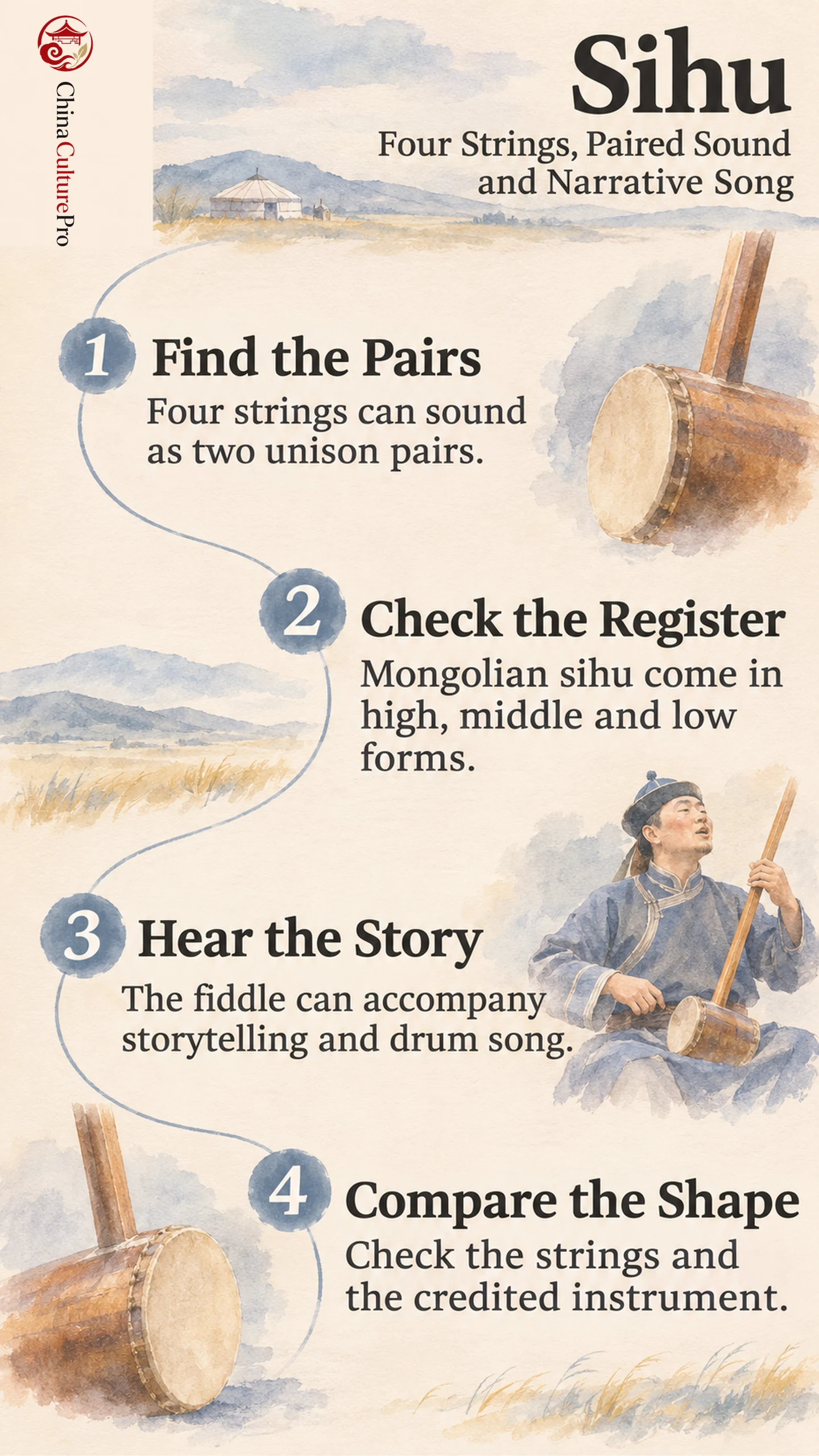
The number of strings is easy to remember. The way they work together gives the instrument its more distinctive feature. Watch the bow near the strings in a close video, then listen to what the instrument does beside a narrator or singer.
How Four Strings Sound in Pairs
In the arrangement described by Taiwan’s Ministry of Education dictionary, strings one and three share a pitch, and strings two and four share another. The members of each unison pair are separated by a string of the other pair. The split bow hair allows one contact direction to sound the two strings in a pair together.[2][3]
Listen for a sustained note with the body of two strings tuned alike. Listen for the combined tone of the pair rather than trying to pick out four separate pitches. A close view of the two bow-hair bundles gives a clearer physical clue.[2]
Read the Body, Size and Register
The Met’s nineteenth-century sihu measures 79.5 centimeters high. The record lists redwood, snakeskin, bamboo and horsehair, and classifies it as a fretless bowed lute. The body is compact relative to the neck, and the player holds this family of fiddles upright.[1]
China’s national heritage inventory describes high, middle and low forms of Mongolian sihu. It associates the higher register with solo and ensemble playing and identifies middle and lower instruments in Khorchin narrative accompaniment. A solo recording and a narrative accompaniment can therefore feature different sizes and registers.[4]
Listen in Two Storytelling Traditions
The heritage entry records sihu accompanying Mongolian forms known as üliger and holboo. In these settings the instrument works alongside storytelling and verse. The broader guide to Mongolian culture in China situates such performance in its regional context.[4]
In Jingyun dagu (京韵大鼓, jīngyùn dàgǔ), a singer stands and marks time with drum and clappers. The accompanying instruments can include a large sanxian, sihu and pipa. Follow the held bowed tone against the quick attacks of the plucked instruments and the beat of the percussion.[5]
How to Tell Sihu From Other Fiddles
Compare the strings with those on an erhu. The sihu’s four strings distinguish it from the two-string erhu.[3][7]
A matouqin or morin khuur can also appear in Mongolian music. The Khorchin instrument-making record discusses the matouqin and sihu separately. Use the credits and the construction together to identify which regional fiddle is playing.[6]
FAQs About the Sihu
How can four strings sound as two pairs?
In a documented arrangement, the first and third strings share one pitch, and the second and fourth share another. The bow hair is divided between neighboring strings.[2][3]
Do all sihu play in the same register?
The Mongolian sihu heritage entry describes high, middle and low versions. Each has documented uses in solo playing, ensembles or accompaniment.[4]
Is sihu the same as the horsehead fiddle?
They are separately named in the Khorchin heritage account. Sihu is the four-string fiddle. The matouqin has its own form and repertoire.[3][6]
出典
[1] The Metropolitan Museum of Art. Sihu, Nineteenth Century
[2] Xilingol League Administration. Sihu
[3] Ministry of Education, Taiwan. Sihu Dictionary Entry
[4] China Intangible Cultural Heritage. Mongolian Sihu Music
[5] China Intangible Cultural Heritage. Jingyun Dagu
[6] China Intangible Cultural Heritage. Making Mongolian Bowed String Instruments
[7] The Metropolitan Museum of Art. Erhu, Late Qing