


Quick Answer: How Do Sheng and Yu Differ?
The sheng (笙, shēng) and yu (竽, yú) are related Chinese mouth organs. Classical sources use yu for a large form of the instrument family. Museum examples have different pipe counts and come from different historical settings.[1][2][4]
- Shared design: Pipes fit into a common chamber through which the player directs air.[2][4]
- Sheng example: One Qing instrument has seventeen bamboo pipes and thin copper reeds.[2]
- Yu example: A Western Han funerary object has twenty-two pipes and lacks working reeds.[3][4]
Use the catalog name, date and object function together when comparing the pipes.
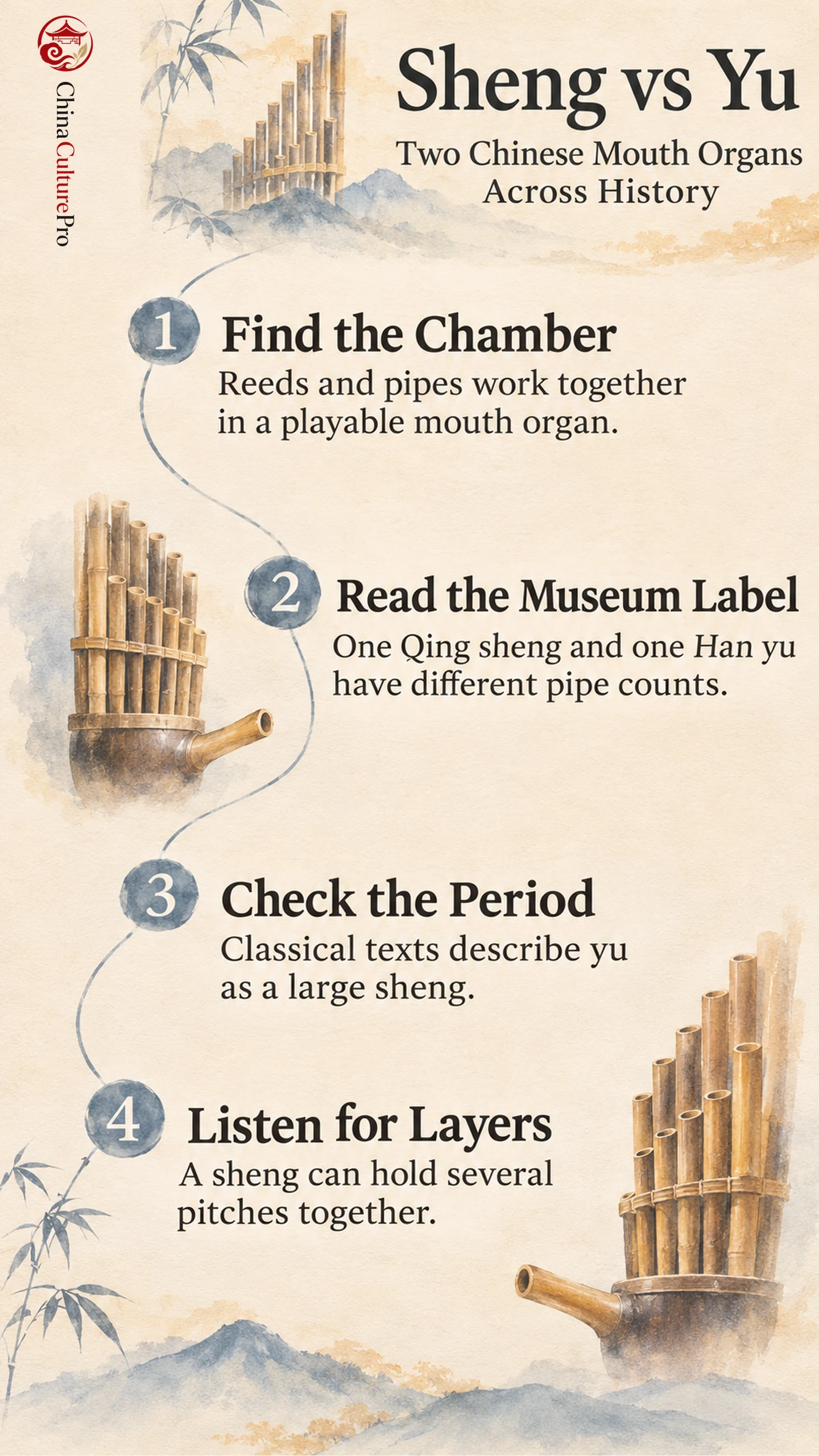
A cluster of pipes can look like several flutes tied together. A mouth organ puts those pipes into a shared chamber. The chamber and the reeds explain why a playable instrument can sustain several notes at once.
How the Mouth Organ Makes Sound
On the Qing sheng in the Palace Museum, copper reeds sit at the base of bamboo pipes inside the wooden chamber. A free reed is a small tongue that vibrates as air passes it. Its motion and the air column in the pipe work together to produce the note.[2]
The Met’s late nineteenth-century sheng catalog describes sounding notes with both outward and inward breath. It can produce more than one pitch at once. A player can use a single note for a melody or combine several notes in a held sonority.[5]
Compare Two Museum Examples
The Palace Museum’s Qing sheng stands 50 centimeters high. Its seventeen pipes differ in length, with the tallest near the middle, and a bamboo ring holds them together. The record describes thin copper reeds fitted into the lower parts of the pipes.[2]
The yu mouth organ from Mawangdui (马王堆, Mǎwángduī) belongs to the Western Han dynasty. The twenty-two bamboo pipes sit in two rows. The cataloged funerary piece lacks reeds, leaving the pipe layout as evidence of its form.[3][4]
How to Read the Names and Pipe Counts
Ethnomusicologist Alan R. Thrasher notes that later classical texts classify yu as a large sheng. The same texts discuss other mouth-organ terms. The terms describe a related family in those sources. Start with the period when reading a label that uses either term.[1]
Seventeen pipes identify one example in the Palace Museum record, while twenty-two describe one burial object. If you encounter a different count in a text, check whether the source describes a surviving object, an instrument type or an idealized design.[1][4]
What to Listen for in a Sheng Performance
Listen first for a single sustained note, then for the moment more notes sound with it. Notice whether the extra pitches enter with the melody or join a note that is already sounding. A close video can help connect that change to the musician’s breath and fingering.[5]
Paixiao also uses a group of pipes, but the player blows across separate openings. The Qing ceremonial inventory lists both instrument names. The Chinese musical instruments guide places their different ways of directing air within a broader wind section.[6][7]
FAQs About Sheng vs Yu
Is a yu a type of sheng?
Later classical texts classify the yu as a large member of the sheng family. Museum labels may retain yu as the name for a particular historical form.[1][3]
Can you identify a yu by counting its pipes?
A pipe count can help describe an object. Check its catalog name, date and purpose as well. The Mawangdui count of twenty-two comes from one funerary example.[4]
How are these instruments different from paixiao?
A playable mouth organ uses reeds and a shared chamber. A set of panpipes sounds when the player directs air across an individual pipe opening.[5][7]
出典
[1] Alan R. Thrasher, RILM Music Encyclopedias. Instruments: Sheng
[2] The Palace Museum, Beijing. Qing Sheng, Object 00169771
[3] Royal College of Music and Hunan Museum, MINIM-UK. Collection Spotlight: Hunan Museum
[4] National Taiwan University. Illustrated Archaeology Teaching Collection
[5] The Metropolitan Museum of Art. Sheng, Late Nineteenth Century
[6] The Palace Museum, Beijing. Zhonghe Shaoyue
[7] Neville H. Fletcher, Journal of the Acoustical Society of America. Acoustics of the Panpipes