


Quick Answer: What Is Rickshaw Boy About?
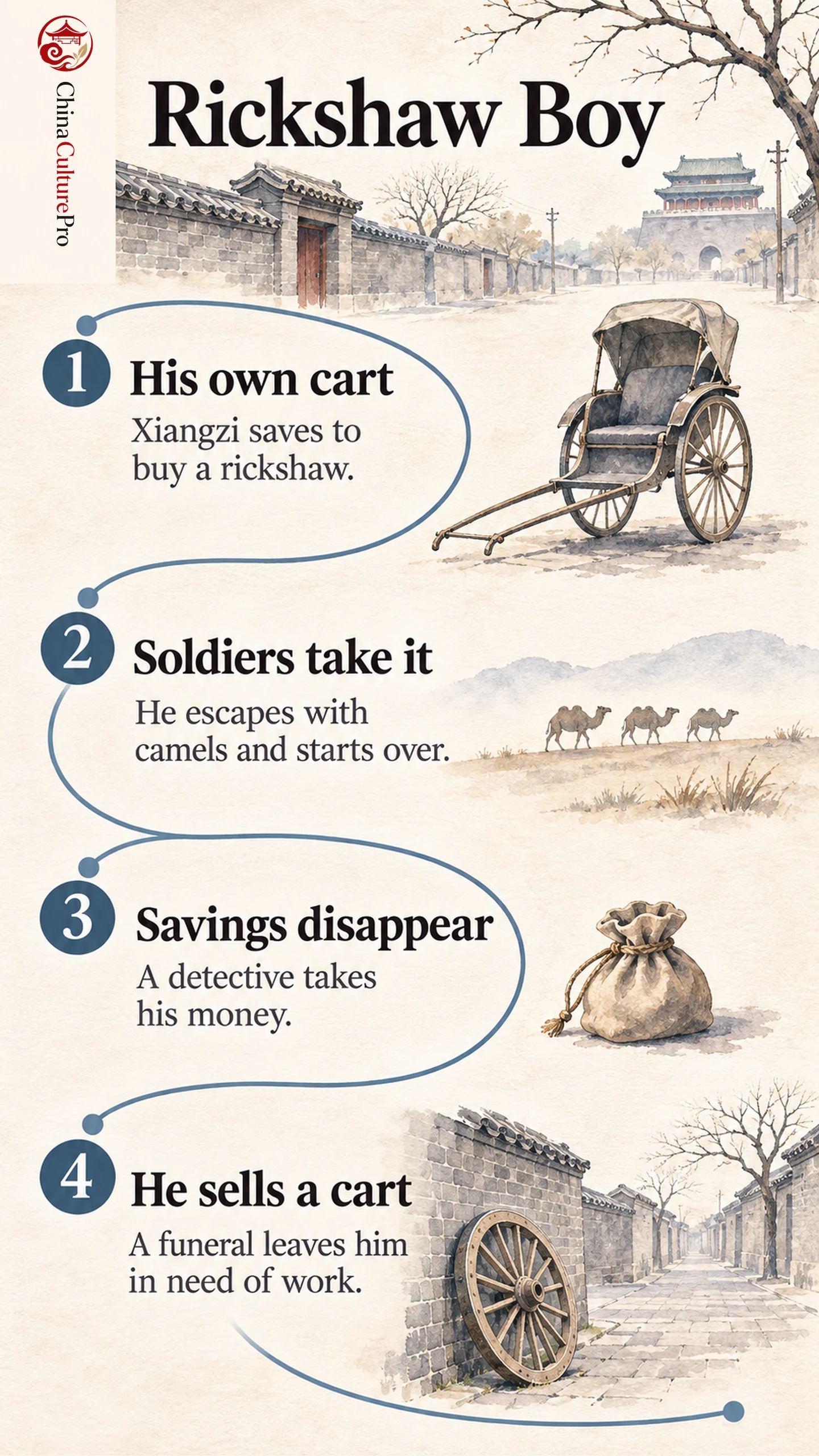
*Rickshaw Boy* (骆驼祥子, Luòtuo Xiángzi) is a novel by Lao She (老舍, Lǎo Shě) about Xiangzi (祥子, Xiángzi), a young rickshaw puller in Republican-era Beijing. He saves to buy a cart so he can keep more of what he earns. When he loses the cart, he tries to start again.[1][2]
- The nickname: Xiangzi escapes from soldiers with camels, sells them and becomes known as Camel Xiangzi.[1]
- The pattern: A cart, savings and a cart again each give him a chance to work more independently.[1][3]
- The editions: The 1945 English translation changes the ending. Howard Goldblatt’s 2010 edition gives English readers another version.[4][5]
Owning the cart would give him more control over a day’s work.
Start with the price of the cart and what it takes to save for it. That makes the changes in Xiangzi’s behavior easier to follow.
Why Xiangzi Wants His Own Rickshaw
The cart is a means of earning money, and renting one means paying another person before the work can support Xiangzi himself. If he has a cart of his own, he can make more decisions about his work. His first success comes through a long period of saving.[1][2][6]
The time that goes into buying the cart matters as much as its price. A loss that takes an afternoon can wipe out the gain from years of pulling. You can count the cost in trips already made, as well as in the trips it will take to reach the same point again.
The Three Setbacks That Shape the Story
| Setback | What Xiangzi loses |
|---|---|
| Soldiers take his first rickshaw | The cart he worked to buy. The camels he takes on escaping bring some money, too little to replace the cart. |
| A detective extorts him | The savings he set aside for his next purchase. He loses a chance to buy a cart at this point. |
| He pays for a funeral | After the death of his wife Huniu (虎妞, Hǔniū), he sells the cart he has acquired since marrying her. |
The book repeats the movement from saving or buying to losing. Each loss has its own cause. The middle one concerns money he has put away, so counting three rickshaws misses how the reversals work.[1][3]
Where Huniu and Xiao Fuzi Fit
Huniu is the daughter of a rickshaw business owner. Her marriage to Xiangzi changes how he can get another cart, but it also leaves him with financial and household obligations. The price of a cart looked like a sum he could calculate. The expenses of keeping a household are harder to set aside in advance.[1][3][6]
Xiao Fuzi (小福子, Xiǎo Fúzi), sometimes called Little Lucky in English, gives him another relationship to consider. She has younger brothers to support. Being willing to share a life means taking on expenses that even a diligent puller may be unable to meet. For her, any decision about leaving also affects two children.[3][4]
For another view of how people make a living in Lao She’s Beijing, read Teahouse. Its proprietor has to keep a business running as the people and institutions around him change.
Why the English Endings Differ
**Ending spoiler.** Evan King’s 1945 English translation allows Xiangzi to rescue Xiao Fuzi and gives them a happier outcome. Lao She objected to the change in his 1950 preface. The Chinese novel follows the lasting cost of Xiangzi’s losses, including the death of Xiao Fuzi.[4][9]
For a modern English edition that retains the tragedy, look for Howard Goldblatt’s *Rickshaw Boy*, published by Harper Perennial in 2010. Because both editions are called Rickshaw Boy, check the translator’s name on the title page.[4][5]
FAQs About Rickshaw Boy
When was Rickshaw Boy first published?
Serialization in the magazine *Yuzhou Feng* began in 1936. A book edition appeared in 1939, so both dates can be associated with its first publication.[7][8]
What kind of rickshaw does Xiangzi pull?
He pulls a two-wheeled passenger cart by hand. The work depends on the puller’s strength and on his access to the vehicle.[1][2]
出典
[1] WorldCat. Rickshaw Boy, Evan King edition and opening plot
[2] National Library of New Zealand. Luo tuo Xiangzi, Chinese edition synopsis
[3] Lao She. Rickshaw Boy, Chapter 20
[4] Lao She. Rickshaw Boy, 1950 preface
[5] CiNii Books. Rickshaw Boy, Howard Goldblatt translation
[6] Wiley. Resignation Open Eyed, on Lao She’s novel about a laborer
[7] Guangxi University Library. Rickshaw Boy, serialization record
[8] Collected Works of Lao She. Volume 3, publication note
[9] Lao She. Rickshaw Boy, Chapter 23