


Quick Answer: What Is Remonstrance in Chinese Thought?
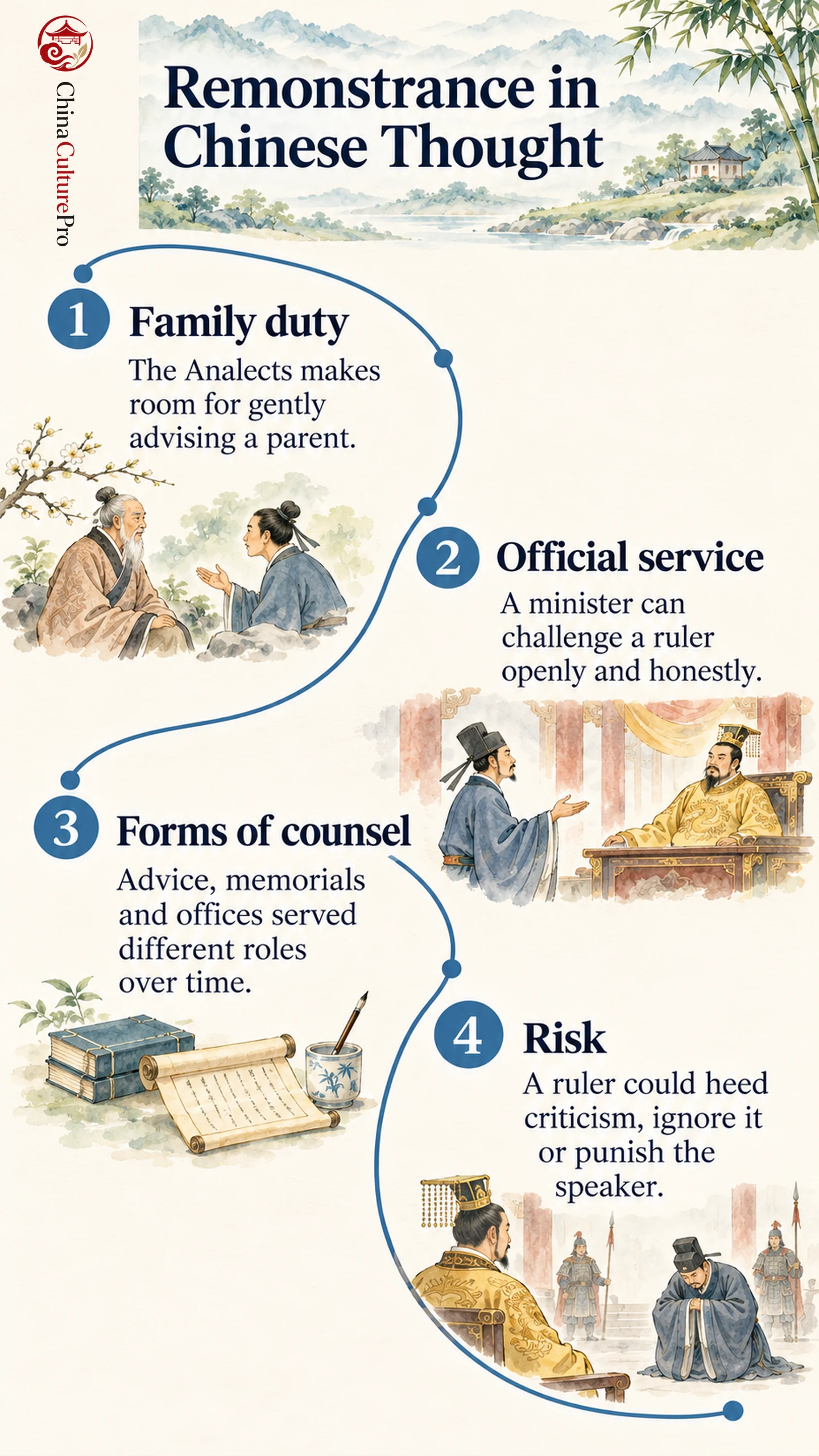
Remonstrance (谏, jiàn), written 諫 in traditional Chinese, is a form of critical advice addressed to someone with authority. The Analects (论语, Lúnyǔ) gives related examples in family and government. It counsels gentle advice to parents and makes room for openly challenging a ruler. The two settings demand different judgments about how to speak.[1][2]
- Family: Advice can be part of how a child meets an obligation to a parent.
- Government: A minister may owe the ruler an honest objection rather than a reassuring report.
- Institutions: Some dynasties gave criticism a formal place through particular offices and duties.[1][2][3][4]
Whether someone was expected to speak and whether an authority accepted the criticism were separate questions.
A subordinate may understand the risks of a decision before the person who has power to make it. The early texts ask what that subordinate owes to the relationship. An answer can require attention to the objection itself and to the manner of giving it.
Advising a Parent in the Analects
In 4.18, the Analects says to advise parents gently. It then addresses the possibility that the advice will be unwelcome and calls for continuing respect. The passage recognizes an obligation to speak while also asking how a person sustains a relationship after an objection fails.[1]
The relevant question is what the continuing respect demands. Readings differ over how much further a child may press the objection once the initial advice has been refused. The passage gives the manner of advice independent weight. Readers can set it beside later accounts of responsibility to parents in the Classic of Filial Piety, with attention to the differences between the texts.[1]
Why a Minister Might Have to Disagree
In Analects 14.22, a disciple asks how to serve a ruler. The reply joins a prohibition on deception with the willingness to challenge him to his face. Some editions number the passage 14.23. Together, the two parts make honesty more demanding than giving an accurate account only when that account is welcome.[2]
Xunzi (荀子, Xúnzǐ) gives a further way to understand the obligation. He holds that serving a ruler has to be guided by a standard that can outrank the ruler’s wishes. This makes space for the thought that an official’s loyalty and commitment might require dissent. It also raises the question of whose welfare is at stake when a ruler receives reassuring advice.[5]
From Remembered Speeches to Offices of Criticism
Historical works about the Eastern Zhou preserve formal speeches in which advisers criticize conduct or policy. Some narratives depict earlier courts as places where criticism circulated freely. Their accounts can illuminate how writers thought good counsel should work and what they wanted rulers to learn. A scene shaped around a speech is also a literary construction, so readers need other evidence to reconstruct the original occasion.[3]
In Song government, bodies commonly rendered as the Censorate and the Bureau of Policy Criticism both participated in official scrutiny. The institutions gave dissent more formal channels, and their responsibilities could overlap or change. A formal means to submit objections could make them harder to overlook, but the historical existence of an office does not establish how much influence it had in every case. The institutions belong to a longer history of Chinese political philosophy about authority and its responsibilities.[4]
FAQs About Remonstrance
Is remonstrance a form of disloyalty?
Some early Confucian texts understand frank advice as a way of fulfilling a responsibility. The obligation can involve opposing a particular decision while continuing to take the relationship seriously.[1][2][5]
How did remonstrance differ from censorial oversight?
Policy criticism typically addressed a ruler’s decisions or direction, while censorial oversight could include scrutiny of officials and conduct. The actual distribution of duties varied, so a specific dynasty’s institutions are the best guide.[4]
What does a recorded speech tell historians?
A speech can show what a history presented as persuasive advice, exemplary conduct or a warning. Its narrative role and its value as a record of an original exchange are questions to consider separately.[3]
出典
[1] The Analects, Book 4. Passage 4.18 with Chinese Text and English Translation
[2] The Analects, Book 14. Xian Asked, Including the Passage on Serving a Ruler
[3] Early China. Remonstrance in Eastern Zhou Historiography
[4] The Cambridge History of China. Sung Government and Politics
[5] Yuri Pines. The Fa Tradition Versus Confucianism